

Why Lunar New Year Has Become More than a Traditional Asian Holiday
By Kelli Luu | 12 Feb, 2026
The spending power associated with Asian Americans has made the holiday a marketing moment for corporate America.
Growing up, Lunar New Year was always something we celebrated quietly at home, playing games, opening red envelopes, and eating traditional celebratory foods. In recent years the holiday has made it onto America's calendar of public holidays.
Fashion brands are releasing full zodiac collections, tech companies are launching themed campaigns, and beauty brands are investing in red and gold packaging.
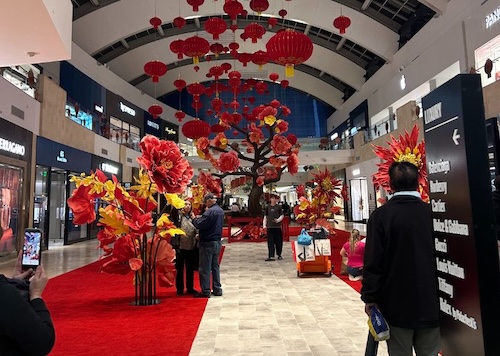
Walking through my local Westfield Mall at the beginning of 2024 has become a vivid memory. I was regaled with a full Lunar New Year visual celebration, complete with an enormous red carpet, hanging lanterns, and golden dragons sitting in the back of photo ops. It was an overwhelming contrast to what I recalled from years when I was growing up.

Westfield Topanga's 2026 Lunar New Year display.
I had spent many years of my life visiting the mall without seeing a Lunar New Year display at its central pavilion. It made me understand that it wasn't that Lunar New Year had suddenly become more popular but that America had begun to see Asian Americans differently. Lunar New Year—or on my Vietnamese side, Tet—had always existed outside but never in classrooms or malls. Now it had made it onto national marketing calendars.
What changed? The release of data from the 2020 US Census had recognized Asian Americans as the highest-spending and fastest-growing ethnic group, one that represent sroughly $1.3 to $1.6 trillion in annual spending power, according to Nielsen, with a median household income of $116,503—39% above the US median of $83,730. Brands began seeing Lunar New Year as not merely a cultural holiday but a fantastic marketing opportunity.
The New Year offers everything every marketing manager looks for—strong symbolism, emotional storytelling, and a visually pleasing theme. Its recurring nature allows for seasonal campaigns and limited-time product releases. It gave brands an ideal occasion to show Asian customers that they are seen and their business appreciated.
One example is Nordstrom which recently brought red envelopes to their stores as gift card holders. If you're buying a gift card for someone during the New Year season, you can hand it to them in a lì xì envelope, turning a retail tradition into cultural acknowledgement. What begins as cultural acknowledgement and appreciation evolved into a vehicle for something more intentional and targeted.

This year's Lunar New Year gift card holders at Nordstrom.
Chase Bank hands out li xi envelopes to customers who walk into their branches, an upgrade over the plain old white envelopes we can pick up year round. It's more than a thoughtful gesture of cultural appreciation. These li xi have been stamped with the Chase logo, letting recipients know exactly who you bank with.

Last year's Lunar New Year lì xì envelopes from Chase Bank.
Brands, especially banks, are fully aware Lunar New Year’s association with wealth and good fortune. Themes like these align well with services that banks have to offer like opening new savings or investing accounts. This is how cultural symbolism is turned into a tool to build trust and loyalty with Asian clients.
Ultimately, campaigns like this bring one thing: visibility. It shows that Asian culture is going mainstream in the United States.
Of course, visibility isn't the same as inclusion. When a culture is embraced because it helps “sell” and is “trendy”, there's risk that the associated community may feel exploited rather than respected. The grand zodiac displays and dragon dances may be remembered but it's another matter to establish a lasting connection with the culture and population behind them.
My one regret about this trend is the wish that Lunar New Year had been “seen” by America before our economic worth became established by Census income data. When I was in school there was no such thing as an excused absence or call-out for Lunar New Year. As someone who didn't grow up with other Vietnamese kids, I never got a chance to share my New Year’s excitement with classmates.
Now, Lunar New Year is completely mainstream, with campaigns and experiences designed for mass consumption. What once felt personal and sentimental is finally public. Of course it hasn't changed how my family celebrates Tết, but it has changed how we perceive our place in the broader American society. And there's the hope that its newfound visibility will expand from marketing into respect for the communities that celebrate Lunar New Year.
Recent Articles
- KOSPI Breaks 7,000 As Samsung Joins $1 Trillion Club
- China Services Growth Sped Up in April
- Trump Cites Deal Progress in Pausing Hormuz Ship Escorts
- Vox Momenti: Whereas I Love You, ...
- Job Openings Fell in March but Hiring and Layoffs Surged
- Musk Wanted $80 Billion to Colonize Mars Testifies OpenAI President
- Nasdaq Hits Record on Surging AI Chip Stocks
- Anthropic's Deep Push into Finance Tasks Likely to Disrupt Software Sector
- 'Yaris Moment' in the Works for Chinese Carmakers Chasing Overseas Growth
- Volvo's Q1 Full-EV Sales Rose 14% in Challenging Market