

What AAPI Heritage Nights Do for the Community—and the Teams
By Romen Basu Borsellino | 27 Feb, 2026
Asian heritage nights are already a staple of baseball and are expanding to other sports as they recognize the value of Asian consumers at home and across the Pacific.
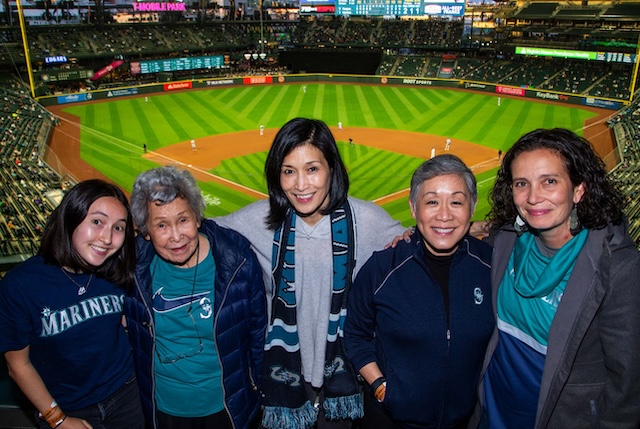
AAPI Heritage Night Promotional Photo from the Seattle Mariners Website
I’m a sucker for giveaways.
I still use the free children’s backpack I got at a Yankees game over 15 years ago and the shelves in my bedroom are adorned with bobbleheads, novelty cups, beads, you name it.
I’ll sometimes even based my decision to attend a sporting event on what they’re giving away at the door.

The Dodgers jerseys given away on Japanese Heritage night featured cherry blossoms
As I was scouring the Dodgers, Angels, and Padres websites trying to determine the best loot the other day, I noticed something:
There are quite a few Asian American-related events in sports.
Sometimes it’s a broad AAPI Heritage night, other times it’s, say, Japanese Heritage night where ticket holders get a jersey with cherry blossoms on it.
My first thought was of course, how do I get my hands on that jersey? But my mind then drifted to a more general curiosity about AAPI nights in sports.
How did they come to be?, I wondered. And what exactly do they achieve?
Major League Baseball

Some ballparks offer special food for AAPI night. The minor league Albuquerque Isotopes sold hot dog sushi and teriyaki burgers
Baseball is generally credited as the first major US sport to observe AAPI nights. That should come as little surprise given the sport’s long history with Asian Americans.
While Japan itself adopted baseball as early as 1870, Japanese American teams began forming in the US in 1899 in Honolulu, just one year after Hawaii became part of the US. By 1910 Los Angeles and Seattle had also become home to full-on Japanese Americans baseball leagues.
It was a literal century later in September 2010 that the Seattle Mariners became the first baseball franchise to hold an Asian Pacific American Heritage Night.
According to Northwest Asian Weekly, actor Scott Foley — a White American who has lived in Japan and speaks Japanese fluently — threw out the first pitch. Ticket sales for the evening helped raise $5,000 for Kin On and Nikkei Concerns, two local Seattle nonprofits dedicated to helping elderly Japanese Americans.

Kobe Bryant and LeBron James pictured during one of the NBA's early "Noches Latina"
A couple things jumped out to me about this event:
1) Despite being billed as an AAPI night, which I commend, this felt more like a Japanese night specifically.
2) $5,000 doesn't feel like a ton
3) Could they really not find an actual Asian American actor for the first pitch?
I realize I’m being nitpickey here. The fact that this event was held at all is a great thing. And the ability to be able to critique it through a 2026 lens is even better. It’s a sign of how far we’ve come.
This past baseball season on May 13, 2025, the Mariners once again observed what is now an annual tradition: Asian American, Native Hawaiian & Pacific Islander Heritage Night (AANHPI).

The Seattle Kraken's ice rink during AANHPI night
The first pitch was thrown by Seattle Philanthropist Jerry Lee and the national anthem was sung by musician Leng Phe. Both are Asian Americans.
$11,721 in funds raised from the game’s 50/50 raffle went to Seattle-based non-profit Asian Counseling and Referral Services, which is definitely a step up from $5,000 though still not a ton if you factor inflation.
Additionally, the Mariners website didn't just encourage fans to come to the game, but heavily promoted pro-AAPI resources including local Asian American owned businesses, Seattle-based Asian museums, suggested reading materials, and ways to stop AAPI hate.
And notably, the Mariners’ 2025 Asian American observance didn't start and stop in May, which is AAPI month. Throughout the season, the ballpark continued to offer concession fare like soup dumplings, sushi, and Korean corndogs.
There were also entirely separate Korean, Taiwanese and Filipino heritage nights during which fans, to my excitement, each received a special jersey.
And while Mariners certainly set a high bar for AAPI Heritage celebrations, they were far from the only baseball franchise to host them. Such Asian American theme nights have become common across the league.
Dodgers stadium here in Los Angeles is another ballpark that does it big. Outside of AAPI nights, the demographic breakdown of the fans as well as cultural symbols and culinary offerings make every game feel like a Japanese Heritage celebration. It doesn’t hurt that the Dodgers are home to players Shohei Ohtani and Yoshinobu Yamamoto, two Japanese American superstars.
Picture Japan, a nation of 125 million baseball fanatics, turning in and seeing their culture celebrated across the Pacific. For a Japanese-loaded team like the Dodgers—who command huge licensing fees for Japan broadcasts—that may be an even bigger incentive to hold Japanese nights than SoCal's relatively small number of Japanese Americans. This isn't being cynical, merely recognizing the obvious marketing benefits for a global sports organization with stars from an Asian nation.
But while Major League Baseball may be at the forefront of celebrating Asian American identity, some other sports leagues still have a ways to go.
National Basketball Association
While MLB teams were hosting AAPI nights in 2010, some basketball franchises have only implemented the tradition more recently.
The Brooklyn Nets held their inaugural AAPI celebration in 2022. The festivities spanned two nights in March and featured food from Panda express as well as programming from AAPI musicians and comics.
I’ll be honest, my immediate reaction was: what took them so long? New York City is, after all, made up of over 1.5 million Asian Americans, which accounts for 17% of the population.
Maybe “welcome” is a better response than “what took you so long?” and one that will encourage more sports franchises to join in on hosting celebrations as well, especially given that plenty of franchises still do not have an AAPI heritage night.
While our goal should absolutely be for the NBA to embrace these events as much as MLB has, it’s not hard to see why baseball has been at the forefront.
There is of course the obvious fact that there are far more Asian American players in baseball than there are in hockey or basketball.
MLB’s calendar is also more conducive to hosting heritage nights of any kind. While NBA and NFL teams each have an 82-game calendar, baseball boasts more than twice that at 162 games. And keep in mind that only some of those games are home games, which means even fewer opportunities to host a theme night. NFL teams each play a mere 17 games per season.
Major League Baseball's annual season also happens to encompass May, which is AAPI Heritage month. Baseball team’s AAPI nights are therefore typically held during the month as it’s a natural fit.
That neither basketball, hockey, and even football’s regular seasons encompass May is yet another obstacle, however minor, to their participation in AAPI heritage observance.
It’s also worth noting, if not truly appreciating, that while the NBA’s AAPI nights have only begun more recently, they are arguably arriving at a time when we need them the most.
As we’re all too familiar, the 2020 COVID-19 outbreak was accompanied by an historic spike in anti-Asian American hate crimes that have not fully abated to this day.
Maybe the aftermath of the pandemic was an excellent time to begin spreading awareness of Asian American heritage.
Noche Latina
19 years ago, the NBA began holding a league-wide “Noche Latina” or Latin Night.
During the 2006-2007 season, then-commissioner David Stern launched the league-wide initiative which designated a single night per season during which all teams wore jerseys written in Spanish such as “Los Lakers” or “El Heat.” Programming included Spanish music and entertainment and highlighted Latin American players.
But after the 2014 season, the league ditched the standardized approach and shifted to one in which individual teams would set their own nights. In other words, it became closer to how they now celebrate AAPI night.
We Asian Americans might be inclined to wonder why Latin Americans have long gotten the representation that we seek. But perhaps a more productive way to look at it would be appreciation for the fact that the success of Latino heritage celebrations paved the way for us to have our own.
The aims of each respective heritage night also seemed to differ. Noche Latina as it was first conceived appeared to have the very explicit goal of growing the sport. In an effort to attract more Latino fans, the annual games were even broadcast on Spanish language programs.
But modern day heritage celebrations, both Latin American and Asian American seem more directed towards honoring the existing fans from the respective demographic and making sure that they feel seen and appreciated.
Demographics
Seattle has neither the highest total number of Asian American residents nor the highest per capita rate. But with 17% of its population being AAPI, Seattle far overshoots the national average of about 6-7%.
And when the Mariners held their first Asian Heritage night, they had something that no other baseball team did: Ichiro Suzuki, the Hall of Famer regarded as the first Japanese position player in baseball.
Between Suzuki, the city’s AAPI population and its liberal political leanings, it made sense that Seattle was one of the first cities to embrace AAPI identity in sports.
As noted above New York, another city with a massive AAPI population has embraced AAPI nights across multiple franchises like the WNBA’s Liberty, MLB’s Mets and Yankees, and of course the NBA’s Nets as well as the Knicks. Oddly, the NHL’s Rangers do not appear to have done an AAPI night.
The greater Houston area, which has a sprawling AAPI population seems to have held AAPI events for baseball but not necessarily in other sports.
The minor case study of looking at various cities appears to confirm what we already knew:
1) MLB rings supreme in AAPI celebrations
2) There appears to be no standardized or consistent pattern for AAPI night observance across other sports and their respective franchises.
Beyond Window Dressing
So we’ve established that AAPI Heritage nights are quickly becoming a staple across the major sports leagues.
But the more cynical among us might still wonder what they actually achieve. It’s a valid question. And it’s one that can and should be asked not just about AAPI nights, but really any celebration of a marginalized community.
It’s a conversation that the LGBT community has been having for some time now.
The term “rainbow capitalism,” has been used to describe how corporations engage with Pride Month. For example, a bank might change its social media profile pictures to include a rainbow flag but will still lend money to entities that are responsible for horrific human rights abuses.
Another company might proclaim to support the cause during Pride Month but then remain virtually silent on the issue of LGBT right for the next 11 months.
But one must ask what the alternative is. Caught up in an anti-DEI wave, numerous companies that had been accused of aforementioned window dressing retreated from even their modest acknowledgement of pride month last year and we were arguably worse off for it. Major businesses pulling sponsorship on pride parades, for example, had a devastating effect on the parades.
No, not all affinity groups are the same. But the history of Pride nights can offer a valuable comparison for what might work and not work for the AAPI community. After all, some baseball teams began hosting pride celebrations a full decade before the first AAPI heritage night, like the Los Angeles Dodgers’ 2000 observance.
Public support for the gay marriage sat at approximately 30% at the time. Today, it starts at 70%. While we certainly can’t claim that LGBT sports nights were the reason, it would be tough to argue that they didn’t at least contribute to a softening of public attitudes.
I contend that even if most present AAPI heritage celebrations do not set out to affect meaningful change, they should still be regarded as a great start towards normalization of a community that is constantly othered.
Not to mention the fact that, particularly in the wake of the pandemic, many of these heritage nights at least make an effort to spotlight important AAPI organizations and promote resources for combating AAPI hate.
When the NHL’s Seattle Kraken celebrated back to back Lunar New Year and AANHPI nights at the end of last month, the festivities included custom uniforms, performances from AAPI artists and temporary tattoos for fans of all ages.
But it also included a major fundraiser for Seattle's Chinatown district and a guide on their website that highlights restaurant Pho Bac or the locally-owned Mam’s Books.
This is a great thing for the AAPI community. Even if they weren’t giving away free shirts.
© 2026 by Asian Media Group Inc.
Recent Articles
- Qantas Bets on Sleep and Light Science to Sell 20-Hour Flights
- High-Wire Diplomacy Delivered US-Iran Deal but the Tricky Part's to Come
- Pentagon Asks for $80 Billion for Iran War Bills
- Ukrainian Drone Makers Zero in on Demand Created by Taiwan Tensions
- Bedtime Story: Tenali Raman and the Thieves
- Fujimori Edges Toward Peruvian Presidency as Sanchez Calls for Protests
- Republicans Blast Trump's Iran Agreement as Details Emerge
- SK Hynix Veteran Seok-Hee Lee Tapped to Lead Intel Foundry Packaging Push
- Mamdani Plans to Air World Cup for Free Throughout New York
- Myra Molloy Parlays Historic Broadway Success into a Leading Film Role