

What's Ro Khanna's Angle with Thomas Massie?
By J. J. Ghosh | 23 Mar, 2026
An Indian American Democrat with presidential ambitions and a far-right Kentucky Republican have become odd bedfellows in opposing Trump on Epstein files and the Iran War.
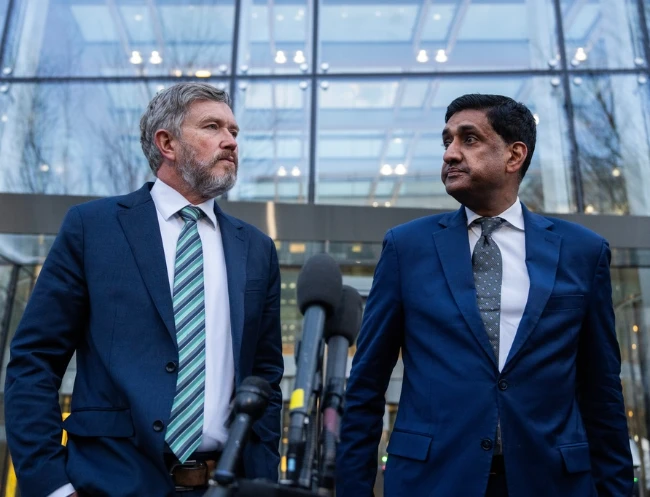
Thomas Massie (L) and Ro Khanna (R) hold a press conference on the release of the Epstein Files
Congressman Thomas Massie sent his colleague Ro Khanna a Christmas card last year. It featured Massie’s entire family posing in front of a Christmas tree, each member holding a gun.
Khanna, who supports an assault weapons ban, thought it was funny, so he kept it.
While surprising, this type of relationship may not be uncommon.
MAGA-darling Matt Gaetz recently revealed on Tucker Carlson’s podcast that prior to the January 6 Capitol insurrection, Squad member Alexandria Ocasio-Cortez would constantly come to his side of the aisle to chit chat.
It was also known that late Supreme Court Justices Ruth Bader Ginsberg and Antonin Scalia, while diametrically opposed ideologically, were best friends.
But what’s different about Khanna and Massie is that their relationship is not simply a personal one.
The son of Indian immigrants who co-chaired Bernie Sanders’s 2020 presidential campaign and a Kentucky Republican who voted with Joe Biden just 1.8% of the time have become partners on multiple key policy agendas.
They appear together on television. They co-sponsor legislation. They take on the President together.
At a time when, due in large part to gerrymandering, political gridlock is at an all time high, one can’t help but wonder:
How did partnership come to be?
Ro Khanna

Ro Khanna is a far-left Democrat
Ro Khanna represents California's 17th District — the heart of Silicon Valley — and has spent his congressional career staking out a position on the left flank of the Democratic Party that leaves little ambiguity about where he stands.
He was co-chair of the Bernie Sanders 2020 presidential campaign. He supports Medicare for All, and a federal $15 minimum wage. He co-founded the No PAC Caucus and introduced legislation to ban PACs from contributing to members of Congress entirely — putting him to the left of most of his own party on campaign finance.
He served on the board of Planned Parenthood. He hauled the CEOs of six major fossil fuel companies before Congress to testify under oath about climate disinformation. He has called for a wealth tax on billionaires and introduced the Stop BEZOS Act to tax large corporations whose employees rely on federal assistance.
He is, by any conventional measure, a progressive Democrat.
Thomas Massie

Thomas Massie is a far-right Republican
Thomas Massie has represented Kentucky's 4th Congressional District since 2012, and in that time he has voted with Democratic presidents so rarely — just 1.8% of the time under Biden — that he’s tied for last place in the entire House. And he wears that as a badge of honor.
His voting record reads like a libertarian checklist: He has voted against every major spending bill regardless of which party put it forward. He opposes foreign aid categorically — to Ukraine, to Israel, to everyone. He voted against NATO funding.
He introduced legislation to abolish the Department of Education, the IRS, and the Federal Reserve. He has fought federal vaccine mandates, mask mandates, and virtually every other form of public health enforcement.
He has argued that the scientific evidence on climate change does not compel him — memorably tweeting in 2013 that a congressional hearing on global warming had been canceled "due to snow."
He is, in short, about as far right as it gets — a man whose ideological comfort zone is approximately the opposite of everything Ro Khanna has spent his career fighting for.
Which makes what happens next all the more interesting.

A social media post by Trump personally attacking Massie
Iran 2025
To be clear, the partnership between Khanna and Massie isn’t ideological.
Khanna believes in the power of government to make a difference in people’s lives and Massie believes in less government at nearly any cost. Their relationship, rather, is issue-specific.
Khanna and Massie’s collaboration began in earnest over war powers.
When President Trump first launched strikes against Iran in June 2025, Massie and Khanna were ready. They had already introduced a bipartisan War Powers Resolution to prohibit U.S. forces from engaging in hostilities against Iran without authorization from Congress.
The resolution failed — Speaker Johnson dismissed it — but the partnership held.
On CBS News’ Face the Nation, host Margaret Brennan introduced them with characteristic understatement: “I know this is an unlikely pairing. You are on completely different ends of the political spectrum.”
Massie’s response was revealing: “I think I represent part of the coalition that elected President Trump. We were tired of endless wars in the Middle East.”
Massie’s observation is backed by data. Depending on the particular poll, military action in Iran is opposed by somewhere between 30-50% of the President’s own party.
But as with many things Trump-related, ideological consistency is not necessarily at play here. While congressional Republicans may agree with Massie on the merits of this or any issue, few are, like him, willing to publicly oppose the President.
The Epstein Files
The second major front of the Khanna-Massie alliance has been the Epstein files.
And this time, their partnership bore real, tangible results.
In July 2025, Massie introduced a discharge petition alongside Khanna to force a vote on a law compelling the release of the Jeffrey Epstein investigative files.
Once again, Republicans theoretically should have been on the same page as Massie. Releasing the Epstein files has been an issue of high importance to MAGA voters.
But given Trump’s own involvement in the Epstein scandal, he has personally taken efforts to block the release. And virtually no elected members of his party dared to challenge him.
Except Masie.
In response to Massie’s actions on the Epstein Files’ release, Trump called him “an embarrassment to Kentucky” and even launched a personal attack on Massie related to the death of his wife and speed at which he remarried.
But Massie and Khanna succeeded. The petition and The Epstein Files Transparency Act was signed into law in November 2025.
The fight didn’t end there, though.
The DOJ released only a portion of the required files, prompting Khanna and Massie to send a letter to a federal judge requesting the appointment of a Special Master to compel full compliance with the law.
Khanna put their shared mission simply: “We do not just do memes or speeches. We take action to fight a corrupt system.”
Iran 2026
While the President’s actions in Iran last summer were relatively minimal, the same could not be said about this year’s. And the dynamic duo found yet another issue to work together on.
When the United States joined with Israel to begin a series of ongoing attacks that have killed Iran’s supreme leader and many others, Massie and Khanna wasted no time pushing for a renewed vote on their war powers resolutions that would require President Trump to get Congressional approval to launch any further strikes.
The resolution, as Khanna noted bluntly, was likely to fail. They pushed for it anyway.
“Trump needs to see that there’s opposition,” Khanna said. “And if the vast majority of Republicans want to own another endless war in the Middle East, they can do that.”
While a vote that’s likely to lose may have seemed like a pointless effort in 2025, the two do so now with a proven track record of effecting actual bipartisan change.
At the very least, this push has gotten the attention that it merits.
Bucking Their Own Parties
Given that Massie’s party controls all three branches of government, his role in this partnership is rightfully the biggest part of the story.
He’s even put his own prospects of re-election at risk.
Trump has recruited a Republican primary challenger to run against him, and an allied PAC has spent $2 million on attack ads against Massie.
In March 2026 Trump visited a facility in Massie’s own district to rally support for the challenger. Massie’s response has been characteristically unbothered:
“I vote with my party 91% of the time, which means I have agreed with the president 91% of the time. But when they’re protecting pedophiles, when they are blowing our budget, when they are starting wars overseas, I’m sorry, I can’t go along with that.”
And Khanna’s own actions are not without controversy as well.
For one, The Massie-Khanna resolution does not enjoy the full backing of Khanna’s own party.
A group of centrist House Democrats unveiled their own alternative war powers resolution that would give the Trump administration more leeway than the Khanna-Massie measure — reflecting real unease among hawkish Democrats about signing onto anything that requires the immediate withdrawal of U.S. forces.
Democratic Senate Minority Leader Chuck Schumer has famously been on the more Hawkish-side. During Obama’s Presidency, Schumer opposed the Iran Nuclear Deal which prioritized diplomacy over military action against Iran.
Khanna, however, has shocked and angered a number of his fellow Democrats by publicly criticizing Schumer’s leadership and calling for him to be replaced.
Khanna has also ruffled Democratic feathers by criticizing our country’s relationship with Israel and boycotting an address to Congress by Israeli Prime Minister Benjamin Netanyahu.
And at a time when many on the left were calling for a boycott of Twitter following Elon Musk’s purchase of the app, Khanna publicly stated that Democrats should instead stay on the platform.
“We should be engaging him… not just dismissing him,” Khanna said of Musk.
When current Health and Human Services Secretary Robert Kennedy Jr. endorsed Trump following his own defeat in the 2024, Democratic presidential primary, Khanna blasted Democrats for not making greater efforts to court him.
“We can be the party of sanctimonious lectures,” said Khanna, “Or the party of FDR that knows how to win & build a progressive majority.”
The Endgame
The cynical read is that both men are positioning themselves.
Khanna is widely believed to have presidential ambitions, and his brand of cross-aisle credibility — taking on Trump while working with Republicans — is precisely the kind of thing that plays well in a general election.
Massie, meanwhile, has built his entire political identity around being the one guy in the room willing to say no, regardless of who’s asking. That allows him to stand out against hundreds of legislators.
But the cynical read undersells something real.
Both men are genuine constitutionalists on the specific issues where they collaborate. Both believe, with apparent sincerity, that Congress has abdicated its war-making authority to the executive branch — under Democrats and Republicans alike.
Both believe that elite impunity, whether in the financial system or in government, corrodes democratic trust. These aren’t positions they arrived at together. They arrived at them independently, from completely different directions, and found themselves standing in the same place.
Khanna put it cleanly “I will never cede my ground on what I believe, but I try not to be gratuitously insulting on social media or on the floor of other people’s character and motives.”
The New Normal?
The optimistic read of the Khanna-Massie partnership is that it represents a template — proof that substantive cross-aisle collaboration is still possible in an era of performative tribalism.
Known as “horseshoe theory” there are certain issues, particularly surrounding executive overreach and government transparency, where those on the furthest ends of the political spectrum are closer to one another than they are to the middle.
Massie is a libertarian in a party that has largely abandoned libertarianism. Khanna is a progressive who is willing to blast his own leadership in service of policy goals, if not his own ambition as well.
The concept of an antiwar left-right alliance is not new but it’s not common and it’s seldom lasting.
The most likely outcome here is that while the Khanna-Massie alliance has produced real results, the two members will ultimately pay a political price for their actions.
For now, the Christmas card stays on Khanna’s wall. And somewhere in Washington, two men who agree on almost nothing are figuring out what to disagree with together next.
© 2026 by Asian Media Group Inc.
These aren’t positions they arrived at together. They arrived at them independently, from completely different directions, and found themselves standing in the same place.
Recent Articles
- US-EU Trade Hits Record High Despite Tariff Tensions, Study Shows
- Chinese Independent Refiners Snap up Discounted Mideast Oil as Supplies Rise
- US Oil Companies See Big Profit Jump, Faces Pressure to Cut Pump Prices
- Drug Gangs Use Social Media to Recruit Thai Air Crew as Couriers
- Ghonhee Lee's Katalyst Launches Orbital Rescue Mission for NASA Satellite
- Zuckerberg Says Meta AI Agent Tech Progressing Slower Than Expected
- Japan's Services Activity Returned to Growth in June
- Air Force to Investigate Officer Who Called for Trump Impeachment
- How Americans Plan to Celebrate July 4th 250
- Tesla's China-Made EV Sales Jumped 24.4% on Year in June