

Why Asia's Third Largest Nation Struggles to Shake Off Its Economic Malaise
By Reuters | 12 Jul, 2026
Indonesia appears trapped in a Groundhog Day cycle of spurts of economic growth followed by collapse, even struggling to cling to its MSCI emerging market designation.

FILE PHOTO: A worker wipes a handrail near the reflection of an electronic board displaying stock movement at the Indonesia Stock Exchange (IDX) in Jakarta, Indonesia, January 30, 2026. REUTERS/Ajeng Dinar Ulfiana/File Photo
Indonesia's latest warning sign came not from a coup, a riot or a banking panic but from the stock market. In early 2026, the Jakarta Composite Index suffered one of the sharpest declines among major global markets, falling more than 30% from its peak amid investor worries over market transparency, possible index downgrades, the expanding role of the state and President Prabowo Subianto's costly populist agenda.
A general view of the city skyline of Jakarta, the capital city of Indonesia, August 5, 2021. REUTERS/Ajeng Dinar Ulfiana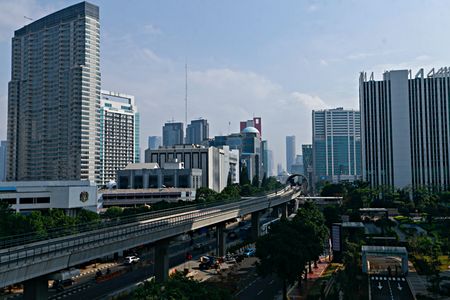
Reuters reported that Indonesia's main stock index was down more than 30% for the year, while the Financial Times noted that warnings from MSCI and S&P Dow Jones Indices raised fears that Indonesia could be treated more like a frontier market than an emerging-market success story. (Reuters)
FILE PHOTO: Indonesian President Prabowo Subianto and India's Prime Minister Narendra Modi arrive for a photo opportunity ahead of their meeting at the Hyderabad House in New Delhi, India, January 25, 2025. REUTERS/Altaf Hussain/File Photo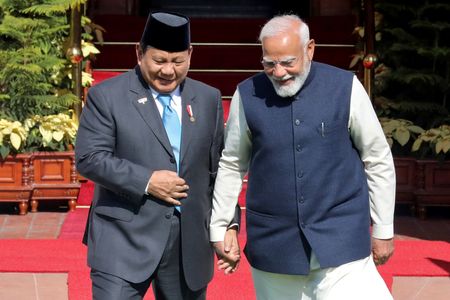
That sudden collapse captured the on-again, off-again nature of Indonesia's modern economic story. This is a country that repeatedly appears ready to break out, only to stumble back into doubt. It has the world's fourth largest population, Asia's third largest after India and China, and a strategic location astride the sea lanes connecting the Indian and Pacific Oceans. It has nickel, copper, coal, palm oil, natural gas, a young workforce, a huge domestic market and an entrepreneurial culture that has produced major digital businesses. By ordinary measures of potential, Indonesia should be one of the most compelling economic stories on earth.

The logo of Indonesia's sovereign wealth fund Danantara is displayed in front of its headquarters in Jakarta, Indonesia, June 11, 2026. REUTERS/Ajeng Dinar Ulfiana
Yet Indonesia has spent decades cycling through familiar phases: optimism, inflows, reform promises, commodity booms, market excitement, then disappointment. Growth spurts have been real, poverty reduction has been impressive and the country's democratic transition remains one of Asia's great political achievements. But the economy has never quite sustained the long, disciplined industrial climb that turned Japan, South Korea, Taiwan, Singapore and more recently parts of China and Vietnam into export powerhouses. Indonesia keeps advancing, but too often in loops rather than in a straight line.

A laboratory technician poses for a picture as he holds a bottle of 50% palm biodiesel fuel during a B50 testing event in Lembang, West Java province, Indonesia, April 21, 2026. REUTERS/Ajeng Dinar Ulfiana/File Photo
A Giant That Keeps Losing Momentum
Indonesia's malaise isn't the same as stagnation. The country has grown, urbanized and modernized dramatically since the late 20th century. Its GDP growth remains respectable by global standards. The World Bank said Indonesia entered 2026 with strong momentum, including 5.6% year-on-year growth in the first quarter, while the Asian Development Bank projected growth of 5.2% in both 2026 and 2027. (Open Knowledge Repository) Those numbers would be envied by many aging rich nations.

Aluminum blocks are seen in Wagner Automotiv industry in Gradacac, Bosnia and Herzegovina February 8, 2022. REUTERS/Dado Ruvic/Illustration
The problem is that Indonesia's ambitions require more than respectable growth. A country of nearly 300 million people can't become truly prosperous by merely expanding at around 5% while relying heavily on domestic consumption, commodities and uneven investment cycles. To catch up with advanced economies, Indonesia needs sustained productivity growth, rising technological capacity, competitive manufacturing and a labor force able to move into higher-value industries. It has made progress on all of these fronts, but not enough to escape the recurring sense that its promise keeps outrunning its performance.
The Blessing and Trap of Resource Wealth
Indonesia's natural resources give it leverage, but they also tempt policymakers into complacency. The country is a major exporter of coal, palm oil and nickel, and it possesses substantial reserves of copper, gold, tin and natural gas. During commodity upswings, money flows in, the currency stabilizes, government revenue improves and investors begin treating Indonesia as a can't-miss emerging-market story. When commodity prices weaken or global investors turn cautious, the same economy suddenly looks more fragile.
This is the classic resource-wealth dilemma. Natural resources can finance development, but they can also reduce pressure to build the hard foundations of prosperity: world-class schools, efficient courts, reliable ports, predictable regulations, deep capital markets and globally competitive manufacturers. Nations that lack easy commodity income often have no choice but to compete through productivity. Resource-rich nations can postpone that reckoning for years, only to rediscover during each downturn that selling raw materials is not the same as building an advanced economy.
The Unfinished Recovery From 1998
Indonesia's deepest modern trauma remains the Asian Financial Crisis of 1997-98. Before the crash, the country had been celebrated as one of Southeast Asia's great development successes under President Suharto. Manufacturing grew, poverty fell and foreign capital poured in. Then the rupiah collapsed, banks failed, companies with dollar debts were crushed and the economy contracted by more than 13% in 1998. The crisis destroyed Suharto's three-decade rule and forced Indonesia to rebuild both its financial system and its political order at the same time.
The country deserves enormous credit for surviving that transition. It became a functioning democracy rather than a failed state. It decentralized power, held competitive elections and avoided the worst predictions of national fragmentation. But the crisis left scars. Investors learned that Indonesia could turn suddenly from miracle to meltdown. Political leaders learned that economic reform must be balanced against social stability, regional bargaining and coalition management. The result has often been caution rather than strategic boldness.
Democracy Made Indonesia Freer, But Not Always Faster
Indonesia's democracy is a major achievement, especially in a region where authoritarian systems often claim to be the only route to development. Peaceful elections, a more open press and a vibrant civil society have given Indonesians freedoms that many of their neighbors lack. But democracy has also made long-range economic planning more complicated. Policy must pass through coalitions, regional interests, religious constituencies, business networks and popular expectations.
That complexity doesn't doom development. India, another vast democracy, has also managed periods of strong growth despite political noise. But Indonesia's system often produces compromise rather than coherence. Leaders announce bold plans, then dilute them. Reform packages appear, then collide with local implementation. Industrial policies begin with ambition but can drift into patronage, protectionism or bureaucratic bargaining. The country rarely lacks ideas; it more often lacks the institutional discipline to execute them consistently for 20 or 30 years.
Infrastructure Is Better, But Geography Is Relentless
Indonesia's geography would challenge any government. More than 17,000 islands stretch across a vast archipelago, making it far harder to build roads, ports, grids and logistics networks than in a compact mainland economy. Java remains the political, economic and demographic center, while many outer islands struggle with weaker infrastructure and thinner industrial ecosystems. For manufacturers, that means higher shipping costs, slower delivery times and less reliable supply chains than competitors enjoy in China, Vietnam or Thailand.
President Joko Widodo made infrastructure the centerpiece of his decade in power, and his administration did achieve visible improvements. Toll roads, airports, ports and power projects expanded. The government also began the extraordinarily ambitious project of moving the capital from crowded, sinking Jakarta to Nusantara in East Kalimantan. But infrastructure isn't only about grand projects. It is about the daily reliability of roads, ports, customs procedures, warehouses, electricity, local permits and last-mile delivery. Indonesia has improved, but not yet enough to make the whole archipelago feel like one integrated production platform.
Manufacturing Never Became Dominant Enough
The central reason Indonesia hasn't become an Asian tiger is that manufacturing never fully took command of the economy. Japan climbed through autos, machinery and electronics. South Korea built ships, cars, steel, displays and semiconductors. Taiwan became indispensable to global electronics. China became the world's factory. Vietnam, though much smaller than Indonesia, has inserted itself deeply into global supply chains for smartphones, electronics, garments and furniture.
Indonesia has manufacturing, of course. It produces autos, textiles, footwear, electronics, processed foods and chemicals. But manufacturing hasn't generated the same export intensity or productivity transformation seen in East Asia's most successful economies. Too much of the economy still depends on commodities, construction, services, government spending and household consumption. That can support moderate growth, but it doesn't reliably produce the technological learning, supplier networks and wage gains that come from competing at the upper end of global manufacturing.
Education Remains the Bottleneck
A huge young population can be a demographic dividend only if young people gain the skills employers need. Indonesia has expanded schooling dramatically, and literacy is no longer the basic problem it once was. The deeper issue is quality. Too many students leave school without strong math, science, reading, technical or English-language skills. Too few vocational programs are tightly connected to industry. Too few universities produce the scale of engineers, researchers and managers needed for advanced manufacturing and technology-driven growth.
This matters because the next stage of development is unforgiving. Basic assembly can absorb low-wage labor, but higher-value industries require technicians who can maintain complex machines, engineers who can improve production systems, managers who can meet global standards and regulators who understand modern technology. Without stronger human capital, Indonesia may attract factories looking for low costs, but it will struggle to move up into design, precision manufacturing, advanced materials and globally branded products.
The Nickel Bet Could Be a Turning Point
Indonesia's boldest attempt to break its old pattern is the push to move up the nickel value chain. Instead of simply exporting raw ore, the government has restricted raw nickel exports and pressed companies to process more material domestically. The goal is to turn Indonesia's nickel reserves into a foundation for battery materials, electric vehicles and higher-value industrial clusters. This strategy has attracted major investment, especially from Chinese firms, and it reflects a serious recognition that commodity exporters must capture more value at home.
The bet is not without risks. Forced downstreaming can create inefficient industries if protection becomes a substitute for competitiveness. Heavy dependence on Chinese capital could expose Indonesia to geopolitical pressure and environmental criticism. Nickel processing can be dirty and energy-intensive, especially when powered by coal. Still, the strategy is an attempt to solve the right problem: Indonesia must stop behaving like a warehouse of raw materials and start acting like an industrial economy capable of turning resources into technology-intensive products.
The Market Crash Was About Trust
That is why the recent stock-market collapse matters. It wasn't merely a technical correction after a strong run. It reflected deeper doubts about transparency, policy credibility and the proper boundary between state ambition and market confidence. MSCI's concerns about investability and ownership transparency reportedly helped trigger large outflows, while S&P Dow Jones Indices later issued its own warning. Indonesian authorities responded with reforms, including higher minimum free-float requirements and lower ownership-disclosure thresholds, but investors remained cautious. (Financial Times)
Markets can be fickle, but they are often brutal judges of institutional trust. Investors don't require perfection from emerging economies. They do require confidence that rules are knowable, ownership is transparent, fiscal discipline will not suddenly disappear and state-linked entities won't distort competition. Indonesia's economic problem is therefore not just roads, schools or factories. It is credibility. Each time investors begin believing that Indonesia has entered a new era, some old concern returns: opacity, bureaucracy, patronage, policy drift or a fear that politics will override economics.
Breaking the Groundhog Day Cycle
Indonesia's story isn't one of failure. It has raised living standards, reduced poverty, built a durable democracy and avoided the catastrophic fragmentation many once feared. It has a younger population than China, Japan or South Korea, a rising consumer class, strategic minerals needed by the green economy and a location that should benefit from supply-chain diversification. In a world where companies want alternatives to China, Indonesia should be near the top of every serious investment list.
But potential has never been Indonesia's problem. The problem is converting potential into a self-reinforcing system of productivity, trust and industrial upgrading. The country needs better schools, cleaner governance, deeper capital markets, more consistent regulation, stronger logistics and a manufacturing strategy that moves beyond extracting resources and assembling imported components. It also needs leaders willing to resist the recurring temptation to substitute state direction, nationalist slogans or commodity windfalls for the slower work of building durable institutions.
The recent 30% stock-market collapse may eventually look like another temporary scare. Indonesia may stabilize, attract fresh capital and return to its familiar 5% growth path. But that would not by itself prove that the pattern has changed. The real test is whether Indonesia can finally turn each growth spurt into a higher platform rather than another prelude to disappointment. Until then, Asia's third largest nation will remain one of the world's most tantalizing economic contradictions: too successful to dismiss, too promising to ignore and too inconsistent to fulfill the destiny it keeps seeming ready to claim.
© 2026 by Asian Media Group Inc.
Recent Articles
- Stellantis Q2 Sales Jump 10% on Refreshed NA Lineup
- California Offers $3,500 EV Rebates to First-Time Buyers
- Shein Eyes $3 Billion Hong Kong IPO in August
- Fresh AI Jitters Cause Plunge in SK Hynix, Other Memory Makers
- China Unveils 1st 5-Year Blueprint Focused on Spurring Consumption
- 15 Nobel Laureates Join 200 Experts to Urge Action on AI's Economic Impact
- US to Be Paid 'a Lot of Money' to Guard Strait of Hormuz Says Trump
- Airlines Resume Some Middle East Flights
- TSMC to Add 2 Advanced Chip Packaging Plants in Chiayi
- South Korean Singles Look for Their Dream Match at Buddhist Temple Retreat