

Big-Power Bullying Succumbs to the Internet and Drones
By Tom Kagy | 17 Jun, 2026
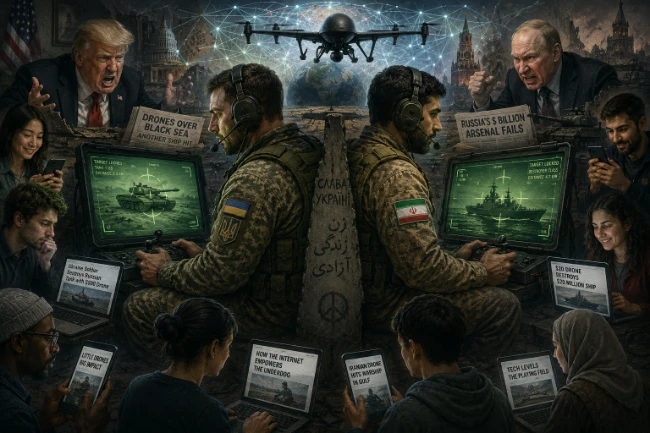
Real-time news cycles and unmanned war machines have effectively neutralized large, expensive militaries.
For most of recorded history, the biggest army could loot, pillage and enslave lesser powers. Empires rose and fell on the back of logistics, numbers, and the willingness to absorb casualties. The Roman legions, Napoleon's Grande Armée, and the Soviet Red Army all operated on the same basic principle: mass, discipline, and firepower decide outcomes.
But human civilization seems to have crossed a new threshhold with the advent of two transformative technologies. As shown by the events of the past half year, the internet and the drone have combined to hollow out the strategic value of large conventional militaries. The United States can't bully Iran into submission with troops. Russia bleeds soldiers and territory it can't replace. China sits frozen across the strait from Taiwan, its invasion fleet a target-rich fantasy.
The age of military superpower coercion is over, and the realization is only now dawning on military planners around the globe.
Internet Publicizes Military Operations
Let's start with transparency. The internet didn't just connect the world's people — it connected the world's cameras. Every soldier carries a smartphone. Every civilian in a conflict zone has the ability to upload footage within minutes of an incident. Satellite imagery that once required a classified intelligence request is now available commercially, and outfits like Planet Labs and Maxar publish updates so frequently that troop movements, airfield activity, and naval deployments are effectively public knowledge. This isn't a minor inconvenience for military planners — it's a structural collapse of the information asymmetry that made coercive military power work in the first place.
When the United States was contemplating serious military pressure on Iran — particularly during the escalation cycles of 2019 and 2020 — the invisible hand of the internet was already shaping the decision space. Any significant troop deployment to the Persian Gulf region would be photographed, reported, debated, and dissected in real time across every major platform on earth. The Iranian government would know the order of battle before the troops were fully staged. More importantly, the American public — and American allies — would be watching. The calculus of a swift, decisive military action that produces a favorable outcome before domestic opposition can mobilize simply doesn't exist anymore.
The Afghanistan and Iraq experiences didn't just scar the American military; they created a permanent, searchable, video-documented archive of what prolonged military engagement actually looks like. Any politician authorizing a ground campaign against a nation of 90 million people with a disciplined Revolutionary Guard, a sophisticated missile arsenal, and proxy networks stretching from Lebanon to Yemen knows that the footage from day one will be compared to the footage from year five. No one wants to own that.
David vs Goliath: Drones vs Mechanized Forces
The drone changes the equation further, but not in the way most people initially assumed. The early narrative around drone warfare was that it made military power cheaper and more precise for the major powers — that the United States could project force without risk to its own personnel. That part is true, and it did give Washington a genuinely novel capability. But drones proliferated. T
Technologies don't stay proprietary, and the same basic architecture — an airframe, a camera, a data link, and a munition — turned out to be manufacturable by middle powers, non-state actors, and even hobbyists with enough motivation. Iran produces drones. Hezbollah has drones. The Houthis in Yemen, one of the poorest populations on earth, struck Saudi oil infrastructure with drones and later harassed international shipping in the Red Sea so effectively that global freight rates spiked. The weapon that was supposed to extend American dominance became a leveler.
Ukraine: A Brutal Classroom
Russia's war in Ukraine has been the most brutal classroom demonstration of what this convergence means in practice. When Vladimir Putin ordered the invasion in February 2022, the Russian military looked — on paper — like an overwhelming force. Thousands of tanks, a massive artillery inventory, a functioning air force, nuclear deterrence, and a professional officer corps. What the paper didn't capture was the interaction between those assets and the new environment.
Ukrainian drone operators, many of them civilians trained in weeks rather than years, turned Russian armor into target practice. First-person-view drones carrying small munitions proved capable of killing a tank that cost millions of dollars and years to build. The economics are staggering — a drone that costs a few hundred dollars destroying equipment worth millions is not a sustainable exchange rate for the larger army.
Ignominious Losses for the World to See
Meanwhile, the internet ensured that every Russian failure was documented and distributed. Destroyed convoys near Kyiv went viral. The sinking of the Moskva — the flagship of Russia's Black Sea Fleet — was public knowledge within hours, confirmed by satellite imagery before Moscow had decided on its official denial. Ukrainian intelligence, drawing on a combination of commercial satellite data, intercepted communications, and tips from a global network of open-source analysts, has been able to anticipate Russian moves with a consistency that would've seemed miraculous in any previous conflict.
Russia hasn't just been losing soldiers at a rate it can't sustain — it's been losing them in a fishbowl. Every botched assault, every abandoned position, every prisoner video gets amplified across platforms in ways that undermine domestic Russian morale, international support, and military recruitment. The fog of war, that ancient friend of the aggressive power, has largely lifted.
Russia's territorial problem compounds this. The land it's managed to hold in eastern Ukraine requires garrisoning, and garrisoning requires troops Russia doesn't have in sufficient quality. Mobilization has scraped the barrel of willing volunteers and moved into coercion, which produces soldiers with limited training and lower morale — exactly the wrong inputs for a modern battlefield where individual unit initiative and technical literacy matter enormously. Russia enters each month of the war in a worse position than the one before, not because Ukraine has a larger military, but because the combination of drone warfare and information transparency has neutralized Russia's conventional advantages while amplifying its institutional weaknesses.
China's Trepidation toward Taiwan Invasion
China's situation with Taiwan is structurally different but arrives at the same conclusion through a different route. An amphibious invasion across the Taiwan Strait would be among the most complex military operations in history — more complicated than D-Day, executed against an island that's been preparing its defenses for decades, now armed with American anti-ship missiles and its own growing drone capability. The People's Liberation Army has modernized dramatically, and nobody sensible dismisses it.
But an invasion fleet crossing 100 miles of open water is one of the most trackable military formations imaginable. Commercial satellites would provide continuous coverage. The United States, Japan, and Australia would have hours of warning. Taiwan's military has invested heavily in mobile, distributed anti-ship systems specifically designed to make a contested crossing catastrophically expensive. The drone dimension matters here too: Taiwan has been building its own unmanned systems, and the lesson from Ukraine — that a determined defender with drones can inflict disproportionate losses on a mechanized invader — has been absorbed by every defense ministry watching the war.
But the internet dimension might be even more constraining for Beijing than the military one. China's economic integration with the global system is vastly deeper than Russia's was in 2022. The imaging of a Chinese invasion fleet leaving port would trigger immediate financial market responses, sanctions discussions, and alliance mobilization before a single shot was fired. The Chinese Communist Party's domestic legitimacy rests in significant part on continued economic growth and stability. A
war that produced immediate economic isolation, a stock market collapse, and the spectacle — broadcast globally in real time — of PLA soldiers dying on Taiwanese beaches is not a trade Beijing's leadership can easily rationalize. The internet has made the cost of failure visible and immediate in ways that constrain the calculations of authoritarian governments as much as democratic ones, perhaps more so, because authoritarian governments have more to lose from the appearance of weakness.
None of this means that major power military conflict is impossible. It clearly isn't — Russia invaded Ukraine, after all, and continues fighting despite mounting losses. But there's a difference between a war a country stumbles into or miscalculates its way into and a war a country chooses with clear eyes as an instrument of strategic coercion.
The United States can't threaten Iran with ground invasion and expect it to produce compliance, because everyone — including Tehran — can see what that would actually look like and how long it would last. Russia can't rapidly subjugate Ukraine, because Ukrainian defenders armed with commercial drones and internet-connected intelligence networks have made rapid subjugation impossible. China can't quietly position forces for a surprise assault on Taiwan, because there's no such thing as a quiet military positioning in the satellite age.
The militaries of the major powers haven't become useless. They retain nuclear deterrence, power projection, logistics capability, and the ability to fight and win in scenarios where they're not facing these specific constraints. But the specific use case that justified their enormous expense — the ability to intimidate a regional power into compliance, or to conquer territory held by a determined defender — has been dramatically degraded.
The age of gunboat diplomacy required the gunboat's threat to be credible and its operations to be obscure. The internet ended the obscurity. The drone ended the cost asymmetry. Together, they've defanged the most expensive military establishments in human history, and the bills are still coming due.
© 2026 by Asian Media Group Inc.
Recent Articles
- Global Demand Surges for Anti-Drone Technology
- BYD Looks to Formula One for Fast Global Brand Expansion
- Europe's EV Sales Keep Growing As Fuel Costs Rise, Car Prices Fall
- SK Hynix Ships Samples of Next-Generation AI HBM Chips
- Apple to Raise Prices Due to Memory Chip Shortage
- Trump Scraps Four More Offshore Wind Leases with $765 Million Refund
- Oil Roundtrips, AI Booms, US Consumers Spend, Economists' Fed Outlooks Go Wild
- Trump Endorsee Loses in Georgia Governor's Primary Race
- BMW Shares Sink After Profit Warning Highlights China and Iran Risk
- AI Will Lead to Labour Shortages, Bezos Says at Paris Conference