

Google Buys Fusion Power from Commonwealth Fusion Systems
By Reuters | 30 Jun, 2025
Fusion is the energy long game for power-hungry data centers, and Google is betting that Commonwealth Fusion System can deliver ahead of rivals.
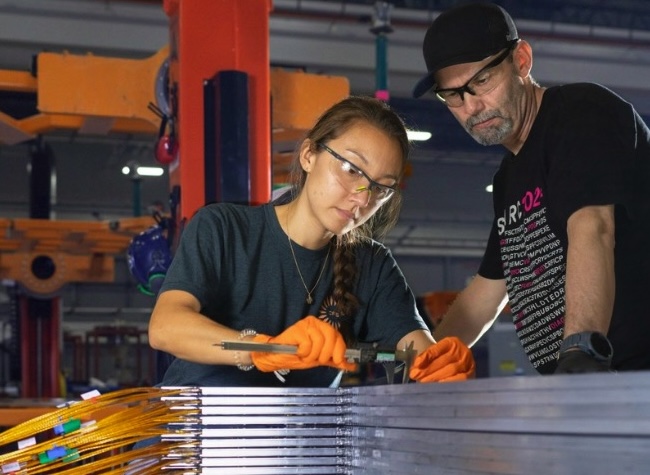
Commonwealth Power Systems technicians at work building the complex array of cutting-edge technology needed for fusion power.
Alphabet's Google said on Monday it has struck a deal to buy power from a project in Virginia fueled by fusion, the reaction that powers the sun and the stars but is not yet commercial on Earth.
Google signed what it called the technology's first direct corporate power purchase agreement with Commonwealth Fusion Systems, a company that spun off from the Massachusetts Institute of Technology in 2018.
The deal is for 200 megawatts of power from CFS' ARC project, which is planned to have a total capacity of 400 MW. The company is developing the project in Virginia, home to the world's biggest hub of energy-hungry data centers. Financial details of the deal were not disclosed.
Physicists at national laboratories and companies have been trying for decades to use lasers or, in the case of CFS, large magnets to foster fusion reactions, in which light atoms are forced together to release large amounts of energy.
In 2022, the Lawrence Livermore National Laboratory in California briefly achieved net energy gain in a fusion experiment using lasers.
But achieving so-called "engineering break-even," in which more energy comes out of a reaction than the overall energy that goes into a fusion plant to get a reaction going, has been elusive. And for a plant to generate power from fusion, the reactions must be constant, not rare.
"Yes, there are some serious physics and engineering challenges that we still have to work through to make it commercially viable and scalable," Michael Terrell, Google's head of advanced energy, told reporters in a call. "But that's something that we want to be investing in now to realize that future."
As artificial intelligence and data centers boost power demand around the world, interest in fusion is spiking. Fusion, unlike nuclear fission, in which atoms are split, does not generate large amounts of radioactive waste. In addition, fusion, if successful, could help fight climate change.
CFS aims to generate power from the ARC project in the early 2030s but must first clear the scientific hurdles.
"Without partnership and without being bold and setting a goal and going for it, you won't ever reach over those challenges," Bob Mumgaard, CFS' CEO and co-founder, told reporters. He said the ARC plant will teach CFS about the "teething phase" of fusion, in which he expects to learn about how often fusion machines break down and how they can run reliably.
Google also said on Monday it was increasing its investment in CFS, but did not disclose the amount. Google was one of many investors that invested a total of $1.8 billion into CFS in 2021. Mumgaard said the current fundraising efforts by CFS are comparable to the 2021 round.
(Reporting by Timothy Gardner; Editing by Paul Simao and Lisa Shumaker)
© 2025 by Asian Media Group Inc.
Google also said on Monday it was increasing its investment in CFS, but did not disclose the amount. Google was one of many investors that invested a total of $1.8 billion into CFS in 2021. Mumgaard said the current fundraising efforts by CFS are comparable to the 2021 round.
Recent Articles
- Global Demand Surges for Anti-Drone Technology
- BYD Looks to Formula One for Fast Global Brand Expansion
- Europe's EV Sales Keep Growing As Fuel Costs Rise, Car Prices Fall
- SK Hynix Ships Samples of Next-Generation AI HBM Chips
- Apple to Raise Prices Due to Memory Chip Shortage
- Trump Scraps Four More Offshore Wind Leases with $765 Million Refund
- Oil Roundtrips, AI Booms, US Consumers Spend, Economists' Fed Outlooks Go Wild
- Trump Endorsee Loses in Georgia Governor's Primary Race
- BMW Shares Sink After Profit Warning Highlights China and Iran Risk
- AI Will Lead to Labour Shortages, Bezos Says at Paris Conference