
How Maggie Kang Created a Global Media Phenomenon
By James Moreau | 15 Mar, 2026
Maggie Kang’s vision for a K-pop-infused supernatural epic shattered Netflix records and became an awards season juggernaut.
© 2026 by Asian Media Group Inc.
KPop Demon Hunters debuted as a global phenomenon in June 2025, shattering streaming records to become the most-watched movie in Netflix history with over 500 million views. The film proved that a story rooted in Korean cultural traditions could command a massive, universal audience. Punctuated during the 2026 awards season, it has been decorated with Golden Globes, Grammy, and Critics Choice honors and is currently the frontrunner for Best Animated Feature and Best Original Song at the upcoming Academy Awards.
The project was the brainchild of Maggie Kang, a veteran animator at Sony Pictures Animation whose distinct visual sensibility was honed on major features including 2017’s The LEGO Ninjago Movie, 2016’s Kung Fu Panda 3, and Rise of the Guardians from 2012. Kang sought to create a story that celebrated her heritage by weaving modern K-pop with the ancient roots of Korean mythology. She drew specific inspiration from the mudang, traditional female shamans who utilized song and dance as a spiritual weapon to ward off evil. In this reimagined world, sacred rituals became massive K-pop concerts where the idols served as secret hunters tasked with maintaining a magical barrier known as the Honmoon through the power of their music.
Kang first brought her vision to Sony in 2018, but they passed. Executives perceived that the project’s fully Asian cast, specific Korean cultural themes, and the K-pop storyline – which had not reached its peak at the time – would be too niche for audiences to connect with. To prove the film’s viability, the creative team developed an exhaustive proof of concept with elaborate storyboards and music demos bringing the presentation to life.
Central to this effort was singer-songwriter EJAE, an aspiring K-pop idol that was released by SM Entertainment after training for ten years. After pivoting into a powerhouse writer for global hits like Red Velvet’s “Psycho” and aespa’s “Drama,” her technical mastery became essential to the project’s development.
Following a refined pitch in 2021, Netflix secured the distribution rights from Sony – which remained on board as the primary creative team, in a unique partnership. Even with the green light Kang, in her directorial debut, had to defend essential components of the film’s identity.
Though Kang has expressed regret over not pushing for even more Korean lyrics within the soundtrack, the music was an undeniable triumph that served as the very heartbeat of the film’s narrative.
KPop Demon Hunters finally allowed EJAE to take center stage as the singing voice of Rumi in the fictional group Huntrix, alongside artists Audrey Nuna and Rei Ami, who provided vocals for Mira and Zoey. Their breakout anthem, “Golden,” became a cultural juggernaut. It won Best Original Song at both the Critics’ Choice Awards and the Golden Globes and is currently favored to win an Oscar in the same category. “Golden” has since topped global charts and been performed at high-profile events including late night shows, the NFL Christmas halftime show and a New Year’s Eve special. The Grammy winning track also served as the background for NBC’s promotion of the 2026 Winter Olympics.
The storyline’s characters drew inspiration from modern K-pop giants like BTS, Blackpink, and Monsta X, and foundational pioneers like H.O.T.
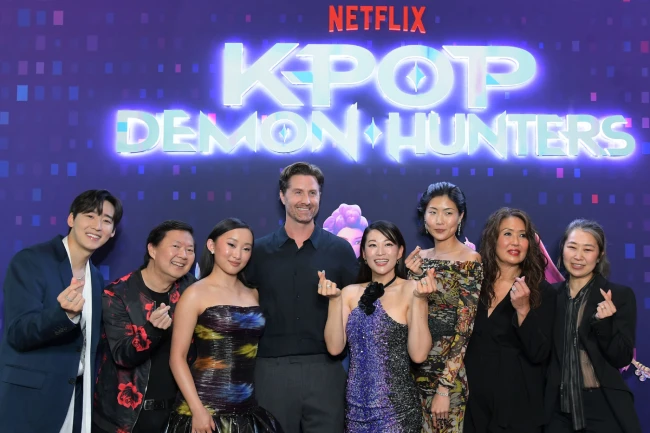
Kang’s vision for authenticity dictated an entirely Korean cast. The lead trio of Huntrix was voiced by Arden Cho, May Hong, and Ji-young Yoo, supported by an elite ensemble including Ahn Hyo-seop, Yunjin Kim, Lee Byung-hun, Daniel Dae Kim, and Ken Jeong.
KPop Demon Hunters’ record-breaking release dismantled the “niche” label and proved that Asian-centric stories can be a massive global draw.
Netflix and Sony are already in the works for a sequel to the hit film, slated for a 2029 release.
Recent Articles
- Global Demand Surges for Anti-Drone Technology
- BYD Looks to Formula One for Fast Global Brand Expansion
- Europe's EV Sales Keep Growing As Fuel Costs Rise, Car Prices Fall
- SK Hynix Ships Samples of Next-Generation AI HBM Chips
- Apple to Raise Prices Due to Memory Chip Shortage
- Trump Scraps Four More Offshore Wind Leases with $765 Million Refund
- Oil Roundtrips, AI Booms, US Consumers Spend, Economists' Fed Outlooks Go Wild
- Trump Endorsee Loses in Georgia Governor's Primary Race
- BMW Shares Sink After Profit Warning Highlights China and Iran Risk
- AI Will Lead to Labour Shortages, Bezos Says at Paris Conference