

How Neurotic 'National Security' Policies Put the US on a Path to Decline
By Tom Kagy | 18 Jun, 2026
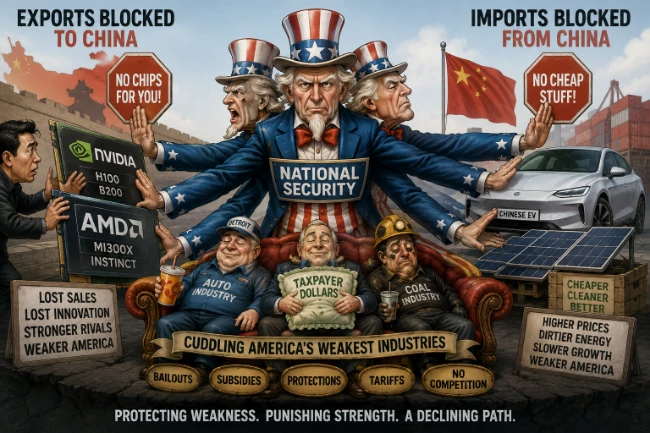
The bizarre fixation on denying other nations access to the products of our strongest companies while protecting our weakest from imports is turning the US into a global backwater.
In the postwar era the United States became the world's richest nation by being a fearless free-trader.
We invented products and services people wanted, sold them to the world, imported whatever others could produce more cheaply, and used the resulting wealth to fund innovation, infrastructure and rising living standards. That's how we became the envy of the world.
Today Washington has succumbed to a philosophy likely to send us down to 3rd-world status in a couple generations.
Increasingly, America's ascendant demagoguery is premised on the certifiably neurotic notion that prosperity comes not from competing but from restricting competition. Exports of America's most advanced technologies are blocked because foreigners might benefit from them. Imports of cheaper foreign products are blocked because Americans might buy them. Entire industries are shielded from competition under the banner of national security, even when the security rationale is tenuous or absurd.
The result is a growing collection of policies that make the US economy less efficient, less innovative, less competitive and, in many cases, even less secure.
What's emerging isn't a strategy for national security so much as a strategy for national insecurity.
History suggests it will end badly.
The Strange War Against America's Strongest Companies
One of the oddest features of modern US policy is that Washington increasingly treats the country's strongest companies as threats to national security.
Consider Nvidia. It became one of the most valuable companies in history by creating the world's most advanced AI accelerators. Its GPUs dominate artificial intelligence training worldwide. For years, Nvidia's success generated enormous profits, tax revenues and technological leadership for the United States.
Yet Washington's response has been to prevent Nvidia from selling many of its most advanced products to China. The infantile logic goes something like this: Chinese AI companies might spend billions to buy Nvidia chips, then use those chips to improve their own capabilities until they're good enough to out-compete the US commercially and militarily.
A 12-year-old might point out that Nvidia and the other US AI industry probably won't be frozen in suspended animation while China goes about progressing.
And any sane business person would note that export restrictions reduce Nvidia's addressable market. Every sale blocked from China is revenue that doesn't flow into American payrolls, American R&D budgets or American tax receipts.
Meanwhile Chinese companies aren't simply giving up just because the US won't let them buy freely.
They're accelerating domestic alternatives from firms like Huawei and a growing ecosystem of Chinese AI-chip startups. The more aggressively Washington restricts access to American technology, the greater the incentive for China to build competing technology stacks that permanently reduce dependence on US suppliers.
The same pattern is unfolding across numerous sectors.
Restrictions on Advanced Chipmaking Equipment
All US high-performance computing technologies face these silly export restrictions. Certain AI software and cloud-computing services face restrictions. Quantum technologies face restrictions. Biotechnology tools increasingly face scrutiny.
Instead of maximizing the global reach of America's technological champions, policymakers are effectively helping create future competitors.
Historically, technological leadership was strengthened by exports. American aircraft manufacturers sold jets worldwide. American software firms sold operating systems worldwide. American pharmaceutical companies sold drugs worldwide.
American firms benefited from economies of scale because they served global markets. Those larger markets funded additional research and development, which widened America's lead. The current approach often reverses that logic. Rather than exploiting leadership, policymakers seek to withhold it.
Yet denying customers access to your products rarely eliminates demand. It merely encourages substitution.
When Japan challenged US semiconductor dominance in the 1980s, American firms didn't respond by refusing to sell chips. They responded by making better chips. When South Korea entered memory manufacturing, US companies didn't ban exports to Korean firms. They innovated.
Today's restrictions often resemble a company refusing to sell its best products because competitors might learn from them.
That may protect an advantage temporarily. But it also sacrifices revenue, market share and customer relationships. And eventually competitors catch up anyway.
The War on Cheap Imports
The same mindset appears on the import side.
If export restrictions target America's strengths, import restrictions often protect its weaknesses.
Chinese electric vehicles provide a striking example. Many Chinese manufacturers now produce EVs that are significantly cheaper than comparable American vehicles while offering competitive quality and technology. Consumers around the world are buying them in large numbers.
American consumers, however, are largely prevented from doing so because of tariffs and trade barriers that push effective duties to extraordinary levels.
The rationale? National security, of course. Yes, it is difficult to explain how an affordable family sedan from China constitutes a national security threat while a luxury vehicle from Germany or South Korea does not.
Of course the real explanation is industrial protection offered by demagogues who always bend toward the simplest political promises rather than exercising actual leadership which is now in very short supply.
The fear that American automakers would struggle against lower-cost competition is valid. Yet protecting domestic producers from competition will merely give them time to become too complacent and backward to survive the increasingly global business world.
The same pattern appears in solar energy. Chinese solar panels dominate global markets because they're inexpensive and efficient.
Instead of embracing cheaper clean-energy technology, the US has repeatedly imposed tariffs and restrictions.
The result is higher installation costs. Fewer solar deployments. Slower decarbonization. Higher electricity costs. And reduced competitiveness for American manufacturers that consume electricity.
A policy nominally intended to strengthen America ends up making American energy more expensive.
Making America Dirtier
One of the strangest consequences of these policies is environmental. The United States routinely claims climate leadership while restricting access to some of the world's cheapest clean-energy technologies. Chinese solar panels, Chinese batteries, Chinese electric vehicles, Chinese heat pumps, Chinese grid equipment.
Many of these products are blocked or heavily penalized precisely because they're so cost-effective in reducing emissions while bolstering our energy grid.
The consequence is simple. Americans buy fewer clean-energy products because they cost more. Utilities install fewer renewable-energy systems because projects become more expensive. Businesses face higher energy costs. Consumers burn more gasoline. Coal and natural gas remain competitive longer than they otherwise would.
A nation that genuinely prioritized environmental outcomes would logically embrace any technology capable of reducing emissions cost-effectively.
Instead, policy often prioritizes industrial protection over environmental progress.
The result is both dirtier and poorer.
The Auto Industry Already Lived Through This
None of this is unprecedented. America has seen a similar movie before. The US auto industry of the 1970s and 1980s offers a cautionary tale.
For decades, Detroit enjoyed a largely protected domestic market. The Big Three—General Motors, Ford and Chrysler—grew accustomed to limited competition. Vehicles became larger, less fuel-efficient and often less reliable than foreign alternatives.
Then came the oil shocks of the 1970s. Consumers suddenly wanted smaller, more efficient cars. Japanese manufacturers were ready. Toyota, Honda and Nissan offered fuel economy, reliability and quality that frequently exceeded American offerings.
Consumers responded enthusiastically. Detroit executives blamed unfair competition. Politicians responded with protectionist measures, including voluntary export restraints negotiated with Japan. These restrictions were intended to save American automakers. Instead, they mostly delayed necessary adaptation.
Japanese firms simply built factories inside the United States. American companies continued losing market share. Quality problems persisted. Financial struggles deepened.
The real solution wasn't protection but competition. Eventually American automakers improved manufacturing processes, quality control and vehicle design because they had no choice. Competition forced the adaptation that protection had merely postponed—to the detriment of the protected industries!
Today's policymakers appear determined to repeat the same mistake across multiple industries.
The Innovation Tax
Protectionism imposes another cost that's rarely discussed: it taxes innovation. When companies face intense competition, they must innovate continuously. When they're protected, they often don't.
The result is that consumers pay higher prices while producers earn larger margins that give executives temporary relief but sets up a weakening process that inevitably takes its toll in future market share.
This isn't merely theoretical. Economic history repeatedly shows that industries facing strong competition tend to innovate faster than industries insulated from competition. Competition exposes weaknesses. Protection conceals them.
The danger is especially severe in emerging technologies like artificial intelligence,electric vehicles, batteries, renewable energy, robotics—all industries that are evolving rapidly. Countries that shield domestic firms from competition risk producing national champions that excel mainly at lobbying.
The Geopolitical Irony
Perhaps the greatest irony is that many of these policies may ultimately weaken national security itself.
Economic strength has always been America's most powerful strategic asset.
The United States became influential because it possessed the world's largest economy, deepest capital markets, strongest companies and most productive workforce.
Those advantages generated military power. Not the other way around.
When policymakers restrict exports, they reduce revenues for American companies. When they restrict imports, they raise costs for American consumers and businesses. When they block competition, they reduce incentives for innovation.
Over time those effects compound. The economy grows more slowly. Productivity rises more slowly. Technological leadership erodes. Fiscal resources shrink. Military capabilities eventually suffer as well.
A nation cannot indefinitely protect itself into prosperity. History has proven that the opposite is the hard but persistent truth. Prosperity is what enables security, and protectionism guarantees ultimate economic descent into second-class status.
The Risk of Becoming a Backwater
The worrying possibility isn't that America loses a trade dispute but that it gradually becomes isolated from the world's most dynamic markets.
Imagine a future in which Chinese consumers no longer need Nvidia chips. Foreign buyers no longer need American solar technology. Global EV markets are dominated by companies excluded from the United States. American consumers pay higher prices for older-generation products while the rest of the world enjoys cheaper, better alternatives.
That isn't national strength but crippling national isolation. Countries rarely recognize decline while it's occurring. They interpret defensive measures as proof of determination. They view restrictions as demonstrations of resolve. They celebrate self-sufficiency while quietly losing competitiveness.
History offers many examples. Great powers often become obsessed with preserving existing advantages precisely when those advantages begin slipping away. The temptation is understandable. Competition is uncomfortable. Innovation is disruptive.
Global markets can cause pain by creating winners and losers. But the alternative is worse.
Economic dynamism comes from exposure to competition, not insulation from it. The United States became the world's most successful economy by welcoming ideas, talent, products and markets from around the globe. Its greatest companies became great because they competed globally, not because they were shielded from global competition.
A national-security strategy that treats exports as dangers and imports as threats risks undermining the very foundation of American strength. The real danger isn't that other countries gain access to valuable technologies or products. The real danger is that America becomes so preoccupied with preventing others from advancing that it forgets how it once became the world's most advanced nation.
© 2026 by Asian Media Group Inc.
Recent Articles
- Qantas Bets on Sleep and Light Science to Sell 20-Hour Flights
- High-Wire Diplomacy Delivered US-Iran Deal but the Tricky Part's to Come
- Pentagon Asks for $80 Billion for Iran War Bills
- Ukrainian Drone Makers Zero in on Demand Created by Taiwan Tensions
- Bedtime Story: Tenali Raman and the Thieves
- Fujimori Edges Toward Peruvian Presidency as Sanchez Calls for Protests
- Republicans Blast Trump's Iran Agreement as Details Emerge
- SK Hynix Veteran Seok-Hee Lee Tapped to Lead Intel Foundry Packaging Push
- Mamdani Plans to Air World Cup for Free Throughout New York
- Myra Molloy Parlays Historic Broadway Success into a Leading Film Role