

A Korean Impresario and an American Girlfriend Lit Up DC Gossip Columns for a Decade
By H Y Nahm | 09 Jul, 2026
With the help of Tandy Dickinson and Suzi Park Thomson, Tongsun Park built a social circle that kept a network of lawmakers supporting US aid flowing to South Korea.
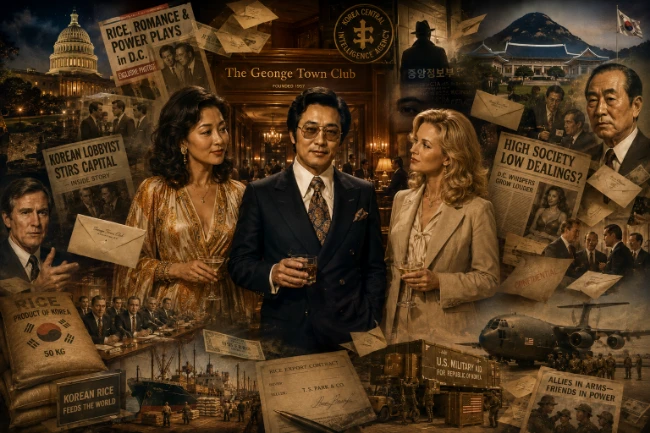
For a decade, Tongsun Park was one of Washington’s more dazzling contradictions: a foreign-born outsider who became an insider’s insider, a Georgetown host who made politics feel like a dinner party, and a rice broker whose business commissions helped fuel one of the biggest influence scandals of the post-Watergate era. He was handsome, wealthy, theatrical and almost absurdly well connected. He seemed to understand earlier than many professional lobbyists that Washington could be entered through its dining rooms as easily as through its hearing rooms.
Park’s American girlfriend, Tandy Meem Dickinson, gave the story the social-page glamour that kept gossip columnists supplied with material long before prosecutors and congressional investigators turned him into a front-page figure. Another woman, Suzi Park Thomson, supplied a more politically sensitive link: she was a Korean-born naturalized American who worked in House Speaker Carl Albert’s office and entertained congressmen and Korean officials after hours. Together they helped give Koreagate its peculiar flavor. It wasn’t merely a bribery scandal. It was a Washington society story with cash envelopes, Watergate apartments, Seoul phone calls, Georgetown clubs, congressional trips, wounded romance and enough ambiguity to keep everyone talking.
Park was born in 1935 in Sunchon, in what is now North Korea, into a well-off family. His father was a Gulf Oil distributor who moved the family to Seoul after liberation from Japanese rule; Park later studied in the US, attended the College of Puget Sound and graduated from Georgetown University’s School of Foreign Service in 1963. By the time he opened the George Town Club in 1966, he had learned that charm could be a form of capital. The club soon drew the kind of people a foreign government would want to know: Gerald Ford, Carl Albert, Tip O’Neill, senators, representatives, diplomats, military men, journalists and social strivers who enjoyed being near power without quite admitting that was the point.
Park’s club at 1530 Wisconsin Avenue NW wasn’t just a restaurant. It was a stage. The lighting, food, drinks and guest lists made members feel chosen. Park himself played the role of impresario—cultivated, discreet, generous and slightly mysterious. His business, when people asked, had “something to do with rice,” a vagueness that only added to his aura. Later accounts nicknamed him Washington’s “Asian Gatsby,” not only because of his parties but because his wealth seemed to arrive wrapped in rumor. WETA’s Boundary Stones history notes that Park grew up with money, came to Georgetown in the late 1950s, threw elaborate parties as a student, became president of his freshman class and used the same instincts to build the George Town Club. (Boundary Stones)
Behind the mood lighting was a hard geopolitical purpose. South Korea in the late 1960s and early 1970s feared losing American protection, American aid and American patience. President Park Chung Hee’s authoritarian rule was generating criticism in Washington, while US troop reductions raised alarms in Seoul. A 1978 House investigation found that Blue House meetings in 1970 discussed centralizing efforts to influence US policy, even proposing at one point to put Tongsun Park at the head of South Korean lobbying in the US. The same report said the George Town Club, established with KCIA assistance, became a lobbying center for the Korean government.
The rice business gave Park more than a cover story. It gave him cash flow. Under Public Law 480, the US sold or provided agricultural commodities to allies, and South Korea bought large amounts of American rice. The House report found that former Rep. Richard Hanna and Park met in Seoul in 1968 with Prime Minister Chung Il Kwon and KCIA Director Kim Hyung Wook and agreed to make Park the selling agent for Public Law 480 rice transactions. The report also concluded that rice was the commodity most improperly manipulated and that Korean officials used rice deals for political and personal aims, as well as to subsidize influence operations in the US.
That was the machinery. Tandy Dickinson was part of the sparkle. She was a blonde Washington socialite, Park’s girlfriend and hostess, and in the years before Koreagate exploded she and Park were a conspicuous pair on the local scene. Later references treated them almost as period symbols: Washington Dossier, looking back in 1980, described Tandy Dickinson and Tongsun Park as a “high flying duo” before Park became an international scandal figure.
By 1978, however, the romance had soured into something more complicated. The Washington Post described Dickinson in her Watergate apartment keeping track of her ex-boyfriend as he moved around the world. Her public social life had grown more private, she told the paper, because political people were no longer eager to be seen with her. Her interest in Park wasn’t only emotional: she had once loaned one of his companies $200,000.
Other reports suggested that Dickinson felt she had been used. A March 1978 Associated Press story, picked up in Singapore’s Straits Times, said Park had asked her to be his “No. 1 girlfriend” and had promised, “I’ll make it worth your while.” That phrase captured the murky boundary between romance, patronage and political theater in Park’s world. Was Dickinson a companion, a hostess, a financial backer, a wounded ex-lover or a social casualty of Koreagate? The available record suggests she was all of those things at different moments.
Her Watergate apartment even became a strange side entrance into the Justice Department’s handling of the scandal. In September 1977, after Park had been indicted and was in Seoul, Attorney General Griffin Bell was summoned to Dickinson’s apartment, where Park was on the phone. Bell later said he took the call because he thought Park might be trying to surrender or negotiate his return. The Post reported that Dickinson was a close personal friend of Park and that the call gave Bell his first clear indication that Park wanted to work out his legal troubles.
Suzi Park Thomson’s role was different and, for investigators, more troubling. Thomson denied being a spy, denied passing money or gifts, and said her ties to Korean officials were innocent. But she sat at a sensitive intersection. She had worked for Reps. Patsy Mink, Herbert Tenzer and Lester Wolff before joining Speaker Albert’s staff when he became speaker in 1971. She traveled to South Korea with congressional delegations, including a 1971 trip as an interpreter for Mrs. Albert, and made additional Korea trips in later years.
The House report identified Thomson as one of the people the KCIA sought to use because of “special contacts,” noting that she was employed in Speaker Albert’s office. It also said the KCIA’s plans included recruiting Americans to advocate South Korean policies, arranging visits to Korea by influential Americans, using rice-sale commissions for KCIA activities and cultivating officials to obtain classified information.
Thomson’s own style made her a ready-made figure for Washington gossip. After office hours, she entertained congressmen and Koreans in her Southwest Washington apartment, with Korean cooking as part of the atmosphere. The Post later described her as a “mystery woman” who shunned the spotlight after Koreagate broke, even as she prepared a book with the help of collaborators.
Her personal life also became part of the story. Rep. Robert Leggett of California acknowledged having had a love affair with Thomson, and Thomson traveled to Korea with him in 1973. That made her more than a staff aide in the eyes of reporters and investigators: she was a social bridge, a translator, a hostess, a lover and a congressional insider. She insisted she had been unfairly swept into the scandal because she gave parties, knew embassy figures and happened to be related through family connections to the wife of a Korean ambassador.
Koreagate’s essential genius, if that word can be used for something so corrosive, was that it made influence look like friendship. A congressman didn’t necessarily feel bribed when he accepted a dinner, a trip, a campaign contribution or an envelope from someone he considered a friend. A hostess didn’t necessarily think of herself as part of an intelligence operation because she cooked, translated, introduced and smoothed over awkwardness. The KCIA, according to the House report, hoped to imitate other national lobbying operations and concluded that questionable activities in the US would be tolerated and useful.
When the scandal finally broke open in 1976 and 1977, Park was out of the country. A 36-count indictment accused him of bribery, illegal campaign contributions, racketeering and failing to register as a foreign agent. Reporters loved the numbers: dozens of congressmen, hundreds of thousands of dollars, possibly more than $1 million a year in South Korean influence money. Time reported in 1978 that Park was expected to identify 31 congressmen and describe about $750,000 in payoffs linked to aid for South Korea and his rice-broker position.
The final legal harvest was far smaller than the gossip crop. Park returned under an immunity arrangement and testified. Richard Hanna pleaded guilty and went to prison. Otto Passman was indicted but acquitted. Three other congressmen were formally reprimanded. The Washington Post later concluded that the scandal ended with unmet expectations, partly because the press had inflated the drama in a post-Watergate race for lurid detail, though investigators also argued that press attention kept pressure on reluctant institutions.
Park’s Washington power collapsed, but his instinct for social comeback never disappeared. In 1982, he quietly returned to the George Town Club for a dinner with old friends. Some guests denied attending; others asked not to be named. Dickinson, still defending him as a former girlfriend, told the Post people should leave him alone and said everything had been taken from him. Park, reached in Seoul, asked reporters to be kind to his friends.
Dickinson’s own life remained connected to Washington society. By the early 1980s, she was linked to C. Wyatt Dickerson Jr., a businessman, real estate investor and social figure who had been married to broadcaster Nancy Dickerson. The Post reported in 1982 that Wyatt Dickerson had taken up with Tandy Dickinson, describing her as Park’s former companion and Dickerson’s former business partner in the Georgetown club Pisces. Decades later, Wyatt Dickerson’s obituary listed his surviving wife of 22 years as Mary Tandy Meem Dickerson, confirming that she remained part of Washington’s social world long after Koreagate faded.
Park, too, endured. He moved among Seoul, London, Washington and the Dominican Republic, kept doing business, and later reentered international influence work in disastrous fashion. In 2005 he was charged with illegal lobbying connected to Saddam Hussein’s Iraq and the UN Oil-for-Food program. He was sentenced in 2007 and released in 2008, after which he returned to South Korea. He died in Seoul on September 19, 2024, at 89.
In the end, Tongsun Park’s story was never only about bribery. It was about the seductive power of hospitality in a capital that pretends to run on principle but often runs on access. Park understood that a dinner table could become a diplomatic channel, that a club could become an unofficial embassy, and that friendship could make lawmakers forget to ask who was paying for the wine, the rice, the trip or the envelope.
Tandy Dickinson gave the tale its romantic gloss and personal wreckage. Suzi Park Thomson gave it the nervous proximity of Capitol Hill. And Tongsun Park, the Korean impresario at the center, turned Washington’s hunger for status into a geopolitical instrument—until the gossip pages became subpoenas and the party finally ended.
© 2026 by Asian Media Group Inc.
Recent Articles
- Global M&A Activity on Track to Eclipse 2021 Deal Boom
- Rising Leverage Raises Funding Pressure in US Markets
- Asian Nations Seek to Build Stabilizing Alternatives to Aligning with US or China
- China Aims to Raise EV Share to 30% by 2030
- SpaceX and AI Startup Wealth Fuels Demand for Private Jets
- China Plans to Let Top AI Firms Buy Limited Nvidia H200 Chips
- Meta's AI Chip Finally Set to Go into Production in September
- Iran Becomes Tar Baby for Br'er Donald
- China's Producer Inflation Near 4-Year High in June, Squeezing Manufacturers
- SK Hynix US Listing Oversubscribed Over 7-Fold