

AAPIs Running for Office in Record Numbers in 2026
By Romen Basu Borsellino | 02 Jan, 2026
2026 is poised to be another groundbreaking year for AAPI representation in government.
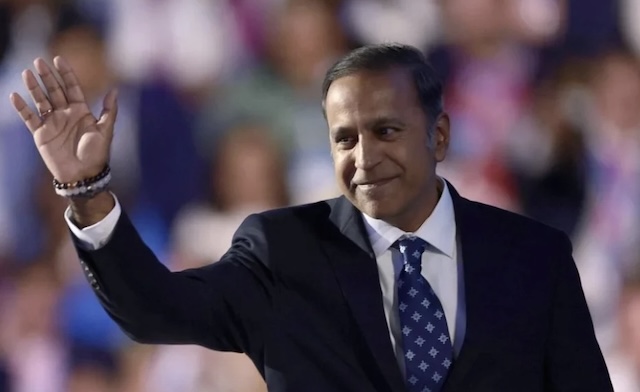
US Senate candidate Raja Krishnamoorthi of IL is just one of a number of high profile Asian Americans running for office in 2026
By defeating Vice President Kamala Harris in 2024 President Donald Trump denied this country its first Asian American president.

Ghazala Hashmi, born in Hyderabad, India, made history in 2025 by becoming the Lieutenant Governor of Virginia
But the 2024 elections also brought a record number of victories by AAPI candidates. In fact that election cycle marked the greatest number of AAPI candidates running for office in US history.
And in 2025 despite the scarcity of major races, AAPI candidates continued to claim historic victories.
Notably Zohan Mamdani became the first Asian American Mayor of New York while Gazhala Hashmi's election to Lieutenant Governor of Virginia, made her the first Asian American to hold statewide office in the commonwealth.

Mazie Hirono of Hawaii is just one of three AAPI Senator
There is still of course a long way to go for Asian Americans to receive proportional representation at all levels of government.
There are currently three Asian Americans serving in the US Senate: Tammy Duckworth (D-IL), Mazie Hirono (D-HI) and Andy Kim (D-NJ. That's just 3% of the governing body which is well below our 6-7% share of the US population.
Representation in the US House is slightly better. An estimated 18 of the 435 seats are held by AAPI-ers. That's 4.1%.
But when is comes to Governors, the number of Asian Americans is literally 0.
We still have a long way to go, but here are a few candidates who could improve those numbers in 2026:
Senate
Raja Krishnamoorthi (Illinois)

In 2012 Raja Krishnamoorthi lost to Tammy Duckworth in the Democratic primary race for Illinois’s 8th Congressional District. When Duckworth ran for the US Senate two years later in 2012, Krishamoorthi ran for the seat once again, this time successfully.
Today, he is seeking to become a United States senator alongside Duckworth.
If Krishnamoorthi does succeed in replacing retiring Democrat Dick Durbin in the Senate, this would mark the second time in history that a state’s entire senate delegation is AAPI. The first instance was when Chinese American Henry Fong served alongside Japanese American Daniel Inouye in Hawaii’s delegation in the 1960s and 70s.
A victory would also make Krishnamoorthi, born in New Delhi, India, the first South Asian man elected to the US senate. Kamala Harris holds the distinction of first South Asian Senator regardless of gender.
Krishnamoorthi holds progressive views on nearly every issue. As a ranking member on the US House’s Select Committee on Strategic Competition between the United States and the Chinese Communist Party, he is the first South Asian American to serve as ranking member on a full committee.
Given the state of Illinois’s propensity to elect Democrats, it is likely that whoever beomes the Democratic nominee will be the front runner to win the November general election.
To secure the nomination Krishnamoorthi will have to beat current Lieutenant Governor Juliana Stratton, Congressman Robin Kelly (IL-02) and a host of lesser known candidates.
Janak Joshi (Colorado)

Republican Janak Joshi, who was born and educated in Gujarat, India, is arguably the front-runner for the Republican nomination in the 2026 US Senate race in Colorado.
Joshi was previously a member of the Colorado House of Representatives and launched an unsuccessful primary bid for Congress in 2024.
He now faces arguably just one other viable competitor: Retired Marine Colonel George Washington Market. B oth Joshi and Washington are running as far-right Republicans on an ardently Pro-Trump platform.
With minimal polling so far, it is tough to surmise who has a better shot though, though Joshi appears to be ahead in fundraising which could be a good indication.
Joshi, who decries "wokeness," does not explicitly mention his ethicity much on the campaign trail, though in 2024 while campaigning for the US House, he stated “Everybody wants to be a chief in Washington, D.C.! And nobody wants to be an Indian. I am that Indian! … Send this Indian to Washington, D.C.”
It is currently unlikely that either Republican would defeat incumbent Democratic Senator John Hickenlooper in the general election. Colorado, where President Trump holds a 59% disapproval rating, has become a reliably Democratic state in recent years.
Abdul El-Sayeed (Michigan)

In 2018 Abdul El-Sayeed resigned from his position as Executive Director of the City of Detroit’s Health Department to run for Governor of the state of Michigan.
The Democratic primary for Michigan Governor echoed the bruising 2016 presidential primary from just two years prior, with many progressive Bernie Sanders supporters backing El-Sayeed while more centrist Democrats tended to support Gretchen Whitmer, who went on to beat El-Sayeed.
His current bid to replace retiring Democratic Senator Gary Peters is by all accounts a long-shot.
It appears that more moderate establishment democrats are backing Rep. Haley Stevens while more liberal mainstream democrats are backing Michigan State Senator Mallory McMorrow. That generally leaves more far-left anti-establishment voter in El-Sayeed's camp, which is unlikely to be a large enough voting bloc for him to win.
It's worth nothing that Michigan is home to a number of Muslim voters who may have voted Democratic in the past, but are now disillusioned with the party given their handling of the crisis in Gaza. Such voters may be draw to El-Sayeed, regardless of whether or not they see him having a viable path to victory.
Governor
Vivek Ramaswamy (Ohio)

Republican Vivek Ramaswamy went from relative unknown to a key player in the 2024 presidential election despite having never held elected office. Now he is hoping to change that.
Ramaswamy announced his campaign to succeed term-limited Republican Ohio Governor Mike DeWine earlier this year and has consistently led the Republican primary field by a substantial margin according to various polls.
A victory by Ramaswamy would make him the first non-White Governor in the state’s history. Yet victory remains far from certain, particularly given the racial dynamics at play.
Ramaswamy has recently become the target of far-right activists whose views on race can be compared to Naziism. In a recent op-ed in the new York Times, Ramaswamy noted that “My social media feeds are littered with hundreds of slurs, most from accounts that I don’t recognize, about “pajeets” and “street shitters” and calls to deport me “back to India” (I was born and raised in Cincinnati and have never resided outside the U.S.).”
The Republican primary and therefore Ramswamy’s chances at victory will ultimately be a battle over whether or not these racist far-right views will prevail against more moderate US conservatism.
Congress
Saikat Chakrabarti (CA-11)

Saikat Chakrabarti, Rep. Alexandria Ocasio-Cortez’s former Chief of Staff, made headlines when announcing a primary challenge from the left of former House Speaker Nancy Pelosi.
Pelosi, however, would later announce that she was not running for election after approximately 40 years in the US House. Following Pelosi’s announcement, more candidates have either entered the race or voiced interest in a run.
Chakrabarti, who has spent time working with far-left organizations, is likely seen as the most progressive candidate in the race.
He is an Indian American who's father came to the US during India's partition.
But he is not the only Asian American in this race:
Connie Chan (CA-11)

Connie Chan, who is ethnically Chinese, was born in Hong Kong before moving to Taiwan and ultimately landing in San Francisco’s Chinatown neighborhood at age 13.
Chan is currently serving her second term on the San Francisco board of Supervisors and announced a run for Pelosi’s seat just two weeks after Pelosi announced her retirement.
California state representative Scott Weiner is running as well.
The district is approximately 30% Asian. Given that this race pits a South Asian American against an East Asian American, a more specific breakdown of that 30% could help paint a clearer picture of who might have an advantage.
Amish Shah (AZ-01)

Amish Shah, an Indian American who serves in the AZ statehouse, is seeking the Democratic nomination for the state’s 1st Congressional District.
Shah was the Democratic nominee for the same seat in 2024, but lost to incumbent Republican David Schweikert by about 4%. Schweikert is now running for Governor, which leaves both parties' nominations up for grabs.
Eric Chung (MI-10)

Eric Chung, a Democrat, is running for Congress in Michigan’s 10th District.
Current Republican Congressman John James is running for Governor rather than re-election. James won his last race by approximately 6%.
Chung, the child of Vietnamese immigrants who fled communist Vietnam, served in the US Department of Commerce under President Biden.
He has received the most endorsements and raised the most money so far and is therefore seen as the frontrunner for the Democratic nomination.
Michael Masuda (CA-05)

Michael Masuda, whose Japanese grandparents were held in a US internment camp during World War I, is running for Congress in California’s 5th Congressional District.
Masuda is highlighting the fact that he is an engineer and not a politician.
While this district is currently held by Republican Tom McClintock, who is running for re-election, the recent passage of CA’s Prop 50, a redistricting ballot initiative, could potentially make the race friendlier to Democrats.
Flipino American Angelina Sigala, who ran for Congress in California’s 13th District in 2024, had filed paperwork to run as a Democrat as well.
OverallIt’s unabashedly good news that Asian Americans — from both parties — are running for office in greater numbers. At the same time, simply having AAPI candidates is not good enough. We need to be winning in order to gain actual proportional representation.
It's also important to note that Asian Americans are the fastest growing voting bloc, which means not just that we will need more AAPI candidates but that non-AAPI candidates need to be focusing on issues that are important in order to gain our votes.
We may be just a few days into 2026, but if the sheer number of candidates running so far is any indication, it's going to be a good year.
© 2026 by Asian Media Group Inc.
If Krishnamoorthi does succeed in replacing retiring Democrat Dick Durbin in the Senate, this would mark the second time in history that a state’s entire senate delegation is AAPI. The first instance was when Chinese American Henry Fong served alongside Japanese American Daniel Inouye in Hawaii’s delegation in the 1960s and 70s.
Recent Articles
- S. Korean Shops Turn to Robots, Self-Service to Escape Labour Woes
- Largest US Power Grid Saw 15-Fold Rate Spike on Record Demand in Heat Wave
- Affluent Consumers Help US Car Sales Overcome Headwinds
- How Hock Tan Built Broadcom into an Indispensable Power in the AI Boom
- US June Private Payroll Growth Misses Expectations; Layoffs Decline
- Progressives Win Big Against Incumbent Democrats in Colorado Primaries
- Sony to End Discs for New PlayStation Releases as Gaming Shifts Online
- Russia Allowed Covert Military Training by China at Top Level
- Exports Help BYD Sales Rise for Second Month
- Older Americans Priced Out of GLP-1 Craze Expected to Flock to $50 per Month Program