

Bangladeshi Community Rattled by USF Murders
By J. J. Ghosh | 09 May, 2026
Two students came to the US from Bangladesh to pursue the American Dream. Their roommate murdered them.
.webp)
On the morning of April 16 Nahida Sultana Bristy called her father in Bangladesh from Florida.
“Father, I am attending classes at the university,” she told him. “I am busy with lab work. Around 5:00pm, we will go shopping. I will go with a friend.”
That was the last time Jahir Uddin Akon heard his daughter’s voice.
“There was so much joy in her voice,” he said afterward. “She was supposed to return home in July. No one will call me ‘father’ anymore. I used to call my daughter ‘Ma’. I will not be able to call anyone ‘Ma’ again.”
A memorial for the victims was set up on the University of Southern Florida's campus
Bristy, 27, was a doctoral student in chemical engineering at the University of South Florida in Tampa. Her friend and former romantic partner, Zamil Limon, also 27, was a doctoral student studying geography, environmental science, and policy at the same university. Both had come to Tampa from Bangladesh — Limon in fall 2024, Bristy in fall 2025 — to pursue advanced research and build careers they planned to bring back home.
Limon had been working on his thesis for two years, studying the use of generative AI to monitor shrinking wetlands in South Florida. He was days away from defending it. After finishing his PhD, he hoped to return to Bangladesh and become a university professor.
Neither of them made it home.
What Happened
Police believe both students were killed in Limon’s apartment on the night of April 16, 2026. Limon’s remains were found in heavy-duty trash bags on the shoulder of the Howard Frankland Bridge, while Bristy’s were later discovered by a kayaker in the mangroves near the Pinellas County side of the same bridge.
Hisham Abugharbieh, 26, has been charged with their murders. He was Limon’s roommate and a former USF student who had dropped out in 2023. Abugharbieh faces two counts of first-degree premeditated murder with a weapon, and could face the death penalty if convicted.
The suspect, Limon's roommate, is facing the death penalty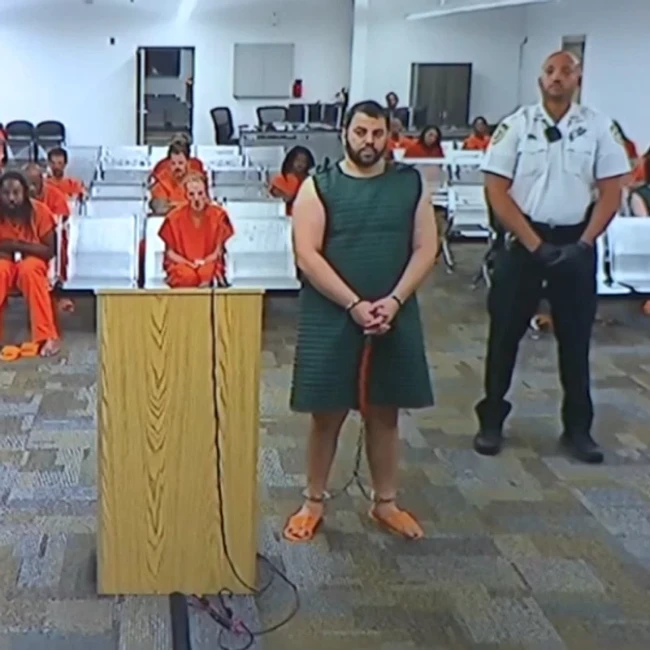
The evidence prosecutors have assembled is damning and methodical. In the days before the killings, Abugharbieh asked ChatGPT what would happen if a human body were put in a garbage bag and thrown in a dumpster. When ChatGPT told him the idea sounded dangerous, he responded: “How would they find out?” He also searched whether it was legal to keep an unlicensed firearm at home, asked whether neighbors would hear a gunshot, and ordered duct tape, lighter fuel, fire starter, charcoal, and a fake beard from Amazon in the week before the murders.
Abugharbieh gave Limon and Bristy a ride to Clearwater on the day they were last seen alive. He initially denied it, then changed his story when confronted with phone location data. That same night, he purchased trash bags, Lysol wipes, and Febreze. Forensic technology later revealed the outline of a human body on the floor next to his bed where the victim appeared to have been curled in a fetal position.
Prosecutors also allege that a history of violent and erratic behavior predated the murders by years. In 2023 his family filed a protective order after he punched his brother and kicked his mother. His brother wrote that Abugharbieh “would start screaming in the middle of the night about how he is God and we should all bow down to him.” A second protective order was filed in 2025 and denied. “We tried to warn police in the past,” his brother said afterward.
A motive has not been officially established.
Limon’s brother, Zubaer Ahmed, shared his own theory with investigators — including a recent incident in which he says Abugharbieh lost his temper over soap. The picture that emerges from court filings is of a man with untreated mental health issues, a pattern of domestic violence, no stable employment, and a roommate who was eight days from completing a doctoral degree he had spent years working toward.
The Community Response
With the victims’ families still in Bangladesh, their classmates and friends stood in for them and packed the courtroom at Abugharbieh’s first hearing in Tampa. Some had known Limon and Bristy since they arrived in Florida. Others came simply because they were Bangladeshi, and this was their community’s loss.
“What you need to understand is that we Bangladeshi people, we live as a family here,” said Abir al Hasib Shourav, who was present in the courtroom. “When we come here, 8,000 miles away from home, these people become our family — our everything.”
The university’s Bangladesh Student Association served as a liaison between the university and the victims’ families, asking USF to help preserve Limon’s remains in accordance with Islamic burial rites.
A GoFundMe started by Limon’s graduate advisers raised tens of thousands of dollars for both families within days. USF announced it would confer posthumous doctoral degrees on both Limon and Bristy at the spring graduation ceremony.
In Bangladesh, the grief has been national in scale.
Limon’s body — the first to be discovered — arrived at Hazrat Shahjalal International Airport in Dhaka on May 4 on an Emirates Airlines flight, where a state minister for foreign affairs and his parents received it.
A heart-rending scene unfolded when his remains reached his village in Jamalpur. Family members, childhood friends, and locals broke down in tears. His father, his voice breaking, said he hoped that students from Bangladesh and other countries would one day be able to study abroad safely, and demanded the highest punishment for the perpetrator.
Back in Noakhali, Bristy’s father made one request. “Find my daughter’s body and bring it back,” he said. “I just want to see her face one last time.”
The American Nightmare
Limon and Bristy were among more than 17,000 Bangladeshi students — an all-time high — enrolled in US institutions, according to the US Embassy in Bangladesh. They came here as part of a well-worn path:
Work hard at home, earn a scholarship, come to America, get the degree, go back and build something. It’s a path that has defined the South Asian immigrant experience for generations, and one that rests on an implicit promise — that the country receiving these students will keep them safe.
A Bangladeshi university vice-chancellor, writing an open letter to the victims, put it plainly: “What does it mean to invite students into a promise of mobility and not guarantee their safety?”
That question isn’t directed at the suspect alone. It’s directed at USF, which housed both students in arrangements it didn’t manage and could not monitor. It’s directed at the Florida courts, which twice received warnings about Abugharbieh’s violence and twice declined to act with sufficient force. And it’s directed at the broader American system that markets itself to international students — to the tune of 17,000 Bangladeshis alone, all paying tuition, all contributing to research programs and university rankings — without fully reckoning with the vulnerabilities that come with being young, foreign, financially dependent on a scholarship, and sharing an apartment with a stranger.
But maybe the toughest pill to swallow is that there is simply no one to blame here beyond the deranged acts of a lunatic. Perhaps it’s even harder to accept the fact that some inexplicable acts of violence can simply happen to anyone, even in places that are hard to fathom.
Zamil Limon and Nahida Bristy’s names will be added to the USF Student Memorial Wall and their degrees will be handed to empty chairs at commencement.
And somewhere in Bangladesh, another family is wondering whether their child’s safety is worth gambling with in exchange for an American education.
© 2026 by Asian Media Group Inc.
Recent Articles
- Intel Turns to Next-Gen ASML Tool to Help Make Its Laptop Chips
- Cambodian Gaming Tycoon Was Landlord to Chinese Scam Compound
- China New Home Price Slide Slows, but Recovery Doubtful
- Iran Threatens to Block More Vital Seaways as Trump Orders Renewed Iran Blockade
- ASML Beats Q2 Revenue Estimates on AI Chip Demand
- Nvidia Has Begun Shipping H200 AI Chips to China
- IBM Warns AI Boom Is Squeezing Software Budgets; Sending Shares Down
- Two Utah National Monuments Fall to Trump Anti-Green Drive
- 72% of Americans Disagree with Trump on Refugees
- June CPI Not As Hot As Feared, Soothing Markets