

Blood Vessels Grown from Kidney Patients' Own Cells
By wchung | 08 Jul, 2026
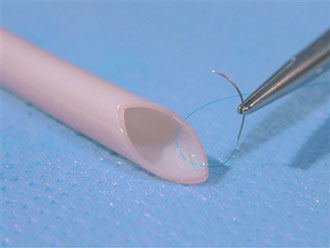
This image released by Cytograft Tissue Engineering shows a blood vessel prior to implantation, with the blue ‘suture’ thread used to attach it to the patient’s circulation. (AP Photo/Cytograft Tissue Engineering, HO)
Scientists have grown blood vessels for kidney patients from their own cells, making it easier and safer for them to use dialysis machines, a new study says.
Some experts said the results suggested that doctors might one day be able to custom-produce blood vessels for patients with circulatory problems in their hearts or legs. Todd McAllister of Cytograft Tissue Engineering in California and colleagues implanted lab-grown blood vessels into 10 patients with advanced kidney disease in Argentina and Poland from 2004 to 2007.
Early results for two of these patients were announced in 2005. In 2007, the scientists published preliminary findings for another 4 patients in the New England Journal of Medicine.
In this most recent study, published Friday in the medical journal Lancet, scientists reported on the new blood vessels in those same patients and 4 others.
Dialysis patients need a vessel, or shunt, to connect them to dialysis machines. This can be made from their own vessels. But because dialysis is done so regularly, kidney patients often run out of healthy vessels and need an artificial one, often made out of gortex. Those are prone to infection and inflammation.
In the study, doctors took a small snippet of skin from patients. Cells from those samples were grown in a lab, to help them produce proteins like elastin and collagen. From those, scientists made sheets of tissue that were rolled into blood vessels 6 to 8 inches (15 to 20 centimeters) long.
The vessels were finished after 6 to 9 months. All of the vessels were implanted into patients’ upper arms, to connect them to dialysis machines.
The vessels failed in three of the patients, which experts said was not surprising in patients so seriously ill. One other patient withdrew from the study and another died of unrelated causes.
In the five remaining patients, the vessels worked for at least 6 to 20 months after they were implanted. Afterwards, those patients needed fewer interventions, including surgeries, to maintain the vessels than regular dialysis patients.
McAllister said he and colleagues plan to test similar devices in patients with heart and leg problems. “It’s basically a piece of plumbing to bypass blockages,” he said.
The study was was paid for by Cytograft Tissue Engineering.
“This technology is very, very promising,” said Vladimir Mironov of the Medical University of South Carolina, who co-wrote an accompanying commentary in the Lancet that praised the study as “a revolutionary milestone.”
“It’s difficult to predict what will happen next, but they are on the right track,” Mironov said. He added the same technique might be useful for people with heart, leg or hernia problems. But Mironov worried the vessels, which cost between $15,000 and $20,000, might be too expensive to be used widely.
Dr. Bryan Becker, president of the National Kidney Foundation in the U.S., said about half of kidney patients could benefit from these vessels if further tests confirm they work. Becker was not linked to the Lancet study.
4/24/2009 12:44 AM MARIA CHENG AP Medical Writer LONDON
© 2026 by Asian Media Group Inc.
Recent Articles
- China Becomes Innovation Engine for Top Global Legacy Carmakers
- Big Tech Data Centers Drive Up Power Bills at America's Rust Belt Factories
- AstraZeneca Pays $200 Mil. Upfront to License Chinese COPD Drug
- Korean Chip Stocks Rebound from Overnight US Selloff as Chip Supply Remains Tight
- DeepSeek Developing AI Chip in Possible Setback for Majors
- Eala and Osaka’s Wimbledon Upsets, Sudo Retains Belt, MLB All-Star Watch
- China Gold Reserves Rise Most Since 2023 As Bullion Tumbles
- Italy's Meloni Seeks to Avoid Escalation After Trump Revives Personal Feud
- Canada's May Trade Surplus Surged to 4-Year High on US Exports
- Beijing Mulls Curbing Overseas Access to China's Top AI Models