

How and When Flying Cars Will Change American Life
By Ben Lee | 28 May, 2026
The ability to avoid urban traffic and cover large distances without commercial transportation will change the shape and size and home pricing of metro areas, among other things.
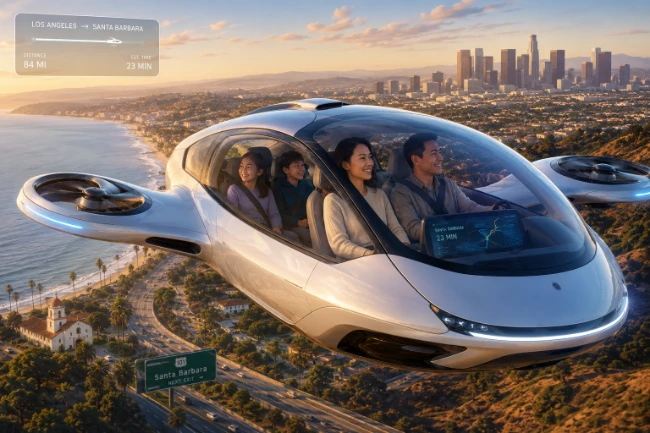
No, won't be zipping over rush-hour gridlock in a flying car by next month. But you might be doing it by 2035. And when personal aerial vehicles become as ordinary as the SUV in your driveway, it won't just change how you get around. It'll change where you live, what your house costs, what cities look like, and honestly, how you think about distance itself.
That's not hype but a fundamental rewrite of the relationship between time and space in a civilization built around commuting.
Automobile Redux
To understand what's coming, it helps to remember what happened the last time personal transportation got a massive upgrade. When the Model T rolled out in the early 1900s, it didn't just replace horses. It exploded the American city outward. Suburbs happened because cars made them possible. The interstate highway system connected places that used to be functionally unreachable. Entire economic geographies reorganized themselves around what a person could reasonably drive in an hour.
Flying cars aka electric vertical takeoff and landing vehicles—eVTOLs—are going to do the same thing, except in three dimensions instead of two.
The companies working on this aren't fringe startups tinkering in garages. Joby Aviation, Archer, Wisk, Lilium, and a dozen others are in serious FAA certification processes right now. Joby has already logged thousands of test flights. United Airlines has pre-ordered aircraft from Archer. Toyota, Stellantis, and other major automakers have sunk billions into the sector. The FAA finalized its first set of air taxi regulations in 2024. This is happening. The only real question is how fast.
New Commute Math
Traffic isn't really about distance but about time. Nobody says "I live 30 miles from downtown." They say "I'm about 45 minutes out — on a good day." The car didn't just move people; it sold them a time budget for how far from work they could reasonably live. And that budget has been getting worse for decades as roads fill up and cities sprawl.
An eVTOL cruising at 150 to 200 miles per hour through unobstructed airspace rewrites that budget entirely. A commute that takes 90 minutes by car might take 20 minutes in the air. And unlike roads, airspace doesn't really have rush-hour congestion — at least not yet, and air traffic management systems are already being designed to handle high volumes of low-altitude autonomous flights.
What does that do to where people choose to live? It pushes the livable radius of every major American city way, way out.
Right now, if you work in downtown Austin, you probably live somewhere within a 30-to-40-mile band around the city if you want a sane commute. In an eVTOL world, that band could realistically stretch to 100 miles or more. Fredericksburg, Texas — currently a 90-minute drive from Austin — suddenly becomes a reasonable place to raise a family and still make a morning meeting. Same idea in every metro in the country.
Impact on Housing Prices
If you've spent any time trying to buy a house near a major American city in the last decade, you know the pain. Demand has been jammed into a relatively small geographic ring around employment centers, and prices have gone absolutely haywire as a result. The average home price in the San Francisco Bay Area. The bidding wars in suburban Boston. The way people in Nashville are getting priced out and moving an hour south.
Flying cars don't solve the housing crisis overnight, but they do attack its root cause: artificial scarcity driven by commuting constraints.
When the effective commutable zone around a city doubles or triples in radius, the supply of viable housing land doesn't double or triple — it grows by something like the square of the radius. That's a massive increase in the theoretical supply of "close enough to the city" real estate. Basic economics says prices should soften as that supply opens up.
The flip side is that currently-sleepy small towns and rural areas within eVTOL range of major cities are going to get a lot more expensive in a hurry. Think about what happened to mountain towns in Colorado or rural areas of Vermont during the remote work boom — that's going to look quaint compared to what happens when a 100-mile commute takes 25 minutes and costs around $50.
The winners will be anyone who already owns land or property in those not-yet-discovered zones. The losers will be people who bought in the urban fringe expecting those neighborhoods to stay premium — because that premium was always just a proxy for commute time, and that pricing signal is about to get scrambled.
Cities Will Be Remade
Urban planners are already having this conversation. If the primary reason people cluster in dense, expensive urban cores is proximity to work and services, what happens to that clustering pressure when proximity becomes less of a constraint?
Some urbanists think cities will hollow out — that people will flee to the exurbs and only come in when they need to, turning downtowns into business and entertainment districts rather than places where people actually live. Others think the opposite: if getting around becomes faster and easier, more people will want to be in the city, using air taxis to hop between neighborhoods and regional destinations without ever touching a road.
The honest answer is probably both, depending on the city. Dense, walkable cities with strong culture and amenities — your New Yorks, your Chicagos — will probably stay dense and get more connected. Car-dependent sprawl cities built around highway interchange logic might actually contract toward their cores as the highways themselves become less important.
What's almost certain is that airports, in their current form, become less dominant. If you can hop in an air taxi and cover 200 miles in an hour, a lot of short-haul commercial flights stop making sense. The Southwest Airlines model of quick regional hops gets undercut pretty badly when individuals can essentially replicate it on demand without the security lines and boarding hassles. That's not great for airline revenues on shorter routes, but it's very good for the rest of us.
The Money Factor
Here's where it's worth being honest about the friction. Flying cars aren't going to be cheap, at least not at first. Early eVTOL rides will likely be priced similarly to helicopter charters, or maybe premium rideshare — accessible to the affluent, not the average commuter. The technology will take time to scale, costs will take time to fall, and infrastructure (vertiports, charging stations, air traffic systems) will take time to build out.
There's also a real risk that this technology deepens geographic inequality rather than reducing it. If wealthier households get access to dramatically expanded commuting radii and start colonizing currently-affordable rural and small-town markets, it could price out the people who actually live there. It's a legitimate concern, and it's one that local governments and housing advocates are already raising.
The optimistic read — and there's reason to believe it — is that the cost curve on eVTOLs is going to drop fast, similar to what happened with commercial drones and electric vehicles. Electric powertrains are mechanically simpler than combustion engines. Autonomy eliminates pilot costs. Manufacturing will scale. The folks at Joby and Archer talk seriously about eventual per-mile costs competitive with rideshare, which would put it in range of a broad chunk of the middle class within a decade or two of launch.
Realistic Timeline
Here's a rough sketch of how this probably plays out: Commercial air taxi service in a handful of major U.S. cities — Los Angeles, New York, Dallas, Miami — launches somewhere between 2026 and 2028, most likely in limited corridors between airports and urban centers. Over the following five years, routes expand, prices start dropping, and the technology gets normalized.
By the mid-2030s, if regulatory frameworks keep pace and battery technology continues to improve range, you're looking at something approaching mass-market accessibility in major metros. Personal ownership of eVTOLs — your actual flying car in your actual garage — is probably a 2035-to-2045 story, and it'll require significant updates to zoning law, noise ordinances, and airspace management.
None of this will happen in a straight line. There will be accidents, regulatory setbacks, company failures, and public skepticism to work through. But the direction of travel is pretty clear.
The Bottom Line
Flying cars aren't going to change everything at once. But they're going to change where you'd consider living, what you'd consider a reasonable commute, and what a piece of land is worth depending on where it sits relative to a city. They're going to stress-test urban planning assumptions that have been baked in since the postwar era. And they're going to do what every major transportation revolution has done before them: make the world feel smaller, and in doing so, make it larger in ways we're not entirely ready to imagine yet.
The traffic isn't going anywhere. But eventually, you will.
© 2026 by Asian Media Group Inc.
Recent Articles
- Intel Turns to Next-Gen ASML Tool to Help Make Its Laptop Chips
- Cambodian Gaming Tycoon Was Landlord to Chinese Scam Compound
- China New Home Price Slide Slows, but Recovery Doubtful
- Iran Threatens to Block More Vital Seaways as Trump Orders Renewed Iran Blockade
- ASML Beats Q2 Revenue Estimates on AI Chip Demand
- Nvidia Has Begun Shipping H200 AI Chips to China
- IBM Warns AI Boom Is Squeezing Software Budgets; Sending Shares Down
- Two Utah National Monuments Fall to Trump Anti-Green Drive
- 72% of Americans Disagree with Trump on Refugees
- June CPI Not As Hot As Feared, Soothing Markets