

How and Why Casinos Market to Asians
By Kelli Luu | 08 Jan, 2026
Casinos have built entire ecosystems around Asian clientele, blending cultural symbolism and familiarity to keep them engaged longer due to studies showing higher rates of problem gambling in the community.
Have you ever wondered why casino advertising is heavily directed towards Asians? Well, casinos don’t leave anything to chance, especially when it comes to marketing and one of the most strategically targeted demographic is the Asian community. Let’s take a look at why the industry has built an ecosystem with Asian customers in mind.
The first thing casinos look at is spending behavior in order to maximize the value of each customer. According to the most recent report from the National Council on Problem Gambling, Asian Americans and Native Americans experience higher rates of problem gambling, around 2.3% in comparison to White Americans who stand at 1.2%. Asians may not be gambling the most, but gambling issues occur more often in Asian communities, like in Illinois.
A 2021 study found that 13.6% of Asian residents in Illinois were frequent gamblers and 5% met the criteria for having an actual gambling problem. Casinos have to pay attention to these numbers because they show potential for repeat spenders, not just visitors.
Social factors are another component that plays into why casinos want to attract Asian customers. Patrons are more likely to participate in casino visits because they function as safe, comfortable, and familiar spaces. Many Asian traditions include games like pai gow or bầu cua, which include low stake gambling, especially during the Lunar New Year to celebrate and bond with one another. These games are played in association to luck and togetherness and winning always symbolizes good fortune.
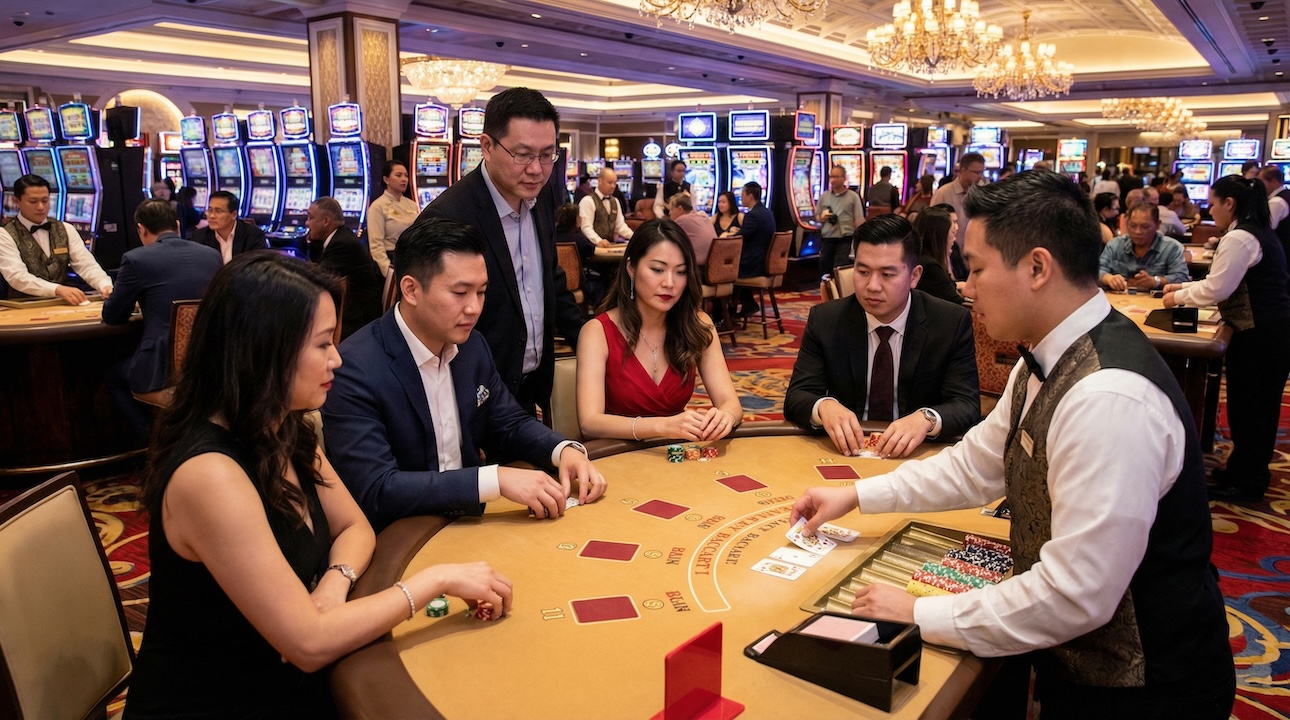
Casinos have taken note of this. They take familiar elements of Asian culture and recreate them in a new environment. Tables are often lined with red and gold decor, the layouts are designed deliberately to align with feng-shui, and lanterns and money trees are strategically placed throughout the venue. Food familiarity also keeps customers from leaving as it creates a full cultural environment rather than just a place to gamble, so casinos make sure there are dim sum deals, congee stations, and Asian buffets only a few steps away from the gaming floors.
During the Lunar New Year, casinos invest heavily in their Asian clientele with aspects like red envelope invitations and zodiac themed displays, making it one of their most profitable times of the year.
Another way casinos directly target the Asian community is with multilingual advertising through billboards, printed mail, and digital ads. There are also shuttle buses that run through Asian neighborhoods, helping reduce transportation issues and making casinos feel more accessible for the community.
While all of these elements can be labeled as cultural inclusion, some find it concerning and believe casinos should not be exploiting cultural traditions for profit. Casinos understand the numbers and the cultural symbolism, meaning they know how to create an environment where Asian customers feel both welcome and encouraged to stay which leaves the line between cultural appreciation and targeted exploitation blurred. Whether your perspective sees this as inclusive or predatory, it is clear that the relationship between casinos and the Asian community is far from accidental.
© 2026 by Asian Media Group Inc.
Recent Articles
- S. Korean Shops Turn to Robots, Self-Service to Escape Labour Woes
- Largest US Power Grid Saw 15-Fold Rate Spike on Record Demand in Heat Wave
- Affluent Consumers Help US Car Sales Overcome Headwinds
- How Hock Tan Built Broadcom into an Indispensable Power in the AI Boom
- US June Private Payroll Growth Misses Expectations; Layoffs Decline
- Progressives Win Big Against Incumbent Democrats in Colorado Primaries
- Sony to End Discs for New PlayStation Releases as Gaming Shifts Online
- Russia Allowed Covert Military Training by China at Top Level
- Exports Help BYD Sales Rise for Second Month
- Older Americans Priced Out of GLP-1 Craze Expected to Flock to $50 per Month Program
Asian American Success Stories
- Asian American Polls
- Asian American Parenting
- Personalities
- Identity
- The 130 Most Inspiring Asian Americans of All Time
- 12 Most Brilliant Asian Americans
- Greatest Asian American War Heroes
- Asian American Digital Pioneers
- New Asian American Imagemakers
- Asian American Innovators
- The 20 Most Inspiring Asian Sports Stars
- 5 Most Daring Asian Americans
- Surprising Superstars
- TV’s Hottest Asians
- 100 Greatest Asian American Entrepreneurs