

CultureThe Truth About Asian American Personalities
By Goldsea Staff | 15 Dec, 2025
What the science says about Asian personality types compared with the general American population.
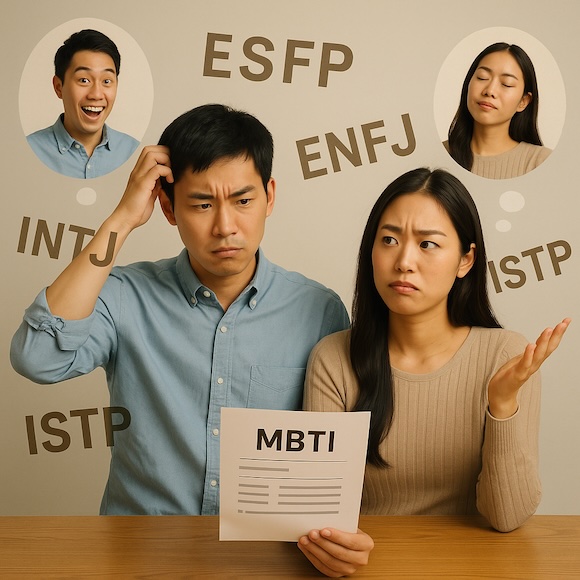
If you've ever taken the Myers-Briggs Personality Type Indicator (MPTI) and been puzzled by its assessment, you may want to get a better understanding of what "personality" is and why some tests aren't created to discern the personalities beneath the cultural overlay, especially of Asian Americans.
For decades, Americans have absorbed the idea that different racial or cultural groups possess fundamentally different “personality types.” Asians, in particular, are often stereotyped as introverted, compliant, emotionally restrained, or hyper-conscientious, while the broader U.S. population is portrayed as outspoken, assertive, expressive, and individualistic. These beliefs are repeated so often—in classrooms, workplaces, and popular media—that they feel intuitive. But intuitions are often nothing more than a combination of spurious stereotypes.
When psychologists examine personality scientifically, a very different picture emerges. The data show that Asians and the general U.S. population do not differ in personality type distributions in any deep or categorical way. What differs instead are cultural norms, values, and styles of expression—factors that can easily be mistaken for personality differences but are not the same thing.
Confusing culture with personality has real-world consequences, shaping hiring decisions, leadership evaluations, and social expectations. A careful look at decades of research reveals a story that is far more nuanced—and far less stereotypical—than popular narratives suggest.
PersonalityTraits Transcend Race
Modern personality psychology does not rely on folk notions of “types” in the everyday sense. Instead, it uses trait models, most notably the Big Five framework: openness to experience, conscientiousness, extraversion, agreeableness, and neuroticism. This model has been tested across hundreds of cultures, languages, and societies.
The striking finding is not how different people are, but how similar they are. The same five broad personality dimensions emerge consistently among Europeans, East Asians, South Asians, Africans, and Americans of every background. No credible study has found a personality trait that exists in one population but not another. Humans everywhere share the same underlying personality architecture.
This means that Asians in the United States draw from the same set of personality traits as everyone else. There are Asian Americans who are highly extraverted, dominant, novelty-seeking, emotionally expressive, risk-tolerant, and rebellious—just as there are non-Asians who are reserved, cautious, emotionally restrained, and dutiful. Personality variation within groups is far larger than variation between groups.
Average Racial Differences Are Vanishingly Small
While personality structures are universal, researchers do find modest differences in average trait levels across populations. These differences are real but frequently exaggerated in popular discourse.
On average, Asians and Asian Americans tend to score slightly higher on conscientiousness and agreeableness and slightly lower on extraversion in large survey studies. Differences in openness and neuroticism are smaller and often inconsistent across samples. Importantly, these are differences in means, not in distributions. The bell curves overlap heavily.
To put this in perspective, the personality difference between an Asian American and a white American is typically much smaller than the difference between two randomly selected white Americans. In statistical terms, most of the variance lies within groups, not between them. This is why psychologists caution against drawing conclusions about individuals based on group averages.
Expression Trumps Traits
One of the most important insights from cross-cultural psychology is that culture influences how personality traits are expressed, not whether they exist.
Extraversion provides a clear example. Western cultures, especially in the United States, often equate extraversion with verbal assertiveness, public self-promotion, and high-energy social dominance. Many Asian cultures emphasize situational awareness, listening, and restraint in public settings. As a result, an Asian American may score lower on extraversion scales while still being socially influential, charismatic, or dominant in familiar or in-group contexts.
Similarly, emotional regulation is often mistaken for emotional suppression. In many Asian cultures, managing emotional display is considered a sign of maturity and social intelligence. On Western-designed surveys, this can appear as low emotional expressiveness or even introversion, even when internal emotional experience is just as intense.
Measurement bias plays a major role here. Most personality instruments were developed in Western contexts and embed Western norms about what it means to be outgoing, confident, or emotionally healthy. When people from other cultural backgrounds answer these questions, they may interpret items differently or respond in ways shaped by modesty norms rather than inner disposition.
Myers-Briggs Type Indicator Tests
Discussions about racial personality differences often rely on popular typologies such as the Myers-Briggs Type Indicator. This is problematic for two reasons.
First, MBTI lacks strong scientific validity. It forces people into discrete categories that do not reflect how personality actually works. Traits are continuous, not binary. People are not either introverted or extraverted; they fall somewhere along a spectrum, often varying by context.
Second, MBTI results are especially sensitive to cultural response styles. Asians are frequently overrepresented in “introverted” MBTI categories, but this pattern weakens or disappears when surveys are adjusted for self-effacing response tendencies. In cultures that discourage overt self-praise, people are less likely to endorse statements like “I enjoy being the center of attention,” even if they function confidently in leadership roles.
In other words, MBTI distributions often reflect cultural norms about self-description rather than genuine personality differences.
Values Are No Personality
Where Asians and the broader U.S. population do differ more reliably is in values, not personality traits.
Asian cultures, on average, place greater emphasis on relational harmony, duty, effort, and role fulfillment. American culture places greater emphasis on individual choice, self-expression, and personal fulfillment. These value systems shape behavior in predictable ways, but they do not constitute different personalities.
A person who defers to authority may do so out of respect for hierarchy, not because they lack confidence. A person who prioritizes group consensus may be just as assertive internally but chooses a different strategy for achieving goals. These are learned cultural behaviors, not innate personality types.
This distinction becomes especially clear across generations. Second- and third-generation Asian Americans tend to show personality trait profiles that are nearly indistinguishable from the general U.S. population. As cultural context shifts, so does behavioral expression, even while underlying traits remain stable.
Why Stereotypes Persist
If the evidence is so clear, why does the idea of Asian personality difference persist?
Part of the answer lies in selective visibility. Asian Americans are overrepresented in academic and technical fields that reward diligence, attention to detail, and delayed gratification. These environments amplify certain traits while downplaying others, reinforcing narrow stereotypes.
Another factor is social interpretation. When Asians violate expectations—for example, by being outspoken, confrontational, or emotionally expressive—they are often seen as exceptions rather than counterexamples. Stereotypes survive by filtering evidence rather than by reflecting reality.
Finally, personality myths serve social functions. They provide convenient explanations for inequality, underrepresentation in leadership, or cultural misunderstanding. If differences are framed as personality-based, structural and cultural factors can be ignored.
Personality Is Human, Not Racial
The scientific consensus is straightforward. Asians and the general U.S. population do not differ meaningfully in personality type distributions. There are small average differences in certain traits, but these are heavily overlapping and deeply influenced by culture, context, and measurement.
Understanding this does not mean denying cultural differences. It means recognizing their proper place. Culture shapes norms, values, and strategies for navigating social life. Personality reflects enduring tendencies that cut across race and ethnicity.
Conflating the two leads to bad science, bad policy, and bad judgment.
As America becomes more diverse, the ability to distinguish personality from cultural expression is increasingly important. The evidence suggests that when we do, the differences we thought were fundamental begin to look surprisingly superficial—and the similarities, all too human.
Recent Articles
- ChatGPT App Hits 1 Billion Monthly Active Users in Record Time
- World Cup Could Cost Employers as Workers Tune into Matches
- Vietnam's May Trade Deficit Widens to Record High
- Taiwan, South Korea Stocks Get Goldman Upgrade As Asia Rally Intensifies
- Where'd the Mike Go?
- Californians Pick New Governor, Possibly Tip Balance in Congress
- Microsoft Teases Devices Powered by AI Cloud
- Microsoft Reveals New Quantum Chip Made with AI, Systems by 2029
- Huang Anoints Marvell 'Next Trillion-Dollar Company'
- China Owns More Than 11,000 German-Developed Patents