

How the Number 3 Smartphone Maker Did What Apple and Samsung Couldn't
By Goldsea Staff | 18 Mar, 2026
A smartphone on wheels eluded the world's leaders but China's Xiaomi now boasts a hit EV line.
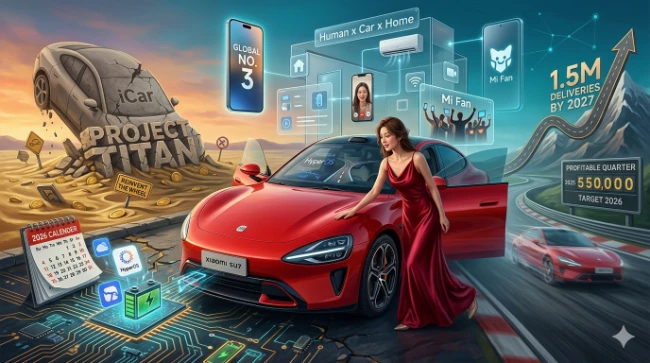
(Image by Google)
The EV is the next smartphone" has been the mantra of every smartphone maker worth its logo. I mean, how hard could it be to amplify a sleek smartphone with a set of wheels, a windshield and a giant battery?
Apple spent a legendary $10 billion and ten years on "Project Titan," a secretive quest to build an autonomous iCar that eventually imploded in early 2024. Samsung, started a car division in 1994 but sold struggling Samsung Motors to Renault after a decade of tinkering without success. That pretty much ended the possibility of putting the Samsung brand on an EV.

(Image by ChatGPT)
Then along came Xiaomi, China's number 2 smartphone maker and the world's distant number 3 behind Apple and Samsung.
In March 2024 the Chinese company—best known globally for affordable fitness trackers and sleek value smartphones—did what the trillion-dollar industry leaders couldn’t. It delivered a car. And it didn't just deliver it but turned it into a cultural phenomenon.
By early 2026 Xiaomi had already retired its first-generation SU7 after a blistering 381,000 deliveries, pivoting to a second generation with the kind of speed that makes traditional car companies look like they’re on Prozac.
How did the global number 3 pull off that remarkable pivot? By embracing a fundamental shift in how a car is conceived, built, and sold.
$10 Billion Trap vs. The Ecosystem Edge
Apple’s failure with Project Titan is often attributed to "feature creep" and a lack of focus. They wanted a car with no steering wheel, Level 5 autonomy. What they really wanted was a masterpiece before they even had a prototype. They were trying to reinvent the wheel before they’d even built the axle.
Xiaomi CEO Lei Jun took a different path. He didn't try to reinvent the car; he tried to "Xiaomi-fy" it. This meant taking the existing, world-class EV supply chain in China—the batteries from CATL, the manufacturing muscle of partners like BAIC—and layering on top Xiaomi’s true superpower—the software ecosystem.
While Apple was hiding prototypes in secret desert testing grounds, Xiaomi was treating the SU7 like a flagship phone launch. They called it "Human x Car x Home." In a Xiaomi world, your car isn't a separate entity. It’s another node on your HyperOS network. When you’re driving home, your car tells your Xiaomi air conditioner to turn on. When you get a video call on your phone, it seamlessly transfers to the car’s massive dashboard display.
Xiaomi realized that people don’t actually want a car that drives itself perfectly (yet). They want a car that fits into their digital life perfectly. By the time the SU7 Ultra—the 1,500-horsepower "halo" car—started tearing up the Nürburgring in 2025, the brand had already proven that a tech company could out-maneuver legacy auto brands by focusing on the "smart" in "smart car."
Moving at Smartphone Speed
One of the biggest shocks to the automotive industry has been Xiaomi’s pace. In the traditional world, a car model lasts seven years with a minor facelift in the middle. Xiaomi laughed in the face of that timeline.
The first-gen SU7 was on the market for less than two years before Xiaomi announced the 2026 refresh. This is smartphone cadence. By April 2026 the new SU7 arrived with a staggering 902 km range and a hardware suite that includes 700 TOPS of computing power—more than most high-end gaming PCs.
This speed is only possible because Xiaomi didn't try to do everything itself. By tapping into China’s matured EV infrastructure, they could focus 100% of their energy on the user experience. While Samsung provides the screens and Apple provides the CarPlay software, Xiaomi provides the whole experience. They aren't a guest in the car's dashboard; they own the dashboard, the motor, and the relationship with the driver.
Miraculous Profitability
For years the narrative was that EVs are a money pit. Tesla took a decade to turn a profit. Rivian and Lucid are still fighting that uphill battle. Yet, by late 2025—just 18 months after the first SU7 rolled off the line—Xiaomi’s EV division reported its first profitable quarter.
This wasn't just luck but a masterclass in scale. By leveraging their existing "Mi Fan" base, Xiaomi didn't have to spend billions on traditional advertising. It sold 100,000 cars in the time it took most startups to build 1,000. By 2025 It delivered 410,000 vehicles. For 2026 it has set a "conservative" target of 550,000.
To put that in perspective, Xiaomi is now selling more EVs in a year than many established European luxury brands. It has successfully bjumped the gap from "the company that makes my $40 earbuds" to "the company that makes my $40,000 performance sedan."
The "Sacrifice" Strategy
In fairness the ride hasn't been perfectly smooth. 2025 and early 2026 saw its fair share of "viral" moments—critics pointing out "losing wheels" in collisions or "small print" in marketing. Lei Jun, ever the tech-CEO-turned-influencer, handled this with a transparency that traditional car execs would find terrifying. He went on a four-hour livestream to explain that the wheels were designed to detach in high-speed impacts to absorb energy—a sacrifice the wheel to save the passenge" strategy.
Whether you buy the explanation or not, the results speak for themselves. The SU7 M9 is currently a top-seller in the luxury segment in China, often out-pacing the BMW X5.
Giants Caught in the Profit and Perfection Traps
So, why did Apple and Samsung miss the boat?
Samsung chose the "Goldman Sachs" route: they realized they had easy profits from selling the shovels (batteries and chips) to everyone else rather than digging the hole themselves. It’s a safe, highly profitable play, but it lacks the brand-defining glory of a finished product.
Apple, on the other hand, fell victim to its own perfectionism. It wanted to define the future of transportation, but forgot that you have to participate in the present to get there. Xiaomi was willing to build a "really good" EV today rather than a "perfect" autonomous pod in 2030.
The Road Ahead
As we move through 2026, Xiaomi is no longer just a smartphone company with a car project. They are an automotive heavyweight. With the upcoming YU9 SUV and a planned expansion into Europe by 2027, the global number three is looking to climb two ladders at once.
The lesson for the rest of the tech world is clear: The smartphone on wheels is now real, but it wasn't built by the people who invented the smartphone. It was built by the people who understood that in the modern world, speed is the only feature that truly matters.
Apple might have the "Titan" files in a vault somewhere, and Samsung might have the best OLED dashboards in the business, but Xiaomi has the keys to the garage.
© 2026 by Asian Media Group Inc.
Recent Articles
- S. Korean Shops Turn to Robots, Self-Service to Escape Labour Woes
- Largest US Power Grid Saw 15-Fold Rate Spike on Record Demand in Heat Wave
- Affluent Consumers Help US Car Sales Overcome Headwinds
- How Hock Tan Built Broadcom into an Indispensable Power in the AI Boom
- US June Private Payroll Growth Misses Expectations; Layoffs Decline
- Progressives Win Big Against Incumbent Democrats in Colorado Primaries
- Sony to End Discs for New PlayStation Releases as Gaming Shifts Online
- Russia Allowed Covert Military Training by China at Top Level
- Exports Help BYD Sales Rise for Second Month
- Older Americans Priced Out of GLP-1 Craze Expected to Flock to $50 per Month Program