

Iran Regime-Change Scheme to Unleash Multiples of Iraq Woes
By Tom Kagy | 02 Mar, 2026
Parallels Between the 2003 Iraq Invasion and the 2026 Iran Strikes — and more importantly, the differences — suggest the strike on Iran won't lead to anything resembling the outcome contemplated by President Trump.
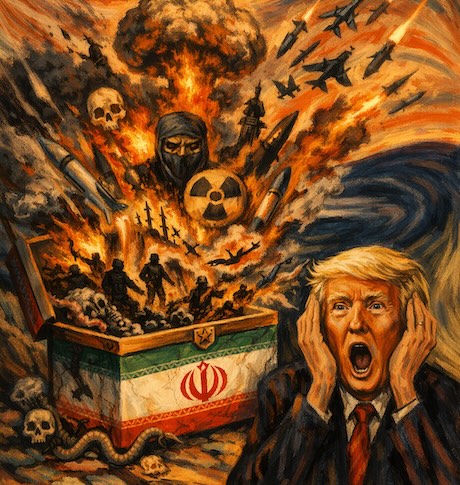
(Image by ChatGPT)
The parallels between the reported US strike on Iran this weekend and the US-led invasion of Iraq in March 2003 invite comparison. But the distinctions—military, social, geopolitical, and historical—are more consequential.
Taken together they suggest that if Donald Trump is seeking regime change in Iran, the odds of success are much worse than those faced by the Bush administration in Iraq—which itself ultimately failed despite overwhelming military force.
Parallels: Familiar Logic, Familiar Temptations
Both episodes reflect an American tendency to believe that a limited, decisive application of military power can shatter a smaller, weaker adversary's will, catalyze defections, and trigger either popular uprising or rapid political collapse. This belief underpinned the March 2003 invasion that toppled Saddam Hussein. Today it appears again in the blithe assumption that precision strikes, economic pressure, and psychological shock will fatally weaken Tehran’s ruling system.
In both cases US leaders framed the target regime as brittle, illegitimate, and hated by its own population. Iraq was portrayed as a hollowed-out dictatorship sustained by fear, while Iran today is often described as an aging revolutionary state facing youth disaffection, economic malaise, and internal factionalism. Of course this is what inspired Trump to assume that the US could easily provide the final push.
And of course the rhetorical premise was the same.
Iraq was cast as an intolerable future threat due to a nuclear weapons program that posed a threat to the world. Iran is framed as a regime whose regional influence and nuclear potential must be curbed before being fully realized. The conclusion being that a strike is urgently necessary.
Big Diferences: Why Iran Is Not Iraq
The most important distinction is structural: Iraq in 2003 was a regime hollowed out by more than a decade of sanctions, no-fly zones, intelligence penetration, and repeated military humiliation. Iran is a far more resilient, internally embedded power whose security services, ideological institutions, and patronage networks are deeply integrated into the social fabric rather than imposed entirely by the will of a dictator.
The Iraqi state collapsed quickly because its army disintegrated and its elites hedged or fled once US forces crossed the border. Iran’s Islamic Republic, by contrast, has spent four decades preparing precisely for the scenario of external attack, building parallel power structures—most notably the Islamic Revolutionary Guard Corps—designed not merely to defend territory but to preserve and enforce regime continuity against external pressure.
Geography and demography also matter. Iraq’s relatively flat terrain and limited population made it vulnerable to rapid conventional invasion. Iran’s mountainous landscape, far larger population of 93 million (vs Iraq's mere 22-23 million in 2003), and complex urban centers make both invasion and sustained control far more costly. What's more, it creates a greater likelihood that external strikes would tend to unify domestic opposition to foreign invasion.
Perhaps even more importantly Saddam Hussein’s regime had little ideological resonance beyond fear and patronage while Iran’s ruling system, though deeply unpopular with some proportion of its citizens, and especially those who had fled the refime, draws legitimacy from nationalism, religion, and resistance to foreign pressure. This is why US strikes—even narrowly targeted ones—are more likely to strengthen hardliners than to embolden reformists.
Changed Geopolitical Context
In 2003 the United States acted at the height of its post–Cold War dominance, with unmatched military superiority and limited peer resistance; today’s Iran strike occurs in a contested global environment. Russia and China will ensure that another US effort at regime change will exact a high price through critical intelligence and military help, proxies, asymmetric retaliation, and diplomatic pressure.
Iran’s ability to respond indirectly—through regional militias, cyber operations, and economic disruption—means that regime change would not be a discrete event but a prolonged, destabilizing process with spillover effects that could rapidly erode domestic and allied support in ways that were less immediate in 2003.
Prospects for Regime Change: Bleaker Than Iraq
The Iraq invasion demonstrated that toppling a government isn't the same as building a stable successor, yet even that initial toppling required massive ground forces, years of planning, and international coalition management. In Iran’s case, the absence of an invasion force, a unified opposition, or a plausible post-regime roadmap makes the idea of externally induced regime change far more speculative.
The lesson of Iraq isn't that regime change is difficult, but that it can succeed tactically while failing strategically. Applied to Iran, this reality suggests an even darker prognosis, since the tactical conditions themselves are far less favorable, and the probability that strikes consolidate authoritarian control rather than undermine it is correspondingly higher.
Trump's strike on Iran echoes the logic and confidence that preceded the Iraq War, placing easy confidence in shock, pressure, and presumed internal collapse. The deeper structural differences between Iraq and Iran, combined with a less permissive global context and a more resilient target regime, strongly suggest that if regime change is his objective, it's far more likely to backfire than to succeed. The result is more likely to usher in precisely the extremist forces he's seeking to obliterate.
© 2026 by Asian Media Group Inc.
Recent Articles
- Samurai Blue Sweep Aside Tunisia, Japan Fans Sweep Monterrey Stadium
- Lebanon Fighting Threatens Switzerland Negotiations
- Danone-Chobani Yoghurt Protein War Underscores GLP-1 Impact
- Italy's Meloni Tells Trump to Focus on His Own Popularity as Row Continues
- Trump Unveils Gifted Qatari 747 As Addition to Air Force One Fleet
- A Warm World Cup Welcome Endears the US to Fans
- China's May Refined Oil Exports Rose from April, Australia Received Agreed Volume
- New Bangladesh Premier to Seek Investments, Jobs in China, Malaysia
- Charles Schwab Working with Cboe to Enter Prediction Market
- Mexico's Love Affair with All Things Korean — Until Thursday's Kickoff