

Korean Cinema's Triumph through a Tortuous Half Century Has a Face
By Romen Basu Borsellino | 08 Jan, 2026
Ahn Sung-ki, who died over the weekend, earned the title "The Nation's Actor" as the most trusted face of South Korean cinema.
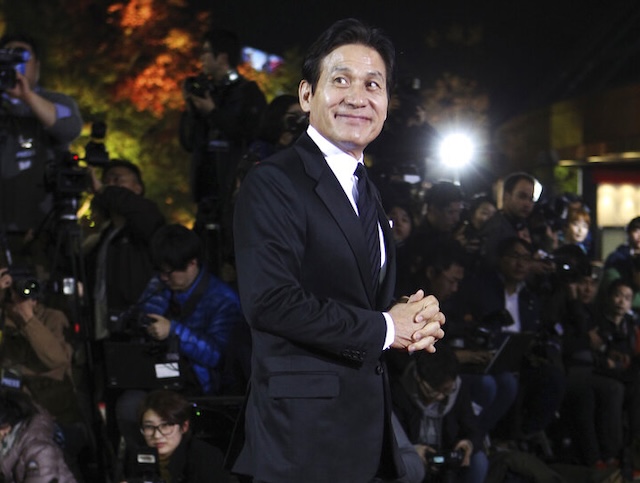
Ahn Sung-ki walks a South Korea red carpet in 2013
When I read about the passing of South Korean Ahn Sung-ki, 74, dubbed “ The Nation’s Actor,” I began to wonder who in the US film industry might be deserving of such a title.

Bong Joon Ho's 'Parasite' became the first international film for Best Picture at the 2020 Academy Awards
I’m probably not alone in going straight to Tom Hanks, lovingly referred to as “America’s Dad.” A few other obvious names that came to mind were Morgan Freeman, Tom Cruise, Denzel Washington, and Meryl Streep.
In some way’s, it’s not a comparison that can be made at all. Yes, it’s safe to assume that Hollywood will remain the undisputed champion of filmmaking for the forseeable future. But to do so would downplay South Korea’s unique but fascinating history with cinema.
It’s a story of repression, freedom, and ultimately rebirth. And if that history was itself a movie, Ahn Sung-ki was the leading man.

'No Other Choice' which is currently playing in theaters, is receiving critical acclaim
Japanese Occupation
While not necessarily intentionally, Korean cinema effectively started around the same time as the Japanese occupation, which began in 1910.
For the ensuing 35 years, Koreans were denied sovereignty, economic independence, and the freedom to enjoy their own culture.
So exactly what is “Korean” cinema under such conditions?
A whole lot of censorship and propaganda, for one. Anything that might explicitly depict the glorification of Korean nationalism or criticism of Japan was outright banned.
As a workaround, Korean films became known for indirect storytelling. Rather than anything overt, they relied on allegory and symbolism to spread their message.
The silent film Arirang, for example, which was released in 1926, was arguably the most important piece of cinema in Korea’s history. While it was ultimately a nationalist film about Korean resistance to Japanese rule, it relied on metaphor to get its themes across and was able to evade Japanese censorship.
The film was considered the first truly great piece of Korean cinema. But certainly not the last
Post-WWII
Japanese occupation of Korea would formally come to an end during the completion of World War II in 1945. But while Koreans were suddenly allowed the freedom of expression, the post-liberation chaos was an impediment.
There was no unified state or functioning government, and few of the film studios that had existed under Japanese rule were still intact.
There was little infrastructure left to carry out any artistic vision.
Yet some filmmakers persevered and managed to take advantage of their newfound freedoms with films that could best be described as leftist.
But that didn’t last for very long.
The Korean War
It took just three years of post-war turmoil until governing tensions came to a head and Korea was split into two occupational zones: The communist North, led by China and the Soviet Union, and the South, which was supported by the United Nations and led by the US.
By 1950 the North and South were at war. The result, of course, was the creation of North Korea and South Korea by the armistice in late July of 1953.
But how did this all affect cinema?
Ironically while South Korea was meant to represent freedom, fear of communism was so rampant that those expressing overtly leftist ideology were seen as a threat that needed to be silenced.
Suddenly many filmmakers became the enemy and were jailed, blacklisted or even executed by the US-backed South Korean government.
Korea’s post-Japanese filmmaking freedom had been short-lived.
The Golden Age
South Korean cinema, which broadly became a proxy for society, seemed to find itself in the same recurring cycle:
Years of prosperity followed by government censorship and propaganda. This would happen over and over again for the next several decades.
Nevertheless, South Korean cinema, while still not granted full expression, found its footing and entered a Golden Age in which cinema became a serious art form. Strong characters — both male and female — became a defining characteristic along with realism, class consciousness and moral despair.
While the government remained skeptical, these themes were typically allowed because they did not seem to galvanize the public to action or dissent, but simply addressed the universal realities of everyday life.
Not to mention that any of the more controversial themes were presented with subtlety and metaphor, much like during Japanese occupation
And during this period, Ahn Sung-ki would come on the scene.
Ahn Sung-ki
Ahn Sung-kii, whose father was a film producer, would act in his first film at age 5 in 1957.
Per the Associated Press, Ahn’s child acting spanned 70 films until he eventually went to college in Seoul.
He would resume the craft as a young adult, playing roles that viewers could relate to. His calm humble demeanor made him an everyman in the eyes of the public.
Ahn’s presence in cinema would play a particularly monumental role as the South Korean government finally shifted from authoritarian rule to Democracy in the late 1980s.
The public had reason to be distrustful of cinema, given the role it had played in disseminating propaganda. But through it all, they had trusted Ahn.
Ahn’s continuing presence allowed viewers to trust the film industry as it transitioned from propaganda to true freedom of expression.
And their trust was ultimately rewarded with genuine films. Under a reformed Korea, films were now criticizing the state, police, capitalism, and class inequality.
And under this new, more honest and nuanced style, Korean cinema hit its peak with Ahn playing career-defining roles.
One such film was 1988’s “Chilsu and Mansu”, the directorial debut of famed director Park-kwang Su, in which Ahn plays an unskilled laborer who is held back in life because of his father’s political dissidence.
In 1993 Ahn received acclaim for his portrayal of a corrupt police officer in Two Cops. The film was directed by Kang Woo-suk, who went on to be regarded as the most powerful man in Korean cinema.
In short, while Ahn had always been respected in film, his career was able to transcend that of any other actor thanks in part to the new Democratic landscape and the artistic vision of several up and coming directors.
Global Expansion
For years South Korean cinema continued to grow both in quality and domestic appreciation.
But it wasn’t until the 2010s that it became a global force to be reckoned with, particularly in the United States.
While Korean cinema was able to replicate certain aspects of Hollywood filmmaking like cinematography, it's arguably the understated nature of the films that Hollywood blockbusters sometimes overlook which make Korean films so popular.
It was actors like Ahn, who portrayed understated everyman and the story lines about members of the working class simply trying to get by, that US audiences found instantly relatable even if it required reading some subtitles.
In 2020 Korean filmmaker Bong Joon Ho’s “Parasite” became the first non-English film to win the Academy Award for best picture. The film is a dark comedy about class struggle.
Present Day
On Sunday I went to Quentin Tarantino’s Vista Theater in LA for a midday showing of “No Other Choice” by filmmaker Park Chan Wook, who is responsible for some of the most successful Korean films to make it to the US in recent years.
The film, which ran in Korean with English subtitles, is about a man who loses his job working for a paper manufacturer when an American company buys them out and downsizes the workforce to cut costs.
What happens next is darkly comedic, meant to satirize the lengths that people will go to maintain their livelihood and provide for their family.
But beneath the absurdist humor is a truth that almost anyone with a job — or seeking one — can relate to. And it’s brought to life by the every-man portrayal by actor Lee Byung-hyun.
Lee is known from Netflix’s Squid Game, which is also about the desperate lengths that people will go to when facing class struggle.
No, Ahn Sung-ki wasn't involved in this film. But it’s hard to argue that he didn’t have an impact on it.
© 2026 by Asian Media Group Inc.
As a workaround, Korean films became known for indirect storytelling. Rather than anything overt, they relied on allegory and symbolism to spread their message.
Recent Articles
- S. Korean Shops Turn to Robots, Self-Service to Escape Labour Woes
- Largest US Power Grid Saw 15-Fold Rate Spike on Record Demand in Heat Wave
- Affluent Consumers Help US Car Sales Overcome Headwinds
- How Hock Tan Built Broadcom into an Indispensable Power in the AI Boom
- US June Private Payroll Growth Misses Expectations; Layoffs Decline
- Progressives Win Big Against Incumbent Democrats in Colorado Primaries
- Sony to End Discs for New PlayStation Releases as Gaming Shifts Online
- Russia Allowed Covert Military Training by China at Top Level
- Exports Help BYD Sales Rise for Second Month
- Older Americans Priced Out of GLP-1 Craze Expected to Flock to $50 per Month Program