

MIT Dropout Leveraged Gig-Worker Army into a $14 Billion Payday and the Richest Post in AI
By Goldsea Staff | 03 Dec, 2025
Alexandr Wang built Scale AI to do the AI industry's grunt work, sold half of it to Meta and took the top job at its Superintelligence Lab.
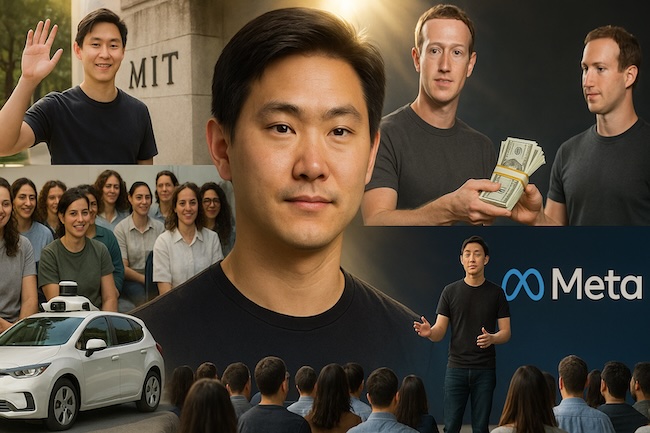
(Image by ChatGPT)
Alexandr Wang may have done the smartest and luckiest thing that a 19-year-old MIT dropout could have done in 2016: identified the tedious task of data-labeling as the essential bottleneck of the nascent AI industry and turned it into a business valued at $29 billion, sold half to Meta and became its new Chief AI Officer.

Alexandr Wang with Scale AI co-founder Lucy Guo participating in a Y Combinator podcast while still a CEO of Scale AI. (Y Combinator Video Frame)
While the brightest minds in Silicon Valley were chasing the glamorous algorithms of artificial intelligence, Wang bet on the unglamorous, manual, yet absolutely critical infrastructure. He put into practice the classic lesson of entrepreneurship: when there's a gold rush, sell picks and provisions instead of joining the rush for glitter.

His journey led him to one of the most high-profile corporate acquisitions and executive appointments in Silicon Valley history.
The Prodigy’s Pivot: MIT to Y Combinator
Alexandr Wang was born in 1997 in Los Alamos, New Mexico, the son of Chinese immigrant physicists who worked on weapons projects at the Los Alamos National Laboratory. This environment instilled in him an early and deep familiarity with large-scale, complex data and systems. By the age of 17, he was already working as a full-time software engineer at Quora, where he first encountered the scale of data moderation and classification problems faced by large tech platforms.
In 2016, Wang enrolled at the Massachusetts Institute of Technology (MIT) to study machine learning. However, his academic career was brief. After just one year, at age 19, he dropped out to co-found a company with Lucy Guo, a fellow Quora alum, and join the prestigious Y Combinator Summer 2016 batch. This decision mirrored the famous drop-out path of other tech giants, including Mark Zuckerberg himself.
The immediate problem they sought to solve was automating the vast amount of human labor needed to make sense of the digital world. The initial idea was an "API for human labor," a generalized outsourcing service. But the true genius lay in the pivot they executed during their time at Y Combinator.
The Unsexy Goldmine: Data Labeling and Scale AI
The central insight that launched Scale AI was this: Machine learning models are only as good as the data they are trained on. As self-driving cars, advanced language models, and sophisticated object recognition systems began to emerge, they all shared one massive, expensive dependency: large volumes of high-quality, human-labeled training data.
A self-driving car needs human annotators to draw bounding boxes around every pedestrian, street sign, and lane marker in millions of frames of video.
A language model needs human contractors to rank and score the quality of its generated responses (RLHF - Reinforcement Learning from Human Feedback).
A defense system needs analysts to segment and label satellite imagery to track assets and assess damage.
Wang recognized that this process was too slow, too costly, and too inconsistent for the world's most ambitious AI companies. Scale AI was founded to build the infrastructure to automate this process as much as possible, managing a network of human contractors—often called "clickworkers"—via its platform and blending that human labor with automated quality control and machine assistance.
This specialization immediately made Scale AI an indispensable piece of the global AI ecosystem.
Scale’s Meteoric Rise and the $29 Billion Valuation
Scale AI’s client list quickly grew to include virtually every major player in AI development:
Automakers: General Motors, Toyota, and various self-driving startups.
Big Tech: OpenAI, Google, Amazon, and, crucially, Meta.
Government & Defense: The U.S. Army, Air Force, and the Pentagon, providing crucial analysis for defense and intelligence purposes.
The company achieved "unicorn" status in 2019 after raising a $100 million Series C round. By 2021, a massive funding round valued the company at over $7 billion, solidifying Wang's status as the world's youngest self-made billionaire at the age of 24.
The company’s valuation continued to climb as the AI boom exploded, driven by the demand for large language models (LLMs) which required exponentially more human-in-the-loop data for alignment and evaluation.
By 2024, Scale AI was valued at nearly $14 billion, with Wang’s stake, estimated at around 15%, contributing to his net worth of approximately $3.6 billion. The growth affirmed his initial vision: the control point in the AI revolution was not just the models, but the data flowing into them.
The Meta Deal: A $14.3 Billion Bet on Superintelligence
The final, defining chapter of Wang's journey unfolded in June 2025. Mark Zuckerberg’s Meta Platforms—in a bold, strategic move to compete fiercely with OpenAI and Google DeepMind—announced a massive investment and partnership with Scale AI.
The Investment: Meta acquired a substantial 49% minority stake in Scale AI for an estimated $14.3 billion.
The Valuation: This transaction priced Scale AI at a staggering post-money valuation of nearly $29 billion.
The Executive Appointment: As the centerpiece of the deal, Alexandr Wang stepped down as CEO of Scale AI and was appointed Meta’s first-ever Chief AI Officer (CAIO), a newly created role.
Wang’s new mission is to lead the Meta Superintelligence Labs (MSL), unifying all of Meta’s AI research, product development, and infrastructure under one aggressive banner. Zuckerberg had made clear his intent to pursue Artificial Superintelligence (ASI)—AI systems designed to surpass human cognitive abilities—and he placed Wang, the infrastructure pioneer, at the helm of this multi-billion dollar effort.
This move was not just a massive financial transaction; it was an acknowledgment by one of the world's largest tech companies that the future of AI leadership belongs to those who understand how to build and scale the underlying engine of data infrastructure. Alexandr Wang, at the age of 28, has transitioned from being the founder of a critical component supplier to the chief architect of one of the most ambitious AI projects in history, proving that in the new age of technology, the most valuable assets are sometimes the ones no one else wanted to build.
© 2025 by Asian Media Group Inc.
Recent Articles
- Italy's Meloni Tells Trump to Focus on His Own Popularity as Row Continues
- Trump Unveils Gifted Qatari 747 As Addition to Air Force One Fleet
- A Warm World Cup Welcome Endears the US to Fans
- China's May Refined Oil Exports Rose from April, Australia Received Agreed Volume
- New Bangladesh Premier to Seek Investments, Jobs in China, Malaysia
- Charles Schwab Working with Cboe to Enter Prediction Market
- Mexico's Love Affair with All Things Korean — Until Thursday's Kickoff
- The Making of a Striking Tiger
- Japan's World Cup Prospects Brighter Than Their Single Group Point Might Suggest
- International Stars in the Red Devils' Lineup Suggests a Deep World Cup Run for S. Korea