

MediaRadio Free Asia Resumes Broadcasts into China with New Funding
By Reuters | 17 Feb, 2026
A bill passed earlier in February allows broadcasts to resume to oppressed minorities inside China after funding had been cut last year.
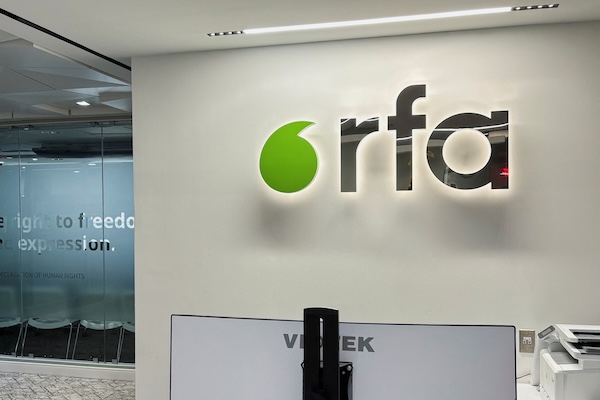
A logo of Radio Free Asia is displayed in its office, following the termination of funding for RFA, which broadcasts in nine Asian languages, a day after U.S. President Donald Trump signed an executive order gutting the government-funded media outlet's parent and six other federal agencies, in Washington, D.C., U.S. March 15, 2025. REUTERS/Staff
Radio Free Asia has resumed broadcasts to people in China, its CEO said on Tuesday, after Trump administration cuts last year largely forced the U.S.-funded outlet to cease operations.
RFA and its sister outlets, including Voice of America, for years had been financed with funding approved by the U.S. Congress and overseen by the U.S. Agency for Global Media, or USAGM.
Last year Kari Lake, a former news anchor appointed by President Donald Trump as acting CEO of USAGM, terminated their grants, alleging waste of taxpayer money and anti-Trump bias. Critics decried the move, which led to mass layoffs, as ceding ground to China and other U.S. adversaries.
"We are proud to have resumed broadcasting to audiences in China in Mandarin, Tibetan, and Uyghur, providing some of the world's only independent reporting on these regions in the local languages," RFA's president and CEO Bay Fang wrote in a post on LinkedIn.
She said the ability to restart the broadcasts was "due to private contracting with transmission services". She did not provide details, but added that rebuilding the network would require consistently receiving newly approved congressional funding.
A bipartisan spending bill that Trump signed into law earlier in February included $653 million for USAGM, which oversees RFA, VOA and other government-funded outlets.
That is down from the $867 million appropriated for the agency each of the past two years, but more than the $153 million Trump requested that Congress provide to shut down USAGM.
U.S. lawmakers of both major parties had said Trump's drive to dismantle the news outlets diminished Washington's clout globally at a time when Beijing is expanding its own sphere of influence.
A spokesperson for China's embassy in Washington declined to comment on what he said was U.S. domestic policy, but accused RFA of having an anti-China bias.
"Radio Free Asia has long spread falsehoods and smeared China, and they have a poor record when it comes to reporting on China-related issues," Chinese embassy spokesperson Liu Pengyu said. "We hope more media outlets in the U.S. can make objective and fair-minded reports on China and China-U.S. relations."
Chinese state media had praised last year's cuts.
Rights activists say that RFA has for decades shone light on abuses by China and other authoritarian countries, raising awareness about the plight of oppressed minorities such as China's Uyghur Muslims.
On Friday, RFA spokesperson Rohit Mahajan said the outlet had contracted with private companies to broadcast to audiences in Tibet, North Korea and Myanmar.
Mahajan said the outlet's Mandarin audio content currently is online only, with the aim to resume regular broadcasts over airwaves soon. Its Tibetan, Uyghur, Korean, and Burmese radio programming airs over short- and medium-wave frequencies. Previous satellite transmissions via USAGM have not resumed yet, he said.
(Reporting by Michael Martina and Patricia Zengerle; Editing by Don Durfee and Ethan Smith)
Recent Articles
- AI 'Chipflation' Spreading from Data Centers to Wider Economy
- Targeted Drugs Let More Live with Cancer
- GLP-1 Drugs May Have a Beneficial Effect Across Many Types of Cancer
- Trump Confirms He Called Netanyahu Crazy in Phone Call
- Macy's Raises Annual Forecasts as Luxury Focus Draws Affluent Shoppers
- US Service Sector Growth Picks up in May Despite Higher Prices for Inputs
- US Private Payrolls Rise Broadly in May
- The 4th Time May Be a Charm for the 'New' Keiko Fujimori
- Global Smartphone Market Faces Record Annual Decline as Chip Crunch Worsens
- Tata Taps Chery Technology for Avinya Premium EV Push