

Should AI Take Over Your Investment Portfolio?
By Wes Yamanoha | 08 Jul, 2026
YouTube founder Steve Chen and finance veteran Jack Fu put their bet on AI for their Draco Evolution ETF, but how well does AI actually do versus human investment managers?
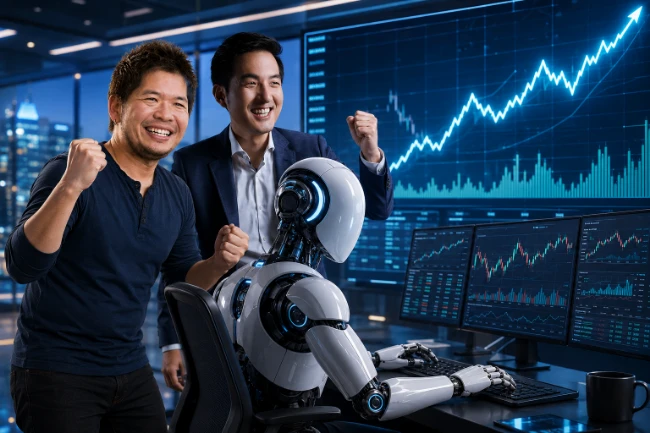
When Steve Chen rang the closing bell at the New York Stock Exchange in July 2024, it wasn't to celebrate a video platform or a social app. The YouTube co-founder was there to launch an exchange-traded fund — one whose buy and sell decisions are guided not by a star stock picker but by an artificial intelligence model.
The Draco Evolution AI ETF, ticker symbol DRAI, is the flagship product of Draco Evolution, the firm Chen built with financial-industry veteran Jack Fu. And it is just one visible marker of a much larger shift: across Wall Street and Main Street alike, algorithms are increasingly deciding what gets bought, what gets sold, and when.
From YouTube to Wall Street
The Draco story begins, improbably, in Taiwan. Chen, who spent two decades in Silicon Valley at PayPal, YouTube, and Google before turning to angel investing, moved his family to Taipei in 2019 for what was supposed to be a short stay. The pandemic extended it indefinitely, and it was there that he met Fu, a former financial advisor whose worldview had been forged in the wreckage of the 2008 financial crisis. Fu had watched everyday clients lose half their wealth almost overnight and concluded that the investment products of the era simply weren't built to protect people in downturns. After managing more than $1.8 billion in multi-asset portfolios as a managing director at All Sun Group, he partnered with Chen to found what became Draco Capital Partners, later Draco Evolution — with Fu as CEO and Chen as chief technology officer.
The pairing is deliberate: Fu brings the quantitative-finance pedigree, Chen the experience of scaling consumer technology. Together with a team of economists and engineers, they developed low-volatility AI investment strategies, first for a private hedge fund serving high-net-worth clients and institutions, and eventually — after managing more than $220 million — for the retail public through the NYSE-listed DRAI ETF.
What makes DRAI notable is that the AI isn't a marketing garnish; it is the portfolio manager's brain. The fund runs on what the firm calls the Draco Model, a combination of a machine-learning system trained on historical pricing data and technical indicators — moving averages, average true range, momentum — and a macroeconomic quantitative model that digests signals like building permits, money supply, consumer expectations, and factory orders. The model makes short-term regime predictions, essentially forecasting whether the next seven to ten days look bullish or bearish, and allocates across 10 to 20 underlying ETFs spanning stocks, bonds, gold, and currencies accordingly. Fu likes to compare it to an automatic transmission: when the road is smooth, the car accelerates; when conditions get rough, it downshifts, moving a sleeve of the portfolio into defensive or even short positions to keep drawdowns manageable. Notably, humans remain in the loop — the AI generates the market view, and the team shapes the fund's response.
Wall Street's Quiet Machine Takeover
Draco may be the marquee example of a founder-celebrity-backed AI fund, but the broader institutional world got there first — and is going all in. Quantitative firms like Renaissance Technologies have used machine learning for decades; its famed Medallion Fund reportedly averaged 66% gross annual returns from 1988 to 2018. What's changed is the breadth of adoption. JPMorgan's technology budget reached $18 billion in 2025, with roughly $2 billion earmarked specifically for AI. Goldman Sachs has reported AI adoption across 90% of the firm. Bridgewater Associates launched a $2 billion fund in 2024 in which machine learning drives the investment process. And an estimated 78% of hedge funds now integrate "alternative data" — satellite images of parking lots, job postings, executive vocal-tone analysis from earnings calls — that only machines can process at scale.
Generative AI has added a new layer. Academic researchers studying 633 hedge funds from 2016 to 2023 found that funds whose trades aligned with ChatGPT's analysis of earnings-call transcripts earned 3% to 5% higher annual returns than peers, with roughly 19% of funds showing significant alignment with AI-generated signals by late 2022. The signal is clear enough that the parent company of the NYSE has begun packaging Reddit forum data into products that help hedge funds train trading algorithms on retail sentiment. On today's Wall Street, the question is no longer whether firms use AI, but how far they let it off the leash.
The Retail AI Revolution
Individual investors are catching up fast — and often with far blunter instruments. A 2026 Investing.com survey of nearly 1,000 U.S. retail investors found that 62% already use AI tools to inform investment decisions, with about a quarter using them regularly. Among those experimenting, general-purpose chatbots like ChatGPT are the most popular gateway, used by more than half of AI-curious investors for research. An earlier eToro survey found 13% of retail investors were already leaning on chatbots for actual stock picks, with nearly half open to the idea. That appetite is fueling explosive growth in the robo-advisory market, projected to swell from roughly $62 billion to nearly $471 billion by 2029.
The use cases range from the sensible to the hair-raising. At the conservative end, investors use AI to summarize 10-K filings, flag accounting red flags, and stress-test portfolios against recession scenarios — tasks that once required a $24,000-a-year Bloomberg Terminal and now cost less than a streaming subscription. At the aggressive end, some investors simply ask a chatbot what to buy and follow orders. Startups have leaned into the spectacle: fintech firm Rallies AI has handed prominent AI models real trading capital to run their own live mini hedge funds as a public experiment.
Investors themselves seem clear-eyed about the risks. In the Investing.com survey, 39% worried about incorrect or misleading AI recommendations, and 24% worried about market herding if everyone trades on the same signals. Only 8% had no concerns at all. Tellingly, while 65% of AI users said the tools had improved their market performance, most respondents said they still verify AI-generated insights against other sources before acting — a sign that even enthusiastic adopters aren't yet ready to hand over the keys entirely.
Who's winning — Man or Machine?
Here is where the story gets complicated, because the honest answer is: it depends on which machines, which humans, and which years you measure.
The bear case for AI comes from the longest-running experiment. The AI Powered Equity ETF (AIEQ), launched in 2017 using IBM's Watson to pick stocks, has been a humbling proof of concept — trailing the S&P 500 for most of its existence and delivering roughly half the cumulative return of a plain index fund over comparable periods, with higher volatility and a lower Sharpe ratio to boot. Other AI-driven funds have posted similarly uninspiring records, and researchers have documented that ChatGPT's stock-picking edge decays as more people use it — one analysis found its Sharpe ratio falling from 6.54 to 1.22 as adoption spread, a classic case of a crowded trade eating its own alpha.
But the bear case for humans is arguably worse. S&P's SPIVA scorecard for mid-2025 found that only about 14% of actively managed U.S. large-cap funds beat the S&P 500 over a ten-year window, and just a third of active strategies outperformed their benchmarks in the twelve months through June 2025 — precisely the kind of volatile, headline-driven period when human judgment was supposed to shine. Individual investors fare worse still: Dalbar's 2025 behavior study found the average equity fund investor earned 8.5 percentage points less than the S&P 500 in 2024, largely due to emotional, badly timed trading. Removing the human, in other words, removes the panic-selling.
And then there's Draco, whose early numbers land firmly in the AI-optimist column. DRAI returned 33.7% in 2025 against a 9.6% average for its conservative-allocation category, and posted trailing one-year returns in the mid-30s into 2026 — remarkable for a fund explicitly designed to prioritize downside protection over moonshots. The caveats are real: the fund is tiny, with just over $20 million in assets, carries a hefty 1.34% expense ratio, and has less than two years of live history. As Fu himself is quick to say, past results guarantee nothing. But as an existence proof that a machine-driven, risk-managed strategy can trounce its human-managed peer group, it's a compelling data point.
What "Taking Over" Actually Look Like
The most likely future isn't a hostile takeover; it's a merger. Even at Draco, the AI doesn't trade autonomously — it produces a market view that humans translate into portfolio decisions. Most funds marketing themselves as "AI-powered" use machine learning as a research engine while a human portfolio manager retains final discretion. The genuinely autonomous funds, where the model's daily rankings directly dictate every position, remain the radical fringe, and their track record is still being written.
For individual investors, the practical takeaway is similar. AI has demolished the information advantage that institutions held for decades — the filings analysis, the scenario modeling, the earnings-call parsing are now available to anyone. But the same tools that crunch data brilliantly in bull markets can misread unprecedented conditions, hallucinate figures, and herd their users into identical trades. The investors doing this well treat AI as a tireless analyst, not an oracle: they let the machine do the reading and keep the judgment — and the accountability — for themselves.
So is AI taking over your portfolio? If you own an index fund, a robo-advised account, or shares of something like DRAI, in a meaningful sense it already has. The better question is whether there's still a human somewhere in the loop who knows what the machine is doing — and, on the evidence so far, the portfolios that keep one tend to be glad they did.
© 2026 by Asian Media Group Inc.
Recent Articles
- Global M&A Activity on Track to Eclipse 2021 Deal Boom
- Rising Leverage Raises Funding Pressure in US Markets
- Asian Nations Seek to Build Stabilizing Alternatives to Aligning with US or China
- China Aims to Raise EV Share to 30% by 2030
- SpaceX and AI Startup Wealth Fuels Demand for Private Jets
- China Plans to Let Top AI Firms Buy Limited Nvidia H200 Chips
- Meta's AI Chip Finally Set to Go into Production in September
- Iran Becomes Tar Baby for Br'er Donald
- China's Producer Inflation Near 4-Year High in June, Squeezing Manufacturers
- SK Hynix US Listing Oversubscribed Over 7-Fold