

The Greatest Divider Has Fractured American Democracy for Decades to Come
By Tom Kagy | 30 Dec, 2025
Donald Trump's political tactic has been to destroy trust in the institutions that once made the United States the world's most stable democracy.
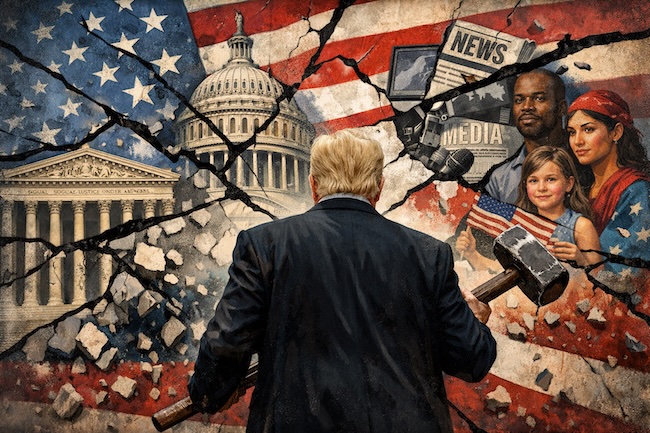
Donald Trump will be remembered as the greatest divider in US history, a President who made it clear that he was governing for one distinctive group of Americans— white Christians born and bred and in the US.
While Trump didn’t invent divisiveness in American politics, he deliberately, relentlessly, and with remarkable success turned division into the point of every one of executive orders. They weren't merely the unavoidable side effect of hard choices or clashing values, but the objective. His constant goal was never to persuade a majority of Americans but to convince a large minority that only Trump and his MAGA movement could be trusted at all.
The damage inflicted by this era of political vandalism will linger long after Trump exits the stage.
For most of American history, politics rested on a few shared assumptions. Elections were real even when you lost. Courts might be wrong, but they weren’t fake. Journalists could be biased, but they weren’t enemies. Government officials were sometimes corrupt, but the system itself wasn’t a con. These beliefs didn’t require everyone to agree—only that enough people accepted the basic rules to keep the whole thing standing.
Trump went after those rules directly.
If he lost, the election was rigged. If courts ruled against him, judges were hacks. If journalists reported uncomfortable facts, they were liars. If civil servants followed the law instead of his wishes, they were traitors in a “deep state.” Over time, this drumbeat did something powerful: it trained millions of Americans to see democracy not as a shared project, but as a hostile system imposed on them by enemies.
That’s not polarization as we used to know it. That’s delegitimization.
The genius—and the danger—of Trump’s approach is that it doesn’t require governing well. You don’t need policy success if failure can always be blamed on sabotage. You don’t need evidence if loyalty matters more than truth. You don’t even need consistency, because contradiction itself becomes proof that “they” are trying to confuse you. In this worldview, chaos isn’t a problem. It’s confirmation.
Once people internalize that mindset, it doesn’t go away just because a presidency ends.
Trump’s supporters didn’t simply come to dislike Democrats. Plenty of Americans have disliked the opposing party before. They came to believe that Democrats, along with judges, journalists, scientists, and career officials, were illegitimate actors. That belief hardens fast and dissolves slowly. When politics becomes existential—when every election is framed as the last real one—compromise starts to look like surrender and restraint starts to look like weakness.
That’s how democratic erosion works in real life. Not with tanks in the streets, but with voters who no longer accept losing as a valid outcome.
The damage doesn’t stop at government. It spills into families, workplaces, churches, and communities. When political identity becomes a moral identity, disagreement feels personal. You’re not just wrong—you’re dangerous. That kind of thinking fractures social trust, and social trust is the glue that holds democratic societies together when institutions are under strain.
And here’s the part that should worry even people who like Trump’s policies: this strategy is contagious.
Trump proved that you can gain power by attacking the referees instead of playing the game. He showed that outrage beats explanation, that insults travel faster than ideas, and that delegitimizing the system can be more effective than working within it. Future politicians don’t need Trump’s personality to copy his method. They just need the incentives—and those incentives are now baked into the political ecosystem.
Media outlets chase conflict because conflict pays. Social platforms reward extremity because extremity drives engagement. Politicians learn quickly what gets attention and what gets punished. In that environment, calm governance looks boring, while escalation looks strong. Trump didn’t create this dynamic, but he leaned into it harder than anyone before him and normalized it at the highest level.
The most tragic part is that American democracy was unusually resilient before this moment. Not perfect, not fair to everyone, but stable. The U.S. survived wars, depressions, assassinations, and scandals because enough people believed the system was worth preserving even when it disappointed them. Trump’s great achievement—if that’s the word—is convincing a large slice of the country that preservation itself is the problem.
Once trust is gone, everything gets harder. Public health becomes partisan. Economic data becomes suspect. Courts lose authority. Elections require ever more forceful defenses just to be accepted as real. The system can keep functioning, but it does so under constant stress, like a bridge with cracked supports that still carries traffic—until one day it doesn’t.
Calling Trump “the Great Divider” isn’t an insult. It’s a description. Division wasn’t collateral damage; it was the engine. And engines, once built, don’t disappear when the driver steps away.
American democracy will survive this period. But it will be more brittle, more suspicious, and more vulnerable than it was before. That’s the lasting fracture Trump leaves behind—not a single broken norm, but a country trained to doubt the very idea that shared rules can still bind us together.
© 2025 by Asian Media Group Inc.
Recent Articles
- Samurai Blue Sweep Aside Tunisia, Japan Fans Sweep Monterrey Stadium
- Lebanon Fighting Threatens Switzerland Negotiations
- Danone-Chobani Yoghurt Protein War Underscores GLP-1 Impact
- Italy's Meloni Tells Trump to Focus on His Own Popularity as Row Continues
- Trump Unveils Gifted Qatari 747 As Addition to Air Force One Fleet
- A Warm World Cup Welcome Endears the US to Fans
- China's May Refined Oil Exports Rose from April, Australia Received Agreed Volume
- New Bangladesh Premier to Seek Investments, Jobs in China, Malaysia
- Charles Schwab Working with Cboe to Enter Prediction Market
- Mexico's Love Affair with All Things Korean — Until Thursday's Kickoff