

The Poetry and Wisdom Baked into Chinese Characters
By H Y Nahm | 12 Apr, 2026
Here are a dozen examples of how Chinese words are packed with startling insights about human nature—and beautiful imagery.
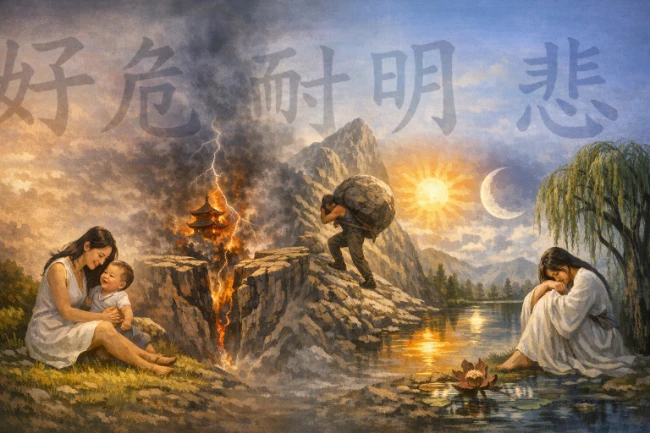
(Image by Copilot)
There's something enchanting about Chinese characters. Unlike alphabetic languages, where letters are just arbitrary sound-markers, Chinese characters are often built from smaller pictographic components — radicals — that carry their own meaning.
Stack them together and you don't just get a word; you get a tiny philosophical argument. A poem compressed into a single brushstroke. Once you start seeing the logic hidden inside these characters, you can't unsee it, and you'll never look at the language the same way again.
Here are twelve characters that pack more human wisdom into a few strokes than most self-help books manage in three hundred pages.
1. 危机 (Wēijī) — Crisis
Let's start with the big one, the character combination that motivates a thousand motivational posters. 危机 is made up of two characters: 危 (wēi), meaning *danger*, and 机 (jī), meaning *opportunity* or *critical moment*. Yes, the Chinese word for crisis literally contains the idea of opportunity. Now, linguists will be quick to point out that this pairing is more nuanced than the "danger + opportunity = crisis" soundbite that JFK popularized. But the philosophical implication still holds — in Chinese thought, a crisis is never purely one thing. It's a turning point, a hinge moment. Danger and possibility arrive together. That's not just a pretty idea; it's a survival strategy.
2. 忍 (Rěn) — Endurance
Look closely at this character and you'll see a knife blade (刃) sitting directly over a heart (心). That's the Chinese character for endurance, patience, or the ability to bear suffering. It's not exactly subtle, is it? To endure is to have a blade pressing down on your heart and choose to keep going anyway. There's no sugarcoating here, no toxic positivity. Just an honest acknowledgment that patience is painful — and the decision to carry it anyway is what separates resilience from mere wishing.
3. 明 (Míng) — Bright, Enlightened
This one's a beauty. 明 combines the sun (日) and the moon (月) side by side. Together, the two greatest sources of natural light create the character for brightness, clarity, and enlightenment. It's a gorgeous piece of visual logic — if you want to describe the most illuminated state possible, you invoke both luminaries at once. It's also used in the word for "tomorrow" (明天), which carries its own quiet optimism: tomorrow is the bright day, the illuminated one still ahead.
4. 家 (Jiā) — Home, Family
Here's one that'll warm your heart a little. 家 shows a pig (豕) under a roof (宀). In ancient agrarian China, having a pig sheltered under your roof was the very definition of a prosperous household. It meant you had livestock, which meant food, which meant security. Home wasn't an abstract concept — it was concrete, sensory, rooted in survival. Today 家 means home, family, and household all at once, and it still carries that ancient warmth: shelter, sustenance, and the people you share them with.
5. 休 (Xiū) — Rest
This one might be the most visually straightforward on the list, and yet it's deeply wise. 休 shows a person (人) leaning against a tree (木). That's rest. Not elaborate, not complicated — just a human being stopping for a moment and leaning on something solid and natural. In a culture that has long prized diligence and hard work, this character is a quiet reminder that rest isn't laziness. It's a person finding their tree.
6. 愁 (Chóu) — Sorrow, Melancholy
Autumn (秋) over the heart (心). That's all it takes to write sorrow in Chinese. There's a whole season of melancholy baked into this character — the falling leaves, the shortening days, the feeling that something golden is passing away. East Asian poetry has always had a special relationship with autumn as an emotional register, and this character proves it goes all the way down to the root of the language itself. Your sadness, according to Chinese, has the texture of a season.
7. 安 (Ān) — Peace, Calm
安 shows a woman (女) under a roof (宀). Peace is a woman sheltered. While modern readers might read gender politics into this (fairly), the historical interpretation is more about the idea of protection, sanctuary, and the safety of the domestic sphere. A home where a woman is safe is a home that is peaceful. It's one of those characters that holds both its ancient context and its continued emotional truth in productive tension.
8. 森 (Sēn) — Forest
Three trees (木木木). That's it. One tree is 木, two trees is 林 (a grove or woods), and three trees is 森 — a forest. There's something almost child-like in its directness, and yet it's also mathematically elegant. The Chinese didn't just name the forest; they built it, character by character. More trees, more forest. It scales. It grows. It's logical in a way that feels almost like a law of nature.
9. 泪 (Lèi) — Tears
水 (water) next to 目 (eye). Tears are literally eye-water. There's zero sentimentality in this construction — it's almost clinical in its precision — and yet somehow that directness makes it more moving, not less. There's something vulnerable about a language that looks you in the eye and says: tears are just water from your eyes. And that's enough. That's everything.
10. 好 (Hǎo) — Good
A woman (女) next to a child (子). That combination, in classical Chinese thought, was the image of goodness itself — a mother with her child, the most natural and nurturing of bonds. It's tender and immediate. Goodness isn't an abstract moral category here; it's relational, embodied, specific. It looks like someone holding someone they love.
11. 闲 (Xián) — Leisure, Idleness
Moonlight (月) coming through a gate or between trees (木). Leisure, in the Chinese imagination, is the experience of moonlight filtering through — quiet, silvery, unhurried. It's one of the most poetic characters in common use, and it reframes idleness not as laziness but as a kind of attentiveness. You're not doing nothing; you're watching the moonlight move.
12. 道 (Dào) — The Way
We end with perhaps the most profound character of all: 道, the philosophical concept at the heart of Taoism. It combines the radical for movement or walking (辶) with the character for head (首) — implying a person who leads, or heads, their way through the world. The Way isn't a destination; it's a manner of moving. It's the path and the walking of it simultaneously. Every spiritual tradition has its version of this idea, but few have compressed it into a single, elegant, four-stroke character quite like this.
What makes Chinese characters so entrancing is that they don't just name the world — they interpret it. They carry the fingerprints of the people who invented them: what they feared, what they treasured, what helped them rest, grieve, and keep going. They go beneath language to human experience and life itself.
© 2026 by Asian Media Group Inc.
Recent Articles
- Intel Turns to Next-Gen ASML Tool to Help Make Its Laptop Chips
- Cambodian Gaming Tycoon Was Landlord to Chinese Scam Compound
- China New Home Price Slide Slows, but Recovery Doubtful
- Iran Threatens to Block More Vital Seaways as Trump Orders Renewed Iran Blockade
- ASML Beats Q2 Revenue Estimates on AI Chip Demand
- The Survivor Champion Who Changed AAPI Representation
- Nvidia Has Begun Shipping H200 AI Chips to China
- IBM Warns AI Boom Is Squeezing Software Budgets; Sending Shares Down
- Two Utah National Monuments Fall to Trump Anti-Green Drive
- 72% of Americans Disagree with Trump on Refugees