

The US Owes a Strategic Future Tech Industry to Asian Immigrants
By Goldsea Staff | 30 Dec, 2025
Synthetic Biology, the most transformative of future industries, was built from the ground up by immigrant innovations.
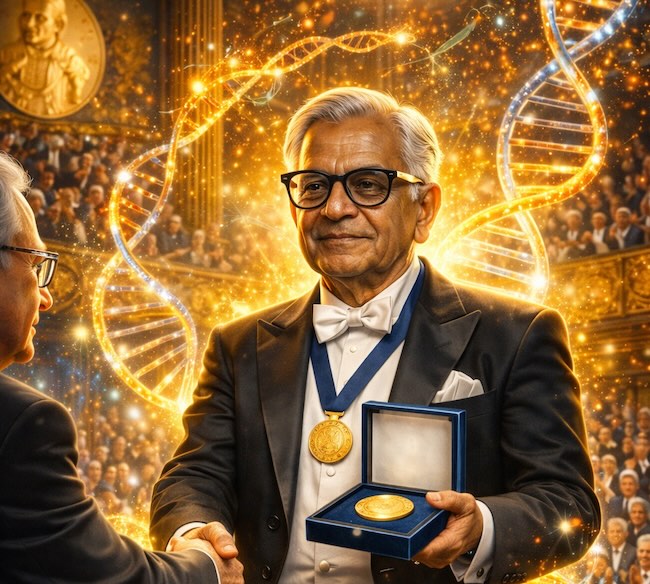
Har Gobind Khorana won the 1968 Nobel Prize in Medicine. (Image by ChatGPT)
As of 2025 the United States stands as the undisputed leader of synthetic biology (SynBio), an industrial sector now valued in the hundreds of billions of dollars and already becoming the engine of progress for everything from pharmaceuticals to personalized medicine to renewable manufacturing to next-generation data storage.

Immigrants (left to right) Har Gobind Khorana, Feng Zhang and Roger Tsien laid the foundation for the synthetic biology industry.
The foundations, the tools, and the commercial engines of American synthetic biology aren't homegrown. They were built by the immigrant talent that has converged on the US.
From the first chemical synthesis of a gene to the high-precision "search-and-replace" of the CRISPR era, the history of synthetic biology is a map of global migration. Without the influx of international minds, the US would likely be a secondary player in a field that is quickly becoming the most important strategic industry of the 21st century.
The Foundation: Har Gobind Khorana and the First Synthetic Gene
The story of American dominance begins not with a Silicon Valley startup, but with a chemist born in a small village in Punjab, British India. Har Gobind Khorana’s journey to the United States via the United Kingdom and Canada is perhaps the most significant "brain gain" event in the history of genetics.
In the 1960s, while at the University of Wisconsin-Madison, Khorana did what was then considered impossible: he helped crack the genetic code. By synthesizing nucleic acids with specific, known sequences, he demonstrated exactly how the sequence of DNA bases translates into the proteins that build life. This work earned him the Nobel Prize in Medicine in 1968.
But his greatest contribution to synthetic biology was yet to come.
In 1972, after moving to MIT, Khorana and his team achieved the first total synthesis of a functional gene—a copy of a yeast gene. This was the birth of "writing" DNA. Before Khorana, biology was a descriptive science of observation. After Khorana, it became an engineering discipline. He proved that human beings could chemically construct the software of life from scratch. That a researcher born in rural India chose an American university to perform this world-changing work set the precedent for the next fifty years of US scientific policy.
The Toolmakers: CRISPR and the Asian American Vanguard
If Khorana taught us how to write a gene, the next generation of immigrant scientists gave us the word processor to edit the entire genome. No technology has accelerated synthetic biology more than CRISPR-Cas9, and no figure has been more central to its American implementation than Feng Zhang.
Born in China and moving to Iowa as a child, Zhang embodies the "1.5 generation" immigrant success story. At the Broad Institute Zhang’s lab was the first to successfully adapt the CRISPR system—originally a bacterial defense mechanism—for use in mammalian cells. This was the Big Bang for synthetic DNA advances. It moved gene editing from a niche, expensive experimental process to a programmable, democratic tool that today any high school lab can use.
Zhang’s work isn't an outlier; it's the norm. The tools that allow us to see what we're editing were also pioneered by immigrants. Roger Tsien, a Chinese-American and 2008 Nobel laureate in chemistry, spent his career at UC San Diego engineering the Green Fluorescent Protein (GFP).
By synthesizing variants of this protein, Tsien allowed scientists to literally light up the inner workings of a cell. Every time a synthetic biologist today confirms that their custom genetic circuit is working because a cell glows green or red, they're using the immigrant-designed toolkit of Roger Tsien.
The Economic Engine: Immigrant Founders and the Biotech Unicorn
The impact of immigrants extends far beyond the academic bench. In 2025 the commercialization of synthetic biology is the primary driver of biotech venture capital, and the statistics are staggering. Research from the National Foundation for American Policy indicates that over 55% of America’s unicorn startups—those valued at over $1 billion—were founded by at least one immigrant. In the specific sector of biotechnology and synthetic biology, that number is often even higher.
Take Ginkgo Bioworks, the AWS of Synthetic Biology. While founded by a team of MIT researchers, the company's culture and workforce are deeply rooted in the global academic pipeline. Or consider the sequencing giant Pacific Biosciences, built on the inventions of Jonas Korlach who immigrated from Germany. Korlach’s invention of Single Molecule, Real-Time (SMRT) sequencing allowed for the long "reads" of DNA essential for assembling the complex synthetic genomes being designed today.
The economic reality is that immigrants don't just fill jobs in synthetic biology; they create them. An immigrant-founded unicorn employs an average of 1,200 people, the vast majority of whom are American-born citizens. By providing the vision and the technical risk-taking necessary to launch a SynBio firm, immigrant entrepreneurs have effectively built an industrial base that the US government now considers critical to national security.
The Research Backbone: The PhD and Postdoc Pipeline
While Nobel laureates and billionaire founders make the headlines, the day-to-day "muscle" of American synthetic biology is powered by an international army of PhD students and postdoctoral researchers. As of 2025 foreign-born students make up more than 50% of the doctoral candidates in US STEM programs. In highly specialized fields like protein engineering and metabolic modeling, the reliance on international talent is near-total.
These researchers are the ones staying in the lab until 2 AM to troubleshoot a failed DNA assembly or to optimize a microbial fermentation process. This brain circulation is America’s greatest competitive advantage. When a brilliant student from India, South Korea, or Brazil comes to a US university to study synthetic biology, they bring with them a unique cultural perspective on problem-solving. This cognitive diversity is the secret sauce of innovation.
The National Bureau of Economic Research has found that immigrant scientists patent at a significantly higher rate than their native-born counterparts. In the high-stakes world of intellectual property that defines synthetic biology, this patent output is what keeps the US ahead of global rivals.
The Geopolitical Risk of a Closed Door
Despite this track record, America’s leadership is fragile. The 2020s have seen increased global competition for this exact pool of talent. Nations like China have launched aggressive programs, like the Thousand Talents initiative, specifically designed to lure back the Chinese-born scientists who have built the American SynBio infrastructure.
If the US makes it more difficult for international students to get visas or for researchers to secure green cards, the brain gain will turn into a brain drain. We are already seeing the early signs: in 2024 and 2025, an increasing number of international PhDs have opted to take their talents to the European Union or back to their home countries where research funding is rising and immigration barriers are lower.
Losing this talent isn't just an academic or economic concern but a national security risk. Synthetic biology is the dual-use technology of the future. It will be used to create the next generation of biodefense sensors and the next generation of life-saving medicines. If the U.S. cedes its leadership in writing DNA because it stopped welcoming the world's best writers, it will be a self-inflicted wound that won't be easily healed.
Recommitting to the Global Laboratory
America’s position at the forefront of synthetic biology is a historical accident of geography and a more inviting immigration policy and a wide-open economic system. We were the country that welcomed Khorana when he couldn't find a job in India. We were the country that gave Zhang the resources to turn a bacterial defense system into a global editing tool. We are the country where an immigrant with a test tube and a dream can raise $50 million in venture capital to engineer a new form of life.
To maintain this leadership the US must recognize that its scientific superpower status is a borrowed one that can be lost. It was borrowed from the educational systems of other nations and the ambition of people born elsewhere. By ensuring that the US remains the world's most welcoming laboratory, we aren't just helping immigrants; we're securing the future of American innovation. Synthetic biology is the most powerful tool ever discovered for solving humanity's biggest challenges: disease, climate change and food scarcity. It's a tool that belongs to all of humanity but was largely forged in America by the hands of immigrants.
Recent Articles
- GoldSea Votes: Tran to Face a Viet Candidate for All-Asian Congressional Race
- US Manufacturing Surge in April Based Entirely on Soaring Aircraft Orders
- AI 'Chipflation' Spreading from Data Centers to Wider Economy
- Targeted Drugs Let More Live with Cancer
- GLP-1 Drugs May Have a Beneficial Effect Across Many Types of Cancer
- Trump Confirms He Called Netanyahu Crazy in Phone Call
- Macy's Raises Annual Forecasts as Luxury Focus Draws Affluent Shoppers
- US Service Sector Growth Picks up in May Despite Higher Prices for Inputs
- US Private Payrolls Rise Broadly in May
- The 4th Time May Be a Charm for the 'New' Keiko Fujimori