

This Man Wants to Put a Nuclear Reactor in Your Backyard
By Goldsea Staff | 14 Jan, 2026
Yasir Arafat's Aalo microreactor may solve the world's energy problems while preserving a green and safe planet.
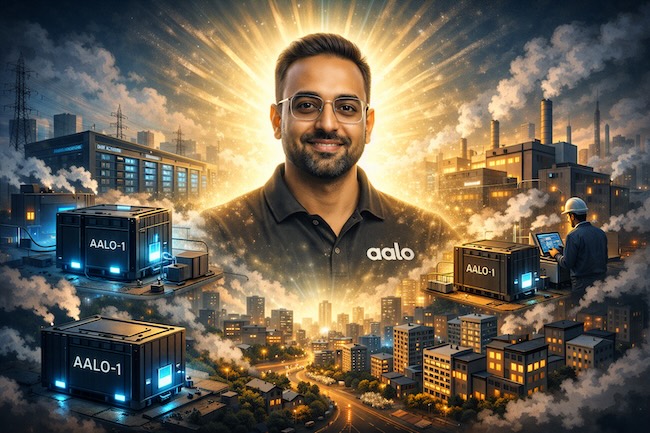
(Image by ChatGPT)
The name Yasir Arafat conjures up images of the kaffiyeh-clad Nobel laureate and former Palestinian leader. But in the tech world in Austin and Silicon Valley, Yasir Arafat is a Pakistani-Canadian engineer, a former Apple veteran, and the founder of Aalo Atomics.

Aalo Atomics' Austin headquarters. (Aalo Atomics Photo)
He believes that solving climate change doesn't lie in massive, multi-billion-dollar concrete monoliths, but in something far smaller, more intimate, and surprisingly ubiquitous. He wants to put a nuclear reactor in your "backyard"—or, more accurately, in the industrial parks, data centers, and neighborhoods of our modern world.

Aalo projects 50-megawatt pods comprising 5 10-megawatt microreactors mated with a turbine to power a large data center, a factory or a small town. (Aalo Atomics Photo)
From Karachi to Cupertino
Born and raised in Karachi, Pakistan, Arafat grew up in a world where energy was neither cheap nor reliable. The frequent blackouts gave him a deep understanding of what happens when a society runs short on power.
He moved to Canada for his education, enrolling at the University of Waterloo where Arafat excelled in mechanical engineering. What set him apart was his ability to see the "system within the machine".
This knack led him to Apple, the world’s most iconic product company. During his tenure at Apple, Arafat worked within the Special Projects Group—the secretive "black box" where the company’s most ambitious future technologies are birthed. He was instrumental in thermal management, the science of keeping electronics from melting down. Whether it was the thermal architecture of high-end MacBooks or the intricate cooling required for Apple’s custom silicon, Arafat learned a key lesson of modern technology: if you can’t manage heat, you can’t manage progress.
After years of refining consumer electronics, Arafat felt a pull toward a more fundamental challenge. While his peers were focused on the next iteration of the smartphone, he became obsessed with energy density. He understood that solar and wind were essential, but lacked the energy density to sustain a the immense energy needs of AI and global industrialization.
Philosophy of the "Potato"
In 2023 Arafat founded Aalo Atomics. The name "Aalo" is the Urdu word for "potato." The choice reflects Arafat’s dry wit and his radical vision for nuclear energy.
"A potato is humble," he has often remarked in interviews. "It’s versatile, it’s found everywhere, and it’s a staple."
He wanted to take nuclear power—a technology often viewed as "divine" and terrifying—and make it as common and reliable as a potato.
Arafat’s core insight went beyond physics to manufacturing. The nuclear industry had fallen into a "bespoke trap", to his thinking. Every traditional nuclear plant is a unique, massive construction project that takes a decade to build and billions in overruns. Arafat wanted to apply the Apple philosophy to reactors. He wanted to build a product, not a project.
This vision produced the Aalo-1, a microreactor designed to be factory-built, shipped on the back of a standard truck, and installed in weeks rather than years. By moving the construction from a muddy field to a precision-controlled factory floor, Arafat wanted to slash costs and ensure a level of quality control beyond that of traditional nuclear construction.
Sodium, Not Water
To achieve this Arafat moved away from the conventional light-water reactors found all over the world, with their massive pressure vessels and complex cooling systems because water turns into steam at high temperatures. Instead, Aalo utilizes a sodium-cooled fast reactor design.
Sodium has a much higher boiling point than water, which means the reactor can operate at atmospheric pressure. This eliminates the risk of the "pressure cookers" scenarios that haunt the public imagination. Furthermore, Aalo’s design uses a specialized Uranium-Zirconium (U-Zr) fuel. This metallic fuel is inherently safe; if the reactor begins to overheat, the fuel naturally expands, slowing down the nuclear reaction without the need for human intervention or electronic sensors. It is "walk-away safe" technology.
A Reactor in the Backyard
When Arafat speaks of putting a reactor in "everyone's backyard," he is advocating for a decentralized energy grid. Currently, our electricity travels hundreds of miles from giant power plants over vulnerable wires. Arafat envisions a world where a 10-megawatt Aalo-1 unit sits behind a shopping mall, a hospital, or a Bitcoin mining farm.
This "backyard" approach solves the two biggest headaches of the green energy transition: transmission and intermittency. Solar panels only work when the sun shines, and wind turbines only spin when the air moves. Batteries can help, but they are expensive and resource-intensive. An Aalo reactor, however, provides a steady, "baseload" hum of carbon-free power 24 hours a day, 365 days a year. Because these units are small—roughly the size of a few shipping containers—they can be tucked away in existing industrial zones, effectively making "the grid" local again.
Green Renaissance
Arafat is a staunch environmentalist who believes the path to "Net Zero" is impossible without a massive expansion of nuclear energy. He points out that a single gummy-bear-sized pellet of nuclear fuel contains as much energy as a ton of coal or 149 gallons of oil, with zero carbon emissions.
For Arafat, the "green" aspect also extends to the land footprint. A solar farm requires thousands of acres to produce the same amount of power that an Aalo reactor can produce on a fraction of a single acre. By shrinking the footprint of our energy production, we can return more land to nature.
The "safe" part of the equation remains the biggest hurdle. Public perception of nuclear is still clouded by the shadows of the 20th century. Arafat approaches this not with dismissiveness, but with the transparency of a product designer. He invites critics to look at the physics.
By using low-pressure sodium and inherently safe fuel, he argues that the Aalo-1 is fundamentally different from the reactors of the past. It is not a bomb waiting to go off; it is a battery that generates its own heat.
The Road Ahead
As of early 2026 Aalo Atomics has made significant strides. They have secured a site at the Idaho National Laboratory for their first experimental deployment of the Aalo-X experimental reactor, and have signed memorandums of understanding with several municipalities interested in localizing their power supply.
The Nuclear Regulatory Commission (NRC) remains a formidable gatekeeper, but Arafat’s team is working through a "new school" regulatory pathway designed for small modular reactors.
Arafat is often seen in the Aalo lab, wearing a simple polo shirt, looking more like the engineer he is than the founder of a company that could change the world. He isn't interested in the "cult of personality" that often follows tech founders. He is interested in the math, the heat transfer, and the "potato-ification" of the most powerful force in the universe.
The world is watching. If Arafat succeeds, the sight of a small, quiet, silver-hued structure at the edge of town might become as common as a cell tower. It would mean a world of energy abundance, where the cost of power drops so low that we can desalinate ocean water for pennies, remove carbon from the atmosphere, and power the next generation of AI without burning a single lump of coal.
Recent Articles
- GoldSea Votes: Tran to Face a Viet Candidate for All-Asian Congressional Race
- US Manufacturing Surge in April Based Entirely on Soaring Aircraft Orders
- AI 'Chipflation' Spreading from Data Centers to Wider Economy
- Targeted Drugs Let More Live with Cancer
- GLP-1 Drugs May Have a Beneficial Effect Across Many Types of Cancer
- Trump Confirms He Called Netanyahu Crazy in Phone Call
- Macy's Raises Annual Forecasts as Luxury Focus Draws Affluent Shoppers
- US Service Sector Growth Picks up in May Despite Higher Prices for Inputs
- US Private Payrolls Rise Broadly in May
- The 4th Time May Be a Charm for the 'New' Keiko Fujimori