

MediaTrump's Temporary 10% Global Tariffs Under Fire at US Trade Court
By Reuters | 10 Apr, 2026
The Trade Court is hearing arguments on a lawsuit filed by several states and small businesses to invalidate Trump's resort to a 150-day tariff provision meant to address balance-of-payment emergencies.
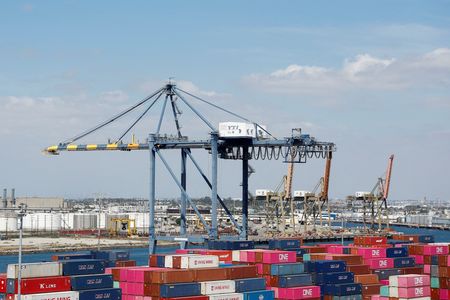
FILE PHOTO: Shipping containers are stacked at a terminal at the port of Los Angeles in Long Beach, California, U.S., March 10, 2026. REUTERS/Caroline Brehman/File Photo
A U.S. trade court on Friday will consider the legality of a 10% global import tax imposed by the Trump administration, which several states and small businesses say sidesteps a U.S. Supreme Court ruling that invalidated most of Trump's previous tariffs.
A group of 24 mostly Democratic-led states and two small businesses sued the Trump administration to stop the new tariffs, which went into effect on February 24. A three-judge panel of the U.S. trade court is set to hear arguments in the cases at 10 a.m. ET (1400 GMT).
Trump has made tariffs a central pillar of his foreign policy in his second term, claiming sweeping authority to issue tariffs without input from Congress. The Trump administration has said that global tariffs are a legal and appropriate response to a persistent trade deficit caused by the fact that the U.S. imports more goods than it exports.
Trump imposed the new tariffs under Section 122 of the Trade Act of 1974, which authorizes duties of up to 15% for up to 150 days on imports during “large and serious United States balance-of-payments deficits” or to prevent an imminent depreciation of the U.S. dollar.
The states and small businesses argue that the Trade Act's tariff authority is meant only to address short-term monetary emergencies, and they say that routine trade deficits do not match the economic definition of “balance-of-payments deficits," according to the two lawsuits filed in the New York-based U.S. Court of International Trade.
Trump announced the new tariffs on February 20, the same day the Supreme Court handed Trump a stinging defeat when it struck down a broad swath of tariffs he had imposed under the International Emergency Economic Powers Act (IEEPA), ruling that the law did not give him the power he claimed.
No U.S. president before Trump had used either IEEPA or Section 122 of the 1974 Trade Act to impose tariffs. The two lawsuits do not challenge other Trump tariffs made under more traditional legal authority, such as recent tariffs on steel, aluminum and copper imports.
(Reporting by Dietrich Knauth; Editing by Noeleen Walder and Lisa Shumaker)
Recent Articles
- The 4th Time May Be a Charm for the 'New' Keiko Fujimori
- Global Smartphone Market Faces Record Annual Decline as Chip Crunch Worsens
- Tata Taps Chery Technology for Avinya Premium EV Push
- Imminent Strong El Nino Impact Likely Worsened by Climate Change
- DeepSeek Slated to Raise $7 Billion in Maiden Funding Round
- ChatGPT App Hits 1 Billion Monthly Active Users in Record Time
- World Cup Could Cost Employers as Workers Tune into Matches
- Vietnam's May Trade Deficit Widens to Record High
- Taiwan, South Korea Stocks Get Goldman Upgrade As Asia Rally Intensifies
- Where'd the Mike Go?