

Who Were Enriched and Impoverished in Trump's First Year
By Tom Kagy | 21 Jan, 2026
The ultra-wealthy, Trump himself and some Asian Americans were among the beneficiaries while the working class got fewer jobs and paid more for virtually everything.
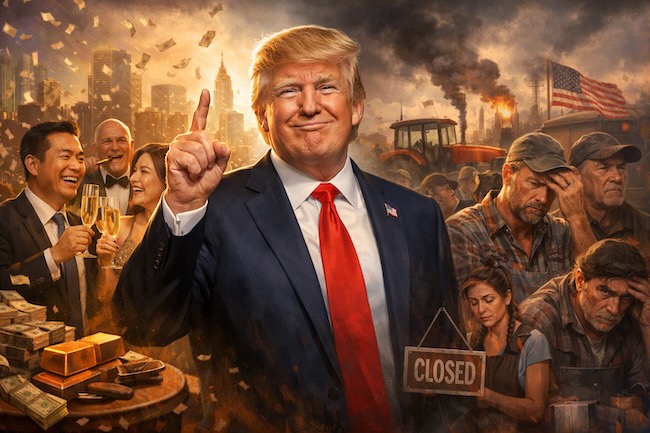
(Image by ChatGPT)
Donald Trump’s first year back in the White House was marketed as a swaggering return to “economic nationalism,” “liberation” from foreign competition, and a long-promised renaissance for the American worker. In practice, it looked a lot like his first term on steroids: more tariffs, louder threats, faster deregulation, and a governing style that rewarded loyalty and proximity to power far more than productivity. Money flowed. Just not evenly.
If you strip away the slogans and look at who actually came out ahead after that first year, a clear pattern emerges. A narrow slice of Americans did extremely well. A much larger slice treaded water or slid backward. And a few groups found themselves oddly benefiting despite being frequent rhetorical targets. Meanwhile, the people Trump claimed to be fighting for — wage workers, consumers, and small businesses without political pull — quietly paid the bill.
Here’s how the gains and losses shook out.
The Big Winners: The Ultra-Wealthy
If you were already rich, Trump’s return was a windfall. Tax policy, regulatory rollbacks, and selective enforcement combined into what amounted to a quiet but enormous transfer of wealth upward.
Capital owners benefited first and fastest. Corporate tax cuts and accelerated depreciation rules made it cheaper to buy machines than hire people. Financial markets, already primed to reward buybacks and mergers, responded exactly as expected. Stock prices rose, executive compensation ballooned, and private equity found a friendlier environment for asset stripping and consolidation.
Deregulation played a huge role. Environmental rules were softened or ignored. Labor enforcement slowed. Antitrust, never aggressive to begin with, practically disappeared. The result was predictable: fewer constraints on large firms, higher margins, and less pressure to share gains with workers.
None of this required companies to invest in new factories or raise wages. In fact, many didn’t. The money went to shareholders, bonuses, and political donations — which in turn bought even more access.
Trump often framed this as success “trickling down.” In reality, it puddled at the top.
Trump Himself
No modern president blurred the line between public office and private business as brazenly as Trump, and his first year back followed the same pattern. Properties linked to him saw increased traffic from lobbyists, foreign delegations, and corporate executives eager to stay in his good graces. Licensing deals, brand exposure, and friendly regulatory decisions all carried obvious personal upside. And of course his World Liberty Financial crypto currency venture which quietly pulled in hundreds of millions of dollars in coin purchases by those seeking his audience and favors.
Even policy fights doubled as marketing opportunities. Every trade war press conference, every grievance-laced rally, every televised signing ceremony kept his brand front and center. Attention, after all, is a currency, and Trump has always been unusually good at converting it into money.
This wasn’t incidental. The presidency functioned as the ultimate promotional platform, and Trump used it that way. Whatever one thinks of the ethics, financially it worked.
Certain Asian Americans
This is where things get counterintuitive. Despite being frequent targets of Trump’s anti-immigrant rhetoric, many Asian Americans quietly did well during his first year back.
The reason wasn’t favoritism. It was positioning.
Asian Americans are disproportionately represented in fields that held up — or even expanded — despite trade disruptions and inflation: technology, medicine, engineering, logistics, and small business ownership with strong family financing. Many had the skills or capital to pivot quickly when supply chains shifted.
Tariffs and restrictions, while painful in aggregate, created niches. Importers found alternative suppliers. Exporters adjusted routes. Professionals with transnational experience suddenly became more valuable. Some Asian American entrepreneurs, especially those already operating across borders, exploited the chaos better than less networked competitors.
It wasn’t universal, and it certainly didn’t mean protection from discrimination or hostility. But economically, a meaningful segment landed on their feet — or climbed higher — while others stumbled.
The Defense and Security Ecosystem
Whenever a presidency leans heavily on confrontation, someone makes money. Defense contractors, cybersecurity firms, border technology vendors, and surveillance companies thrived in Trump’s first year back.
Budgets grew. Contracts multiplied. Emergency justifications bypassed scrutiny. “National security” became the all-purpose excuse for spending.
This didn’t translate into broad-based employment. These sectors are capital- and expertise-intensive, not labor-hungry. But they are incredibly lucrative for shareholders and executives.
If your business sold fear mitigation, Trump was good for you.
The Losers: Working-Class Americans
Here’s where the rhetoric collapsed. Trump promised jobs. What many workers got instead were higher prices and fewer opportunities.
Tariffs raised costs across the board. Manufacturers paid more for inputs. Retailers passed those costs on. Consumers noticed it at the grocery store, the hardware store, and the car dealership. Inflation didn’t feel abstract; it felt like a weekly annoyance that never went away.
Meanwhile, job growth slowed. Companies facing uncertainty delayed hiring. Some automated faster. Others moved operations abroad despite the threats, because it still made economic sense. The idea that tariffs would magically force companies to hire domestically ignored decades of corporate behavior.
For workers without advanced skills or bargaining power, the squeeze was real. Wages lagged prices. Benefits didn’t improve. Job security worsened.
In short, the people Trump claimed to be rescuing paid more for less.
Small Businesses Without Political Pull
Large corporations can absorb shocks. They have lawyers, lobbyists, and accountants to navigate policy whiplash. Small businesses don’t.
For mom-and-pop shops, Trump’s first year back was brutal. Supply costs rose. Credit tightened. Demand softened as consumers pulled back. Relief programs favored bigger players with better banking relationships.
Many small business owners discovered that “America First” came with a footnote: unless you’re big enough to matter.
Some adapted. Many didn’t. Closures climbed quietly, without press conferences or rallies.
Consumers
This group overlaps with workers but deserves its own mention. Tariffs are taxes, and consumers paid them. Not all at once, not always obviously, but relentlessly.
Everything cost a little more. Appliances. Clothing. Electronics. Food. Over time, those “little mores” added up.
Trump dismissed this as a necessary sacrifice. But it wasn’t evenly shared. Wealthy households barely noticed. Lower- and middle-income families did.
The irony was hard to miss: a presidency sold as relief from economic pain made daily life more expensive for the majority.
Farmers: Collateral Damage in the Trade Wars
One group learned fastest how expensive Trump’s policies could be — farmers. They were sold the idea that tariffs were a short-term sacrifice for long-term gain — a kind of patriotic down payment on American strength. What they got instead was collapsing export markets, volatile prices, and a growing dependence on government aid just to stay afloat.
Trump’s trade wars hit agriculture at its most vulnerable point: exports. China, once the largest buyer of American soybeans, corn, pork, and other farm products, retaliated almost immediately. Orders evaporated. Prices fell. Grain bins filled up with nowhere to go. Farmers who had invested heavily in equipment and land based on steady global demand suddenly found themselves squeezed from all sides.
The administration responded with bailout programs, writing checks to farmers to offset losses. It was a stark admission that the policy itself was hurting them. Many farmers hated the optics — proud, independent producers reduced to relying on federal aid because their markets had been deliberately blown up.
The pain wasn’t evenly distributed. Large agribusiness operations with scale and political connections fared better. Smaller family farms struggled. Some sold land. Others took on more debt. A few quietly shut down. Rural banks felt the strain as loan defaults crept upward.
Even worse, some lost markets never came back. Once foreign buyers found alternative suppliers in Brazil, Argentina, or Southeast Asia, loyalty to American producers proved thin. Trade relationships, farmers learned, are easier to destroy than rebuild.
Trump loved posing in front of tractors and grain silos, but behind the photo ops, many farmers had become leverage in a geopolitical gamble they didn’t choose — and one that left them poorer, more indebted, and more uncertain about the future than before.
Immigrants Without Legal or Economic Protection
While some immigrants — including many Asian Americans — managed to navigate the turbulence, those without status or resources were hit hardest.
Crackdowns reduced job opportunities. Fear kept people from reporting abuses. Wages in informal sectors fell. Deportation threats disrupted families and communities, even when removals didn’t actually increase dramatically.
The economic effect was chilling. Vulnerable workers accepted worse conditions, which in turn undercut standards for everyone else.
It was a race to the bottom, and the bottom moved lower.
Who Stayed Roughly Even
A large middle band of Americans neither soared nor collapsed. White-collar professionals with stable employment managed. Retirees on fixed incomes felt squeezed but survived. Unionized workers fared better than nonunion ones, though gains were limited.
This group often felt confused more than anything else. The economy didn’t collapse, but it didn’t feel good either. Headlines said “strong.” Lived experience said “stressful.”
That disconnect defined the year.
The Bigger Picture
Trump’s first year back wasn’t about broad prosperity. It was about power — who had it, who could leverage it, and who could get close to it.
Those with capital, connections, or adaptability thrived. Those without paid higher prices, faced shakier jobs, and absorbed more risk.
The administration framed every outcome as proof of success. Rising markets? Victory. Corporate profits? Victory. Tough talk abroad? Victory.
But economics isn’t a press release. It’s a balance sheet, and most Americans’ balance sheets told a different story.
The core truth is simple: Trump governed in a way that rewarded wealth and punished vulnerability. That’s not unique in American politics, but he did it louder, faster, and with fewer apologies.
And perhaps the most revealing detail of all is this: the people who gained the most didn’t need saving, and the people who needed saving didn’t gain.
That gap between promise and outcome is the real legacy of Trump’s first year back.
© 2026 by Asian Media Group Inc.
Recent Articles
- Samurai Blue Sweep Aside Tunisia, Japan Fans Sweep Monterrey Stadium
- Lebanon Fighting Threatens Switzerland Negotiations
- Danone-Chobani Yoghurt Protein War Underscores GLP-1 Impact
- Italy's Meloni Tells Trump to Focus on His Own Popularity as Row Continues
- Trump Unveils Gifted Qatari 747 As Addition to Air Force One Fleet
- A Warm World Cup Welcome Endears the US to Fans
- China's May Refined Oil Exports Rose from April, Australia Received Agreed Volume
- New Bangladesh Premier to Seek Investments, Jobs in China, Malaysia
- Charles Schwab Working with Cboe to Enter Prediction Market
- Mexico's Love Affair with All Things Korean — Until Thursday's Kickoff