

Why Only Brave Asian Tourists Visit the US
By Goldsea Staff | 14 Dec, 2025
Images of shootings, homeless people, aggressive police and choked-off freeway interchanges make the US a risky adventure destination for only intrepid foreign visitors.
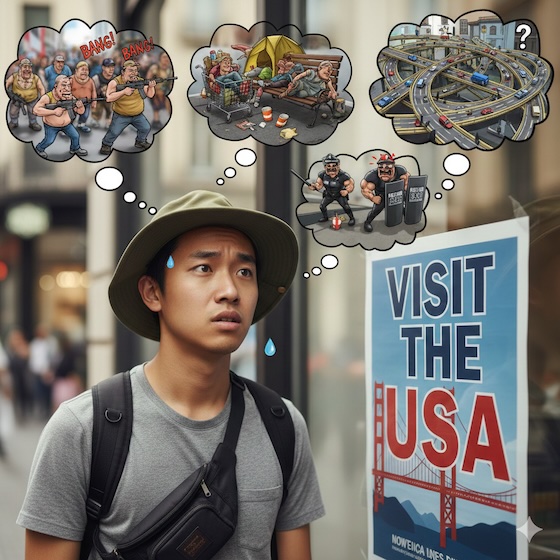
(Image by Gemini)
Asian tourists have emerged as the world’s most enthusiastic international travelers, setting records for spending, hotel occupancy, and attraction visits wherever they choose to go.

(Image by ChatGPT)
In recent years the United States has been slipping from the top tier of destinations. It's not that the US lacks attractions. America still boasts some of the world’s most iconic experiences, from Manhattan and Hollywood to the Grand Canyon and the many wide-open national parks. What has changed is the mental images that international travelers carry when considering where to spend their travel budgets.
For many Asians, those images mix admiration with unease, marvel with dread, and curiosity with a sense of personal risk. Millions still visit, but they are among the boldest of adventurers willing to brave the dangers embedded into their images of the US.
The trepidation of Asian tourists are rooted in daily news events that seem to become exaggerated when filtered through foreign media. Yet they remain powerfully influential. Tourist decisions aren't made by spreadsheets and actuarial tables but by emotional comfort, visual impressions, and a sense of control over one’s surroundings. And for many in Asia, the images associated with the United States look less like the glossy spreads of travel brochures and more like scenes out of a suspense thriller.
Gun Violence
One of the most potent images shaping Asian perceptions of the United States is gun violence. In Japan, South Korea, Singapore, China, and much of Southeast Asia, firearms are strictly controlled and mass shootings are almost unheard of. Virtually all travelers have seen American news cycles dominated by incidents involving firearms. Thus images of Broadway lights or the Golden Gate Bridge are often superceded by live news coverage featuring police tape, grieving families, and flashing emergency vehicles.
Of course, statistically the odds of a tourist being caught up in such an event are very low, but the images are far more immediate than rational calculations of statistical odds of falling victim to such events. Asian travel forums are filled with posts like “Is it safe to go shopping in the U.S.?” or “Which American cities should I avoid due to gun violence?” The imagined dangers are enough to divert less adventuresome travelers to destinations that feel safer, more predictable.
Homeless Encampments
Visitors from East Asia, where public spaces are generally spotless and homelessness is rarely seen, find it jarring to encounter large encampments in cities like San Francisco, Los Angeles, Portland, and Seattle. Photos shared on Chinese and Korean social media often depict entire city blocks lined with tents, sidewalks crowded with discarded belongings, and individuals behaving erratically in ways that can feel threatening to unaccustomed visitors.
The contrast between America’s image as a rich, orderly superpower and the reality of glaring, post-apocalyptic levels of poverty produces a sense of cognitive dissonance. Tourists describe feeling uneasy walking downtown, unsure whether they might be approached or startled by someone experiencing a mental health crisis or on the throes of a drug trip. For families traveling with children, this discomfort becomes a strong deterrent, even if most of these interactions pose no actual danger.
Aggressive Police
In Asian countries police presence is orderly, polite, and rarely confrontational. Tourists are not accustomed to being stopped, questioned, or asked to comply with strict procedural commands. But media images of tense police encounters in the United States—often involving shouting, drawn weapons, or rapid escalation—create a perception that even a minor misunderstanding could spiral into something frightening.
Foreign travelers fear accidentally violating a traffic rule, mishandling a police stop, or being treated suspiciously because of limited English fluency. A scene that Americans interpret as standard protocol may feel to an Asian tourist like a stressful, high-stakes encounter. This anxiety is especially common among travelers planning long road trips, who imagine the possibility of highway stops becoming confrontational.
High Medical Costs
Layered on top of these images is the fear of America’s high medical costs. In Asia healthcare is generally affordable, predictable, and government-regulated. The image of the US conveyed abroad is that of a country where a simple emergency room visit can cost thousands of dollars, and an ambulance ride can cost more than a plane ticket home.
Travelers imagine slipping on a sidewalk, getting into a minor accident, or experiencing sudden illness and being financially devastated. Travel insurance helps but does not erase the image of unexpectedly receiving a stack of medical bills. For risk-averse travelers, this alone becomes reason enough to rethink the trip.
ICE Inspections
Then there is the image of unfriendly ICE officers both inside and outside of U.S. airports. Many Asian travelers report feeling scrutinized, interrogated, or judged during entry procedures. Online forums brim with stories of visitors being pulled aside for secondary questioning, having their electronic devices inspected, or being asked detailed questions about their personal backgrounds. Whether these experiences are typical or not, the perception is one of sternness bordering on hostility.
This has been recently amplified by stories about aggressive ICE deportations of migrants. Compared with the warm welcomes offered by many Asian and European airports, the US entry experience can feel tense and uncertain. Travelers imagine long lines, stern officers, and the possibility of being denied entry for unclear reasons.
Anti-Asian Racism
Another powerful deterrent is images of street-level social tensions and public confrontations. During and after the pandemic, international news highlighted incidents of anti-Asian harassment or violence, especially in major cities. Although many of these incidents were local and isolated, the circulated visuals—security camera footage, smartphone videos, and social media clips—created a perception that the United States had become unsafe specifically for people of Asian descent.
Even after these incidents declined, the images continued to reverberate across Asian social platforms. As a result, some travelers now look at a subway map of New York or a street corner in downtown Los Angeles and imagine themselves becoming targets of verbal harassment or worse.
Natural Disasters
Hurricanes in Florida and the Gulf Coast, wildfires in California, tornadoes in the Midwest, and extreme heat in the Southwest all contribute to images of a country beset by natural disasters. Satellite imagery of wildfire smoke or floodwaters covering entire towns make Asian travelers wonder whether they might find themselves stranded or endangered. Even if these events are seasonal or localized, their intensity creates a visceral impression that America is a place where nature itself can suddenly turn threatening.
Driving Uncertainty
The image of driving in the United States is, for many Asian travelers, is more daunting than the attractions are enticing. Long multi-lane highways, complicated interchanges, aggressive drivers, and unfamiliar rules such as turning right on red all add to a perception that renting a car could lead to dangerous mistakes. Videos of pileups on icy roads or fiery crashes on desert freeways amplify these concerns. Asian tourists imagine being overwhelmed by fast traffic, missing exits, or getting lost in unsafe areas, transforming what should be a scenic road trip into a stressful ordeal.
Unexpected Charges
Even everyday consumer experiences contribute to an image of unpredictability. Tourists accustomed to all-inclusive pricing are confused and alarmed by American tipping culture, unexpected add-on fees, resort charges, and taxes revealed only at checkout. The image of being nickel-and-dimed at every turn creates a perception that the U.S. is both expensive and opaque. For many Asian travelers, the fear is not just overspending but feeling taken advantage of in situations they do not fully understand.
These images form a mosaic of concerns that weigh on the minds of potential Asian visitors to the US. They often compare the United States against alternative destinations that feel safer, smoother, and more predictable. Japan, South Korea, Australia, Singapore, and many parts of Europe project images of cleanliness, order, affordability, and low crime. These contrasts make the US seem like a place where exhilaration is paired with risk, where beauty coexists with unpredictability, and where every postcard scene hides a set of cautions.
Alluring to Adventurers
All these fears don't stop millions of Asian tourists from visiting the United States each year. They're motivated by curiosity, cultural fascination, educational opportunities, shopping, entertainment, and the appeal of iconic landscapes. But increasingly those who do come see themselves as part of an adventurous minority—travelers willing to navigate uncertainties for the sake of a uniquely American experience. These are the bravest Asian tourists, the ones who weigh the risks, brace for the unknown, and step onto U.S. soil with both excitement and caution.
For the United States to regain its former standing as a top Asian destination, it would need to reduce the gap between the images shaped abroad and the reality experienced on the ground. Until then, many Asian travelers will continue to ask themselves a simple question: Why travel to a country that scares me when so many others welcome me with calm and clarity?
© 2025 by Asian Media Group Inc.
Recent Articles
- S. Korean Shops Turn to Robots, Self-Service to Escape Labour Woes
- Largest US Power Grid Saw 15-Fold Rate Spike on Record Demand in Heat Wave
- Affluent Consumers Help US Car Sales Overcome Headwinds
- How Hock Tan Built Broadcom into an Indispensable Power in the AI Boom
- US June Private Payroll Growth Misses Expectations; Layoffs Decline
- Progressives Win Big Against Incumbent Democrats in Colorado Primaries
- Sony to End Discs for New PlayStation Releases as Gaming Shifts Online
- Russia Allowed Covert Military Training by China at Top Level
- Exports Help BYD Sales Rise for Second Month
- Older Americans Priced Out of GLP-1 Craze Expected to Flock to $50 per Month Program