

2026 Looks Big for Quantum Computing Real-World Deployment
By JL Zhang | 20 Apr, 2026
Thanks to major advances in error-correction the IBM's Quantum Nighthawk processor is just one of several developments seeking to demonstrate quantum advantage by the end of 2026.
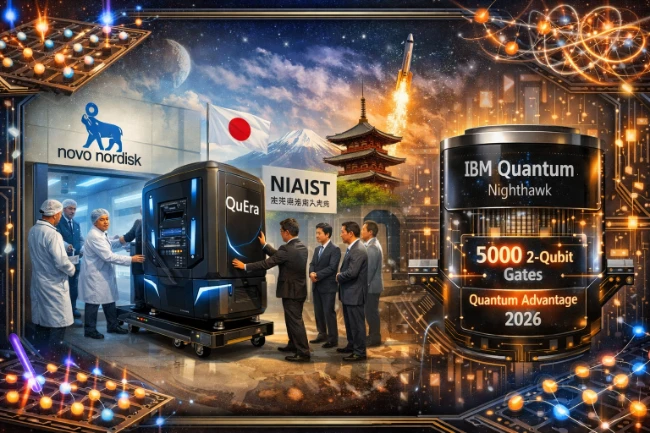
(Image by ChatGPT)
The old quantum computing joke has been that practical machines are always "five years away."
It's been a reliable joke — and, for skeptics, a reliable reason to tune out. But 2026 is proving different. Error correction has crossed a critical threshold, error-corrected systems are shipping to real customers, and IBM is publicly betting that quantum advantage over classical computers will be verified by year's end. The goalposts haven't just moved; the game itself has changed.
Lab Curiosity to Salable Hardware
The clearest sign that quantum computing is maturing is that companies aren't just announcing processors — they're delivering them. Microsoft, working alongside startup Atom Computing, is shipping an error-corrected quantum computer to the Export and Investment Fund of Denmark and the Novo Nordisk Foundation. QuEra, meanwhile, has already delivered a quantum machine capable of error correction to Japan's National Institute of Advanced Industrial Science and Technology, with plans to make it available to global customers before the year is out.
These aren't prototype demonstrations destined for a press release. They're working systems going to organizations with real scientific missions. Microsoft's VP of quantum, Srinivas Prasad Sugasani, has described the goal plainly: the machines should establish scientific advantage, not commercial advantage yet, but that's the intended path forward. It's a rare example of the industry setting expectations that are ambitious but honest about where the technology actually stands.
Error Correction Changes Everything
To understand why these deliveries matter, it helps to understand what's made quantum computing so frustrating for so long. Qubits — the fundamental units of quantum computation — are extraordinarily fragile. They're sensitive to heat, electromagnetic interference, and even the act of being measured. Early quantum systems were essentially racing against their own noise, and the more qubits you added, the worse the problem often got. Raw qubit counts climbed impressively, but real computational progress stalled.
Error correction tackles this problem by grouping many physical qubits together to create a single, more reliable "logical" qubit. If some of the physical qubits in a group misbehave, the others can catch and correct the mistake. The concept has been understood theoretically for decades, but making it work in practice — where the correction overhead doesn't consume all the resources you've saved — has been the hard part. That's now changing. The industry has crossed into what analysts are calling the fault-tolerant foundation era: a regime where adding more qubits actually reduces error rates rather than amplifying them. That's not a minor refinement. It's the structural shift the whole field has been building toward.
IBM's Nighthawk Races for Quantum Advantage
IBM's contribution to this year's momentum is the Quantum Nighthawk, its most advanced processor yet. The company introduced Nighthawk at its annual Quantum Developer Conference in late 2025, and its architecture is specifically designed to push toward a clearly defined target: quantum advantage, meaning the ability to solve a problem better than any classical-only method, by the end of 2026.
Current Nighthawk systems can handle up to 5,000 two-qubit gates — the fundamental entangling operations that make quantum computation possible. That's already a significant capability. But IBM's roadmap calls for 7,500 gates by the end of this year and 10,000 by 2027. By 2028, Nighthawk-based systems could support up to 15,000 two-qubit gates, enabled by 1,000 or more connected qubits linked through long-range couplers. That's a credible engineering roadmap, not a wishlist.
To make the progress verifiable and not just self-reported, IBM has teamed up with Algorithmiq, researchers at the Flatiron Institute, and BlueQubit to build an open, community-led quantum advantage tracker. The idea is that when quantum systems start genuinely outperforming classical ones, the wider research community — including skeptics — can confirm it independently. That kind of institutional humility is itself a sign of maturity.
Neutral Atoms Pull Ahead
Superconducting systems like IBM's Nighthawk aren't the only hardware architecture making headlines. Neutral atom quantum computing — which uses individual atoms held in place by lasers as qubits — has emerged as one of the most exciting platforms of the year. Neutral atom arrays are now exceeding 6,100 atoms while maintaining 99.98% single-qubit accuracy, a precision figure that would have seemed extraordinary just a few years ago.
The appeal of neutral atoms lies in their flexibility. Unlike superconducting qubits, which are fixed on a chip, neutral atoms can be rearranged during computation, enabling new approaches to error correction and parallel processing. Both QuEra and Microsoft's Atom Computing partnership are betting heavily on this architecture, and the early results justify that confidence.
"Transistor Moment" and the Conservative View
A paper published in *Science* early this year offered a useful historical framing: quantum technology has reached something like the transistor moment of classical computing. Researchers say functional quantum systems now exist across multiple hardware platforms — superconducting qubits, trapped ions, neutral atoms, photonic systems, and others — and they're beginning to move out of the lab and into real applications in communication, sensing, and computing.
It's a compelling analogy, but the paper's authors are careful not to oversell it. MIT's William Oliver put it well: semiconductor chips in the 1970s were considered mature technology for their time, but they could do very little compared to what's possible today. A high readiness level doesn't mean the end goal is within reach — it means the foundation has been laid. Practical quantum computers capable of the most transformative applications, like large-scale quantum chemistry simulations, could still require millions of physical qubits with error rates far beyond what's currently achievable.
Today's State of Quantum Computing
So what are these early machines actually being used for? The honest answer is that we're still in the proof-of-concept phase for most industries, but the proofs are getting more convincing. Quantum chemistry and materials science are the most promising near-term applications, particularly for simulating highly coupled electronic systems that are genuinely hard for classical computers to handle. Financial services, healthcare, insurance, and energy companies are beginning to explore use cases in optimization and simulation. Chattanooga, Tennessee has staked an interesting claim as the first U.S. community with a commercially available on-premises quantum computer and quantum network, and it's already attracting interest across sectors.
On the cybersecurity front, the picture is more urgent. Quantum computers capable of breaking current encryption standards — a scenario sometimes called "Q-Day" — are still years away, but organizations are being urged not to wait. Post-quantum cryptography standards are already available, and the pressure to adopt them is growing alongside quantum hardware's capabilities.
Long Road Ahead
2026 isn't the year quantum computing solves everything. It's the year it stops being a promise and starts being a product. The distinction matters. Error correction has cleared a fundamental hurdle, error-corrected machines are shipping to customers with real scientific goals, and the community infrastructure to validate genuine quantum advantage is now in place.
That doesn't mean the hard work is done — scaling to millions of qubits, solving the "wiring problem" of controlling each qubit individually, and proving commercial return on investment are all still significant challenges. But the industry has earned a little optimism. The joke about five more years is finally getting old.
© 2026 by Asian Media Group Inc.
Recent Articles
- Modi Calls for Foolproof Exam System in India After Youth Protests
- US Looks to Speed Air Taxis, Supersonic Planes to Market
- Tesla Cash Burn to Test Investor Faith in AI Bets
- Charles Schwab Posts Record Quarterly Profit on Trading Boom
- Hasbro Raises Annual Forecasts on Digital Gaming Demand
- US Auto Industry Races to Purge Chinese Connected-Car Hardware Amid Federal Push
- Both Sides Express Interest in Peace Talks As They Continue Flinging Ordinance
- TSMC to Raise Chipmaking Prices by up to 10% in 2027, Nikkei Asia Reports
- GM Boosts Profit Outlook on 'Resilient' Consumer Demand
- Novo Nordisk Sues Eli Lilly, Alleging False Advertising