

How India Became the Leading Incubator of Talent for the US
By Ben Lee | 16 Jul, 2026
India's colonial history, cultural focus on education and an economy barely emerging into the 21st century make it an ideal incubator of the talent and ambition necessary to the US tech industry.
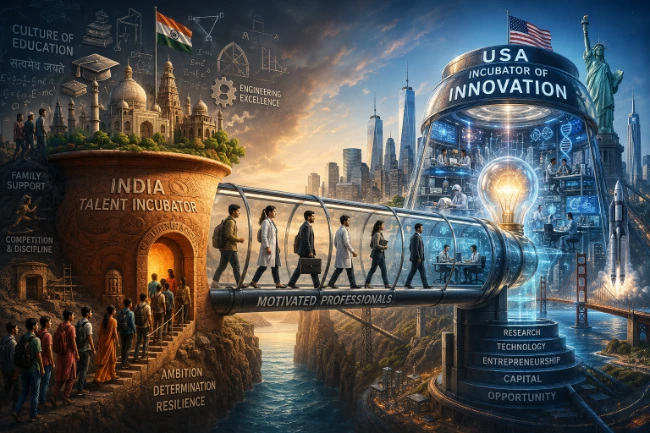
No other country has become as important to America's knowledge economy as India. From Silicon Valley and Wall Street to medical research laboratories, hospitals, universities and AI startups, Indian-born professionals occupy roles that are increasingly central to US competitiveness. CEOs of some of America's most influential technology companies were educated in India. Indian engineers and physicians are among the largest immigrant professional groups in the country. Every year tens of thousands of Indian students arrive at American universities, many remaining to build careers and businesses.
This remarkable pipeline did not emerge by accident. It reflects a combination of historical, cultural, educational and economic forces that have made India unusually effective at producing highly motivated, English-speaking professionals eager to seize opportunities abroad.
Ironically, many of the factors that once limited India's economic development have become advantages in supplying talent to the world's most advanced economy. Britain's colonial legacy, India's intense emphasis on education, its immense population, its long period of relative poverty and its rapid but incomplete modernization have together created one of history's most productive talent incubators.
As America confronts labor shortages in engineering, medicine, AI, semiconductor manufacturing and scientific research, India's unique strengths are becoming increasingly indispensable.
The British Left Behind More Than Railroads
British colonial rule imposed enormous economic costs on India, but it also left institutions that later proved surprisingly valuable in a global economy.
Perhaps the most important inheritance was the widespread use of English.
Unlike many developing nations whose brightest students must first master English before participating in international science or business, Indian students often receive English-language instruction from an early age. Universities, engineering schools and medical colleges routinely use English as the language of instruction.
This linguistic advantage dramatically lowers barriers for Indians entering American graduate schools and corporations. An Indian engineer can often begin contributing immediately without years of language training.
British influence also established legal traditions, civil service institutions and university systems modeled after those of the United Kingdom. These institutions familiarized generations of Indians with concepts and organizational structures that translated relatively smoothly into American corporate life.
Colonialism certainly was not designed to create future Silicon Valley executives. Yet one of its unintended consequences was preparing millions of Indians to function comfortably within English-speaking global institutions.
Education Became India's National Religion
India's reverence for education predates British rule, but modern economic realities intensified its importance.
For many families, education represents far more than intellectual development. It is viewed as the primary route out of poverty and toward social mobility.
Parents routinely devote extraordinary portions of household income to tutoring, examination preparation and university education. Students often endure years of demanding preparation for entrance examinations whose acceptance rates rival those of the world's most selective universities.
Success on these examinations can transform an entire family's future.
The resulting culture rewards discipline, delayed gratification and sustained academic effort.
American employers often notice these characteristics. Many Indian professionals have spent years competing under extraordinary academic pressure before ever entering the workforce.
The ability to master difficult technical material becomes not merely an educational achievement but a deeply ingrained habit.
Competition on an Extraordinary Scale
India's enormous population magnifies this educational culture.
More than 1.4 billion people compete for limited seats at elite institutions.
The Indian Institutes of Technology, Indian Institutes of Management and leading medical colleges accept only tiny fractions of applicants. Entrance examinations eliminate vast numbers of highly capable students.
Although this intense competition creates stress and inequality, it also produces graduates who have survived one of the world's most demanding academic filtering systems.
American companies recruiting from India's top universities know they are drawing from a talent pool already subjected to years of rigorous competition.
Even students who do not enter the most prestigious institutions frequently possess strong technical foundations simply because educational competition throughout the country remains so intense.
Scarcity Creates Extraordinary Motivation
Ironically, India's slower economic development has helped produce exceptionally ambitious professionals.
For decades, even highly educated graduates faced limited domestic opportunities.
An engineer capable of designing advanced software might work in an organization lacking cutting-edge technology.
A physician might encounter resource constraints that limited professional growth.
A scientist might struggle to obtain research funding.
These constraints encouraged talented individuals to look abroad.
Unlike professionals leaving wealthy countries primarily for lifestyle reasons, many Indians viewed international careers as transformative opportunities that could dramatically improve both their own lives and those of extended family members.
The motivation to succeed therefore became unusually powerful.
Immigration represented not simply a career move but often a multigenerational family project.
That level of commitment frequently translates into exceptional work ethic and persistence.
The Power of the Indian Family
Family dynamics also contribute significantly to India's talent pipeline.
Parents often make substantial financial sacrifices to educate children.
Grandparents frequently assist with childcare or household responsibilities, allowing parents to focus resources on education.
Extended families commonly celebrate academic achievement as a shared accomplishment.
This collective investment creates powerful incentives.
Students understand that their success reflects years of sacrifice by multiple family members.
The resulting sense of responsibility often encourages perseverance during demanding university programs or difficult early career years.
Many immigrants describe succeeding not merely for themselves but for parents whose own opportunities had been limited.
This intergenerational perspective frequently produces long-term thinking valued by employers.
Engineering Became a National Strength
Following independence, India invested heavily in technical education.
Political leaders believed engineers, scientists and physicians would be essential for national development.
Institutions such as the Indian Institutes of Technology became symbols of national ambition.
Although relatively small compared with India's population, these institutions established global reputations for technical excellence.
Graduates increasingly pursued advanced study overseas, particularly in the United States.
Once established, they created networks that helped later generations navigate admissions, employment and entrepreneurship.
Today, Indian professionals occupy leadership positions throughout semiconductor design, cloud computing, cybersecurity, pharmaceuticals, AI, finance and biotechnology.
These successes reinforce aspirations among younger students, creating a virtuous cycle in which each generation inspires the next.
The American Economy Rewards Exactly What India Produces
The United States excels at transforming talent into innovation.
Its universities lead global research.
Its venture capital ecosystem funds ambitious startups.
Its legal system protects intellectual property.
Its large consumer market allows successful innovations to scale rapidly.
India supplies exactly the kind of technically trained, ambitious individuals capable of thriving within this environment.
American companies gain employees with strong quantitative skills, high English proficiency and experience solving difficult problems despite limited resources.
Indian professionals gain access to research laboratories, advanced technology, capital markets and career opportunities unavailable at similar scale in India.
The relationship has become remarkably complementary.
Neither country alone could achieve the same outcomes as efficiently.
Immigration Networks Reinforce Success
Once immigrant communities become established, they reduce uncertainty for future arrivals.
Indian Americans have built extensive professional organizations, alumni associations, mentoring networks and entrepreneurial communities.
New immigrants can receive guidance about graduate schools, internships, visa processes, housing and career development.
These networks accelerate integration.
Rather than beginning from scratch, many newcomers immediately gain access to experienced professionals willing to offer advice.
This social infrastructure significantly increases the probability of success.
Over time, successful immigrants become investors, mentors and founders themselves, reinforcing the cycle.
Silicon Valley illustrates this phenomenon especially well, where Indian entrepreneurs frequently mentor younger founders and recruit talent from universities in both India and America.
Why India Differs From China
China also produces enormous numbers of engineers and scientists, yet India's role within the American economy differs in several important respects.
English proficiency remains much higher in India.
Indian professionals generally encounter fewer linguistic barriers when collaborating with American colleagues or leading multinational organizations.
India's democratic political system, despite its imperfections, also resembles Western governance more closely than China's one-party model.
American institutions often find cultural adaptation somewhat easier.
In addition, Indian immigration has emphasized long-term settlement, entrepreneurship and executive leadership.
Many Indian immigrants build permanent careers in the United States while maintaining commercial ties with India.
These transnational relationships strengthen business connections between the two democracies.
India Is Also Becoming a Stronger Partner at Home
India's economic rise does not necessarily threaten America's access to Indian talent.
Instead, it may deepen collaboration.
As India's technology sector grows, increasing numbers of professionals move back and forth between the two countries throughout their careers.
Research collaborations, startup investments, semiconductor partnerships and AI development increasingly occur across both countries simultaneously.
Rather than representing one-way brain drain, the relationship is evolving toward "brain circulation."
Knowledge acquired in one country benefits innovation in the other.
Companies gain access to larger talent pools while professionals enjoy broader career options.
This dynamic may prove more sustainable than permanently relocating talent in only one direction.
Challenges Should Not Be Ignored
India's talent advantage does not eliminate important challenges.
Educational quality remains highly uneven outside elite institutions.
Large portions of the population still lack access to excellent schools.
Infrastructure gaps continue to limit economic opportunity.
Women remain underrepresented in several technical professions despite substantial progress.
The United States also faces immigration policies that can discourage highly skilled workers through visa backlogs and uncertainty.
Lengthy green card waits, particularly for Indian professionals, create inefficiencies that benefit competing countries seeking the same talent.
Improving these systems would strengthen both economies.
Neither country should assume the current success will continue automatically.
Continued investment in education, research and immigration reform will remain essential.
A Partnership Likely to Grow Even More Important
Artificial intelligence, biotechnology, advanced manufacturing, quantum computing and clean energy will require unprecedented numbers of highly skilled professionals over the coming decades.
The United States possesses many advantages in research, entrepreneurship and capital formation, but it cannot meet all of its talent needs solely through its domestic educational system.
India, meanwhile, continues producing millions of technically trained graduates while expanding its own innovation ecosystem.
The combination is likely to become one of the defining economic partnerships of the 21st century.
India's colonial past unintentionally created an English-speaking population comfortable operating within global institutions. Its educational culture prizes academic excellence with unusual intensity. Fierce competition sharpens talent. Economic constraints encourage ambition. Strong families reinforce perseverance. American universities and companies provide unmatched opportunities for those abilities to flourish.
The result is not simply immigration. It is the convergence of two national strengths.
America remains exceptionally good at converting exceptional talent into world-changing innovation. India has become exceptionally good at producing ambitious, resilient, technically capable people eager to seize those opportunities.
That combination has already transformed Silicon Valley, medicine, finance and scientific research. As the global economy becomes increasingly dependent on human capital rather than natural resources, the partnership between American opportunity and Indian talent may become one of the most consequential competitive advantages either nation possesses.
© 2026 by Asian Media Group Inc.
Recent Articles
- Chipmakers' Big Profit Gains May Not Be Enough
- Blockbuster Films Produce Record Revenues for AMC
- Archer, Anduril Unveil Autonomous Aircraft Platform for Defense
- Why Oil Prices Haven't Gone Crazy Despite 5 Months of US-Iran Conflict
- Suzuki's No-Frills Cars Once Ruled India. Then Buyers Demanded Frills.
- Japanese Mayor Makes History with Maternity Leave That Caused a Stir
- Chinese Brave Simulated Typhoons to Prepare for the Real Thing
- GE Aerospace Unveils Breakthrough in Hybrid-Electric Flight
- Houthi Red Sea Blockade Tightens Iran's Grip on Global Energy Supplies
- Google's Newest Chip to Run Gemini Models 6 Times More Efficiently