

How the AI Boom Is Keeping Afloat an Economy Battered by Trump Tariffs and Deportations
By Ben Lee | 18 May, 2026
Without the stimulating effect of the $1 trillion+ committed to AI infrastructure spending, both the stock market and the job market would have sunk into recession.
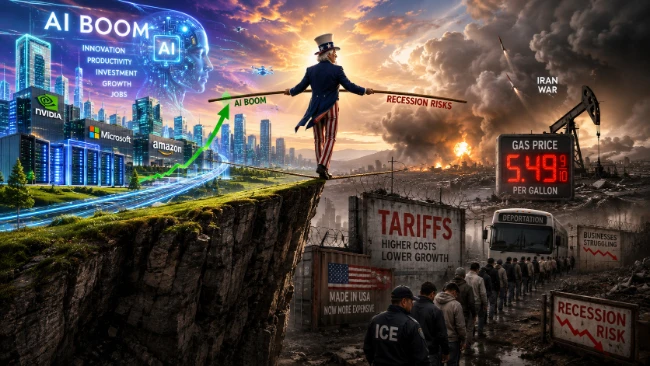
Only a miracle is saving the American economy from possibly the worst string of policy errors ever committed by a single administration in the span of under one year.
It's difficult to overstate the disastrous series of moves the Trump administration managed to string together practically back-to-back: imposed the steepest tariffs since the 1930s, rattling trading relationships with allies and adversaries alike, and carried out ICE sweeps that stripped hundreds of thousands of workers from farms, construction sites, restaurants, and factories. That was followed up by a series of strikes on Iran, leading to the loss of a quarter of the world's oil production and a surge in fuel prices.
Consumer confidence has cratered. Manufacturing has bled jobs for months on end. And yet — GDP has continued to grow, the stock market has avoided a full-scale collapse, and unemployment has not spiked into recession territory.
The reason for this apparent paradox lies inside the giant, humming, climate-controlled rectangles being built at a frantic pace from Virginia to Arizona: data centers. The artificial intelligence infrastructure boom has, quietly and almost single-handedly, kept the American economy from tipping into the downturn that the Trump administration's policies have otherwise engineered. Without it, most economists agree, we would already be in a recession.
Numbers Tell the Story
The scale of AI's economic contribution is almost difficult to absorb. Data center investment accounted for 92% of GDP growth in the first half of 2025, despite representing just 4% of total US GDP, according to Harvard economist Jason Furman. Without tech infrastructure investment, annualized GDP growth would have been just 0.1%, suggesting a near-stagnant economy outside the AI boom.
Read that again: nine-tenths of the economic growth keeping the country out of recession came from a single sector — one that barely existed, in its current form, a decade ago.
AI-related capital expenditure has contributed more to US GDP growth than consumer spending in the first half of 2025 — an unprecedented milestone in modern economic history. The four largest hyperscalers — Amazon, Google, Microsoft, and Meta — are expected to spend more than $350 billion on capital expenditure in 2025, a year-over-year increase in the mid-30% range. Including other tech players pushes the total toward an estimated $500 billion in 2025 alone.
According to the St. Louis Federal Reserve, in the first quarter of 2025, the contribution of information processing equipment to real GDP growth jumped to 0.90 percentage points — more than two standard deviations above its long-run average. The AI boom has, in short, surpassed even the dot-com era in its impact on measured economic output.
Zooming out further: the capital expenditure of the 14 largest publicly owned data center operators globally is expected to reach close to $750 billion in 2026, against roughly $450 billion the year before. Over 23 gigawatts of data center capacity was under construction globally at the end of September 2025, with about three-quarters of it coming up in the United States.
What Trump's Policies Did
To understand how much AI is doing to prop up the economy, you have to understand just how destructive the administration's signature policies have been.
On tariffs: the Trump tariffs represent the largest U.S. tax increase as a percentage of GDP since 1993 and amount to an average tax increase per household of $1,500 in 2026. The Penn Wharton Budget Model projects that Trump's tariffs will reduce long-run GDP by about 6% and wages by 5%, with a middle-income household facing a $22,000 lifetime loss — losses twice as large as a revenue-equivalent corporate tax increase from 21% to 36%.
The sectoral carnage has been concrete. Manufacturing employment has declined by approximately 59,000 jobs since Trump's April tariff announcement, with durable goods manufacturers — those making cars, appliances, and electronics — hit hardest. The Joint Economic Committee warns that uncertainty from the tariffs could cost the US more than $490 billion in manufacturing investments by 2029.
The immigration enforcement campaign has compounded the damage. The foreign-born population, which stood at roughly 53.3 million in January 2025, declined to about 51.9 million by June — nearly 1.5 million fewer people in just six months. The economic consequences have been immediate and measurable. The agricultural industry saw a total drop in employment of 155,000 workers from March 2025 to July 2025 — compared to a 2.2% increase over the same period in 2024. The 10 states with the highest concentration of undocumented immigrants in the construction industry saw a 0.1% drop in construction employment at a time when other states saw a 1.9% increase.
The Peterson Institute for International Economics projects that the tariffs reduce the US growth rate by 0.23 percentage points from baseline in 2025 and by 0.62 percentage points in 2026, while pushing inflation 1 percentage point higher than it would otherwise be. The institute also warns grimly that the US economy would contract if the tariffs were combined with the mass deportation of unauthorized immigrant workers and the Federal Reserve's loss of political independence. All three of those conditions are now in varying stages of realization.
Sector by Sector: How AI Is Filling the Gap
The AI infrastructure boom has effectively acted as a privately funded stimulus program, injecting capital into sectors that would otherwise be reeling. Consider the specific economic channels:
Construction: The AI data center buildout is the single largest driver of commercial construction in American history. At a time when residential construction has slowed due to high interest rates and deportation-driven labor shortages — with estimates projecting the removal of up to 1.5 million workers from the construction industry in a mass deportation scenario — data center construction has kept cranes in the sky. Estimates place direct construction spending on new AI facilities at more than $100 billion in 2025, supporting hundreds of thousands of skilled construction jobs that would not otherwise exist.
Semiconductors: Nvidia is on track to capture more than $180 billion in AI-chip revenue across 2025 and 2026. Its GPUs have become the modern equivalent of crude oil. That revenue ripples outward into the entire semiconductor supply chain — wafer suppliers, packaging firms, memory manufacturers — generating an estimated $60–80 billion in additional domestic and near-shore economic activity.
Energy: New data centers under construction will, if all planned facilities are completed, add 140 gigawatts of new electrical load to the US grid — an almost incomprehensible figure. Utilities are investing hundreds of billions in grid expansion, new power generation, and transmission upgrades. The energy sector, which had seen flat demand for two decades, is now one of the fastest-growing areas of private capital expenditure in the country, adding an estimated $80–120 billion in energy-related infrastructure investment tied directly to AI demand.
Real estate: Data centers require massive campuses in low-tax, high-power jurisdictions. Markets from northern Virginia to central Iowa to the Phoenix suburbs are seeing commercial real estate booms — office parks converted, industrial land rezoned, local tax revenues soaring — at a moment when office real estate elsewhere remains deeply distressed.
Employment: The AI infrastructure buildout is estimated to generate 5.4 million temporary and permanent jobs over the next decade, with 4,149 active data centers and 2,788 under construction driving $27 billion in state and local tax revenues. In the near term, these are largely construction and engineering jobs — precisely the categories where tariff-induced uncertainty and immigration enforcement have destroyed employment elsewhere.
A Fragile Lifeboat
Harvard economist Jason Furman has offered the most honest accounting of AI's buffering role: absent the AI boom, the US would probably have lower interest rates and electricity prices, generating some additional growth in other sectors — but in very rough terms that could maybe make up only about half of what the economy got from the AI boom. The implication is stark: even with some counterfactual offsets, the non-AI economy in 2025 would have registered near-zero growth at best, and contraction at worst.
Unlike short-lived stimulus measures, investments in AI create enduring capacity — data centers, semiconductor fabs, and advanced infrastructure — that could power the economy for decades. But that long-term promise does not insulate the country from near-term risk. The AI boom is concentrated in a handful of companies, dependent on continued confidence in AI's commercial payoff, and increasingly constrained by power availability and permitting bottlenecks. If any of those conditions shift, the one pillar keeping this economy upright could wobble.
The deeper problem is structural. The Trump administration has simultaneously damaged the industries that employ the most Americans — manufacturing, agriculture, construction, and hospitality — while benefiting from a technology-sector surge that it had no role in creating and that employs, at scale, a far smaller share of the workforce. AI-driven sectors have decisively outperformed traditional industries. Manufacturing, retail, and real estate posted weak or negative growth in 2025, signaling a structural shift in economic value creation that favors high-tech infrastructure over legacy sectors.
That divergence is politically and economically unsustainable over the long run. The farmers, factory workers, and construction laborers who form the backbone of Trump's political coalition are precisely the people being squeezed by his tariffs and deportation policies — and who are not, for the most part, the ones benefiting from the AI gold rush.
For now, the data centers hum, the GPUs ship, and the GDP numbers remain — barely — in positive territory. America's economy has, in effect, bet its near-term fate on a technology that its government did not build, cannot fully control, and may not be able to sustain.
That's a remarkably precarious position for the world's largest economy to find itself in.
Recent Articles
- Trump Signals Nuclear Deal Possible, Pauses Strikes
- Starbucks Korea Head Fired After Promotion Sparks Public Uproar
- Japan, China Led Declines in Foreign Holdings of Treasuries in March
- Elon Musk Loses Jury Trial Against OpenAI, Altman
- China's Economy Lost Steam in April as Consumption, Output Disappoint
- Nikka Bets Japanese Whisky Boom Has Room to Run
- Trump Got a Small Rare Earth Win but Failed to End China's Export Controls
- Xpeng Begins Mass Production of Robotaxis in Guangzhou
- Baidu Beats Q1 Revenue Estimates as AI Cloud Surge Offsets Ad Slump
- Musk Expects Widespread Use of Cars Without Human Monitors in 2026