

MA Police Department's Racist Anti-Asian Texts Unearthed
By J. J. Ghosh | 12 Jun, 2026
A murder case revealed something that has nothing to do with murder: two Massachusetts officers spent a decade sending anti-Asian slurs.
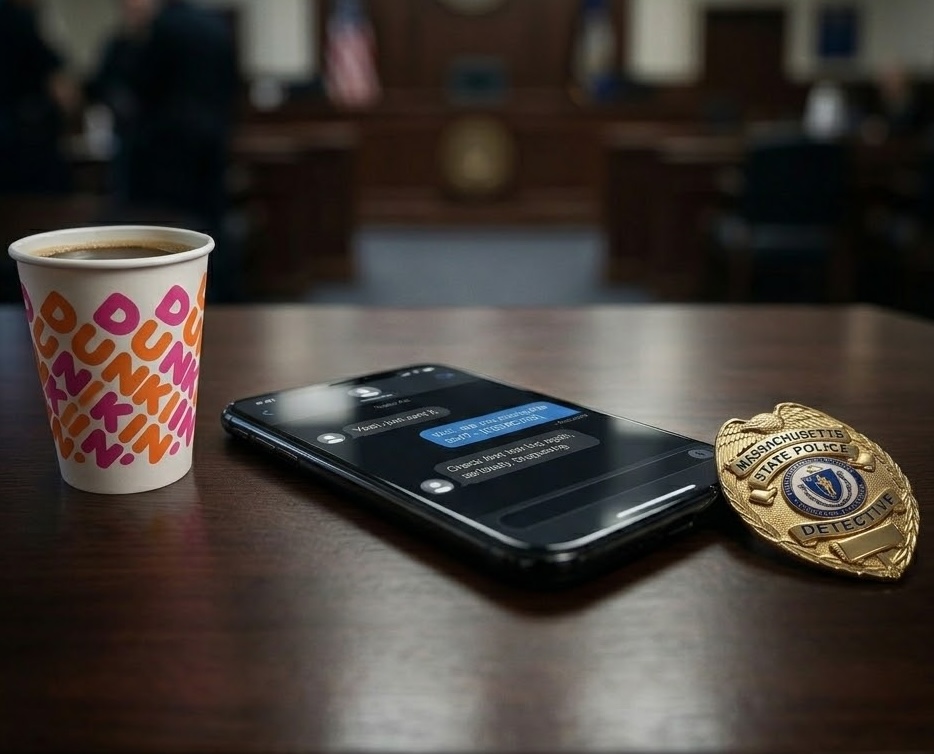
In 2022 Karen Read — a white financial analyst from suburban Massachusetts — was charged with second-degree murder in the death of her boyfriend, Boston police officer John O'Keefe, whose body was found in the snow outside a colleague's home in Canton, Massachusetts.
Read maintained from the beginning that she had nothing to do with his death — that O'Keefe had been beaten inside the house and left outside to die, and that she was being framed by a close-knit network of law enforcement officers protecting one of their own. The prosecution said she had struck O'Keefe with her SUV during an argument.
What followed was one of the most sensational criminal cases in recent Massachusetts history: a first trial that ended in a hung jury, allegations of prosecutorial misconduct, a second trial in which Read was acquitted on all counts, and now a civil lawsuit against the Massachusetts State Police and the Canton Police Department.
In her lawsuit, Read's attorneys allege that corrupt and biased officers violated her constitutional rights and caused her immense harm through negligent hiring, training, and supervision.
Karen Read and her late husband John O'Keefe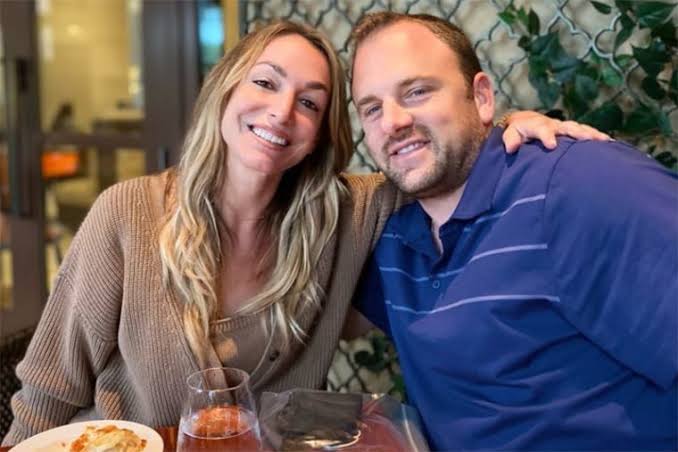
The lawsuit has attracted new national attention — not just for its allegations about how the investigation was conducted, but for what it revealed about the private communications of two officers at the center of the case.
Their text messages span nearly a decade. They contain racial slurs targeting multiple communities — Black, Latino, Jewish — and a significant number that are specifically anti-Asian.
They are also, it must be said, the private communications of officers who spent years responding to calls, conducting investigations, and interacting with the very communities they were privately disparaging.
What the Texts Say
The lawsuit specifically mentions MSP Detective Michael Proctor, who was fired last year, and former CPD Sergeant Sean Goode, who resigned earlier this week.
Among the anti-Asian messages the two officers are alleged to have written:
"All g*oks have shrubs between their legs." — Michael Proctor
"I can't deal with the g*oks." — Sean Goode
"Deport their asses. I don't care if they are here legally or what their excuse was. F*cking deport those sand n**gers." — Michael Proctor
Boston’s Mayor Michelle Wu is described in vulgar terms as well.
According to the complaint, in written and recorded audio conversations beginning in 2013 — the year MSP hired Proctor and when Goode was already an officer — and for almost a decade later, the two referred to community members as "stupid ugly gok(s)," "chnk(s)," "chnk tard(s)," "spc(s)," and a range of other slurs. The attorneys allege that Proctor and Goode "believed these folks were polluting the neighborhoods in which they lived and worked, and where they eventually served."
The town of Canton released a statement saying the messages are "abhorrent, deeply offensive, hateful, and do not reflect the values of the Canton Police Department or its members."
Massachusetts State Police Colonel Geoffrey D. Noble also released a statement: "These disturbing messages are entirely inconsistent with any basic standard of decency and certainly with the expectations of a Massachusetts State Trooper. These racist, sexist, and abhorrent comments absolutely do not reflect the values of the Massachusetts State Police and are not tolerated within our ranks. They underscore and fully support my decision to terminate Michael Proctor."
Proctor was fired in March 2025 following a mistrial declared in the first trial of Read. He admitted on the stand during that trial that the texts were "unprofessional."
Why This Matters
The Read lawsuit is about Read. But the texts are about something larger: what happens when the people charged with protecting a community hold that community in contempt.
Michelle Wu — the target of Goode's slur — is the first Asian American mayor of Boston. She is also, theoretically, the person at the top of the chain of command overseeing the city's law enforcement apparatus. The image of a Boston police sergeant sending slurs about his own mayor is not a quirk. It is a data point in a long and well-documented pattern.
A new poll from AAPI Data and the Associated Press-NORC Center for Public Affairs Research found that about one-quarter of AAPI adults have personally experienced a hate crime or incident in the past year, and about 3 in 10 think it's "extremely" or "very" likely that they'll be a victim of discrimination in the next five years. Anti-Asian hate crimes recorded by the FBI in 2025 stood at 318 incidents — approximately 2.4 times higher than the pre-pandemic average. And those are only the reported ones. Federal victimization surveys estimate that 42% of violent hate crimes go unreported entirely.
The underreporting is not a mystery. Asian Americans Advancing Justice has documented that hate crimes go unreported due to fear of retaliation, language and cultural barriers, and distrust of law enforcement. The US Commission on Civil Rights has specifically found that Asian Americans may be even less likely to report discriminatory incidents than other groups. Hua Wang, co-chair of the New England Chinese American Alliance, put it plainly: "Many in the Asian American community are not completely comfortable with law enforcement for a lot of reasons historically and culturally."
Think about what that means in practical terms: A community experiencing hate crimes at more than double its pre-pandemic rate is simultaneously among the least likely to report those crimes to the police.
The Massachusetts texts give that distrust a name and a badge number. They’re not an argument against law enforcement. They’re an argument for understanding why an AAPI victim might hesitate before picking up the phone — and for taking that hesitation seriously rather than dismissing it as cultural reticence.
What Needs to Happen
The institutional responses to the texts have been adequate in their language and inadequate in their implications. Proctor was fired and Goode resigned. Statements were issued claiming that the standards of decency were not reflected.
But firing one detective and accepting one resignation doesn’t address the question of how two officers spent nearly a decade exchanging these messages without consequence, or whether there are others in the department whose texts have not yet surfaced in a civil lawsuit.
The AAPI community in Massachusetts — and nationally — is being asked to trust law enforcement to take anti-Asian hate crimes seriously. That is a meaningful ask when the evidence shows that some of the officers taking those reports privately refer to the people filing them as goks and chnks.
Sim J. Singh Attariwala, director of the anti-hate program at Asian Americans Advancing Justice, said: "The FBI's topline data pulls back the curtain of the lived reality for many Asian American communities who continue to face targeted violence, harassment, and intimidation because of their perceived race."
And to think, if this was all uncovered more or less by accident —in a white woman’s attempt to clear her name against a murder accusation — imagine what we might find if holding bigots accountable was an actual priority.
© 2026 by Asian Media Group Inc.
Recent Articles
- Tehran Says Deal Won't Be Signed Sunday
- Two Phones and an App: How Russians Skirt Putin's Digital Iron Curtain
- Mag 7? MANGOS? Post-SpaceX Wall Street's Forced to Invent New Shorthand
- Trump Removed from Kennedy Center in Predawn Operation
- Zuckerberg Says Meta Made 'Mistakes' in AI Workforce Shift
- LE SSERAFIM Hits Stratosphere with Iconic Summer Collaboration
- Jane Fonda to Host First Amendment Celebration Opposite Trump's UFC Event
- SK Hynix Picks Nasdaq for Planned US Listing
- Ukraine's Defense AI Chief Predicts 'New Paradigm' of Warfare
- How Musk's Tactics Blinded Investors to SpaceX Risks