

Peace Talks Uncertain As Ceasefire Nears End
By Reuters | 20 Apr, 2026
Iran is considering attending peace talks in Pakistan even as it takes issue with coercion from Trump.
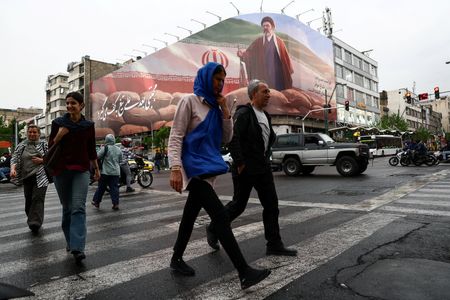
People walk near a billboard featuring an image of Iran's new Supreme Leader Mojtaba Khamenei, amid a ceasefire between U.S. and Iran, in Tehran, Iran, April 20, 2026. Majid Asgaripour/WANA (West Asia News Agency) via REUTERS
Iran is considering attending peace talks with the United States in Pakistan, a senior Iranian official told Reuters on Monday, following moves by Islamabad to end a U.S. blockade of Iran's ports, a significant obstacle to Tehran rejoining peace efforts as the end of a two-week ceasefire approaches.
However, the official stressed that no decision had been made and Iranian Foreign Minister Abbas Araqchi said that "continued violations of the ceasefire" by the U.S. are a major obstacle to continuing the diplomatic process.
Araqchi told his Pakistani counterpart Ishaq Dar in a telephone call that Iran, while taking all aspects of the matter into account, had yet to decide how to proceed further.
On Monday night, Iran’s top negotiator Mohammad Baqer Qalibaf accused U.S. President Donald Trump on X of increasing pressure on Tehran through the blockade and ceasefire violations, saying Iran rejects negotiations under threat.
The two-week ceasefire in a conflict that has killed thousands and roiled the global economy, particularly energy markets, is set to expire this week.
It had appeared to be in jeopardy after the U.S. said it had seized an Iranian cargo ship that tried to run its blockade and Tehran vowed to retaliate.
In the Islamabad talks, Trump is eager for a deal that would help avoid another surge in oil prices and plunge in stock markets. Iran hopes to leverage its control of the Strait of Hormuz, a crucial shipping channel for global energy supplies, to get an agreement that prevents a resumption of the war, and allows financial relief from long-running sanctions and some breathing room for its nuclear program.
Adding to the uncertainty, Vice President JD Vance remained in the United States on Monday, a separate source told Reuters, denying reports he was already on his way to Pakistan for talks.
The unnamed senior Iranian official said Tehran was "positively reviewing" its participation, a shift from earlier statements ruling out attendance and pledging to retaliate for U.S. aggression.
The official said mediator Pakistan was making positive efforts to end the U.S. blockade and ensure Iran's participation.
Trump announced the two-week ceasefire with Iran on April 7, and has not specified when precisely it ends.
A Pakistani source involved in the talks said it would expire at 8 p.m. ET on Wednesday, which would be midnight GMT or 3:30 a.m. Thursday in Iran.
Trump said on social media that he believed his administration's nuclear deal with Iran would be better than a 2015 international agreement reached after years of negotiations under then-President Barack Obama, a Democrat.
Trump withdrew from that agreement - which had been vehemently opposed by congressional Republicans and Israeli Prime Minister Benjamin Netanyahu - in 2018, during his first term as president.
It was unclear what kind of agreement could be reached in just a few days of talks, but the Republican U.S. president predicted a quick result.
"I am under no pressure whatsoever, although, it will all happen, relatively quickly!" Trump said in a Truth Social post.
BLOCKADE POSES A PROBLEM
A Pakistani security source said Pakistani mediator Field Marshal Asim Munir had told Trump the blockade was an obstacle to talks, and that Trump had promised to consider ending it.
The U.S. was hoping to start negotiations in Pakistan shortly before the ceasefire expires.
However, Iranian President Masoud Pezeshkian said that "unconstructive & contradictory signals from American officials carry a bitter message; they seek Iran's surrender."
"Iranians do not submit to force," he added on X.
The U.S. has maintained its blockade of Iranian ports, while Iran lifted and then reimposed its own blockade of the Strait of Hormuz, which typically handles roughly one-fifth of the world's oil and liquefied natural gas supply.
Oil prices rose around 5% as traders remained fearful that the ceasefire would collapse. Traffic through the Strait of Hormuz was at a virtual standstill with just three crossings in the space of 12 hours, according to shipping data. [O/R]
U.S. MARINES BOARD IRANIAN VESSEL
The U.S. military said it had fired on an Iranian-flagged cargo ship headed towards Iran's Bandar Abbas port on Sunday after a standoff. U.S. Central Command released video showing Marines descending ropes from helicopters onto the vessel.
The vessel is likely to have been carrying what Washington deems dual-use items that could be used by the military, maritime security sources said on Monday.
Iran's military said the ship had been travelling from China and accused the U.S. of "armed piracy", according to state media. They said they were ready to confront U.S. forces over the "blatant aggression", but were constrained by the presence of crew members’ families on board.
China, the main buyer of Iranian crude, expressed concern over the "forced interception", and Chinese President Xi Jinping called for ships to resume passage through the strait as normal and for the conflict to be resolved through political and diplomatic channels, state news agency Xinhua reported.
Trump warned on Sunday that the U.S. would destroy every bridge and power plant in Iran if it rejected his terms, continuing a recent pattern of such threats.
Iran has said that if the United States were to attack its civilian infrastructure, it would strike power stations and desalination plants in its Gulf Arab neighbours.
PREPARING FOR TALKS THAT MIGHT NOT HAPPEN
Pakistan geared up to host the talks despite uncertainty over whether they would go ahead. Nearly 20,000 security personnel have been deployed across Islamabad, a government official and a security official said.
Thousands of people have been killed by U.S.-Israeli strikes on Iran and in an Israeli invasion of Lebanon conducted in parallel since the war began on February 28. A truce in Lebanon is also currently in place and Washington is to host a second round of ambassador-level talks between Lebanon and Israel on Thursday as part of efforts to protect a fragile ceasefire.
(Reporting Reuters bureaus; Writing by John Geddie, Alexandra Hudson, Keith Weir, Patricia Zengerle and Tim Reid; Editing by Lincoln Feast, Kevin Liffey, Alison Williams and Nia Williams)
© 2026 by Asian Media Group Inc.
Recent Articles
- US and Iran Conclude High-Level Talks in Switzerland
- Oil Slips After US-Iran Conclude Talks in Switzerland
- China Targets US Rare Earth and Other Firms with Export Controls
- Shipping Slows After Iran Says It Has Again Shut the Strait of Hormuz
- China Tightens Indium Export Checks as AI Demand Increases
- Samurai Blue Sweep Aside Tunisia, Japan Fans Sweep Monterrey Stadium
- Lebanon Fighting Threatens Switzerland Negotiations
- Danone-Chobani Yoghurt Protein War Underscores GLP-1 Impact
- Italy's Meloni Tells Trump to Focus on His Own Popularity as Row Continues
- Trump Unveils Gifted Qatari 747 As Addition to Air Force One Fleet