

The Brilliant Success and Mysterious Death of a Chinese American Author
By Goldsea Staff | 23 Mar, 2026
Iris Chang's purported suicide just as she attained the peak of her success raised suspicions of possible foul play.
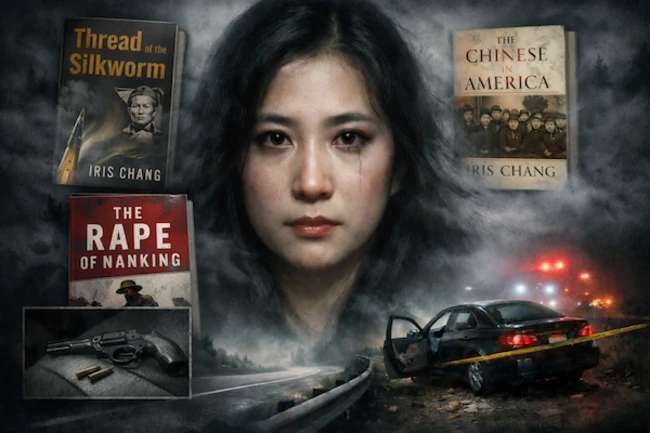
(Image by ChatGPT)
On the morning of November 9, 2004, a motorist noticed a car parked along a side road on Highway 17 just south of Los Gatos, California, stopped to check, and found inside a woman dead from a self-inflicted gunshot wound.
She was 36-year-old Iris Chang, a bestselling author at the height of her powers, a wife, a mother of a two-year-old son, and one of the most consequential voices in modern historical writing.
The world had lost one of its most fearless chroniclers of human suffering. The circumstances of her death have remained unsettled in the minds of those who loved her, admired her, or had their eyes opened by reading her books.
Born to Academia
Iris Shun-Ru Chang was born on March 28, 1968, in Princeton, New Jersey, to a Taiwanese American family, and raised in Champaign-Urbana, Illinois. Her parents, Ying-Ying and Shau-Jin Chang, were university professors — her mother a biochemist, her father a physicist — and they raised Iris and her younger brother steeped in the values of intellectual rigor, hard work, and historical memory.
It's that last quality that would define everything. Iris grew up hearing stories about the Nanjing Massacre, in which Japanese troops swept into what was then China's capital city in 1937 and unleashed a campaign of slaughter, rape, and torture so extensive that it left hundreds of thousands of civilians dead. Those stories never left her.
She was a prodigy from the start. At the University of Illinois at Urbana-Champaign, she started as a computer science major before switching to journalism, earning her bachelor's degree in 1989. During her time in college she also worked as a New York Times stringer, writing six front-page articles over the course of a single year.
Thread of the Silkworm
After brief stints at the Associated Press and the Chicago Tribune, she pursued a master's degree in Writing Seminars at Johns Hopkins University. She went to work on her first book, a biography of Chinese-born scientist Tsien Hsue-shen — a man who'd helped pioneer the American space program only to be falsely accused of communist sympathies during the McCarthy era and deported to China where he would later help launch that country's missile program.
The Thread of the Silkworm established Chang as a serious and compelling historical voice.
Rape of Nanking
But it was Rape of Nanking: The Forgotten Holocaust of World War Two, published in 1997 when Chang was just 29, that launched Chang's fame into the stratosphere.
The book brought the Nanjing Massacre to the attention of Western readers who'd barely heard of it. Chang had traveled to China, interviewed survivors, combed through diaries and photographs, and assembled a narrative so vivid and morally urgent that it couldn't be ignored. The book became a New York Times bestseller and made its author famous almost overnight.
The late historian Stephen Ambrose described Chang as perhaps the best young historian alive because she understood that communicating history meant telling the story in a way that made people feel it.
Angry Japanese Nationalists
But its success brought complications. The book infuriated Japanese nationalists and right-wing politicians who'd long worked to suppress the massacre from the historical record. Chang received frequent harassment and threats from Japanese groups after the book was published.
She confronted the Japanese ambassador to the United States on television, demanding a full apology rather than vague diplomatic non-acknowledgments that she said left Chinese people infuriated. She wasn't just an author anymore; she was an activist, a spokesperson, a symbol. That's a heavy burden at age 29.
Chinese in America
Her third book, The Chinese in America, argued that Chinese Americans had been treated as perpetual outsiders despite their obvious adherence to the American ethic of hard work. It was another success. Chang was in demand everywhere — as a speaker, an interview subject, a public intellectual. She was also a new mother, and by all accounts she was pushing herself at a pace that would've broken most people.
Bataan Death March
It was in 2004, while deep in research for her fourth book — about the Bataan Death March and the atrocities committed against American POWs by the Japanese military in the Philippines — that things began to unravel.
The subject matter was extraordinarily painful. She was conducting interviews with aging survivors, listening to accounts of torture and death and the particular anguish of men who felt their suffering had been deliberately ignored.
Her literary agent recalled sometimes talking with Chang for hours by telephone after she'd conducted an especially difficult interview, noting that there was no question the painful subjects she explored took a toll.
Depression and Suspect Medication
In August 2004, while traveling to Harrodsburg, Kentucky, to gain access to archival recordings from servicemen, she suffered an extreme bout of depression that left her unable to leave her hotel room in Louisville. A local veteran who'd been assisting her research helped her check into Norton Psychiatric Hospital, where she was diagnosed with reactive psychosis, placed on heavy medication, and then released. She never fully recovered.
Her parents came to believe the medications she was prescribed worsened her state of mind. Her mother, drawing on her biochemical background, researched the drugs and concluded that doctors hadn't accounted for the fact that Asians can experience far stronger effects from certain psychiatric medications.
"We do not think she was well treated," her father said plainly.
Persisting Questions
And then there are the questions that won't quite go away — not because there's hard evidence of foul play, but because the circumstances of Chang's life in her final years were genuinely alarming in ways that extend beyond mental illness alone.
Because of her personal involvement in the experiences of those she was interviewing, Chang had become possessed by fears of reprisals from conservative Japanese groups or the US government due to the political embarrassment caused by her books and activism.
Whether those fears were symptoms of her deteriorating mental state or rooted in some real danger has never been fully resolved. Her parents didn't believe she was targeted, though they acknowledged she'd received death threats because of her research.
"We knew she was suicidal. She left a suicide note," her mother said.
Multiple Pressures
What's not in dispute is that the forces bearing down on Iris Chang in the last year of her life were genuinely enormous — professional pressure to produce, the psychological weight of years spent immersed in human atrocity, new motherhood, physical exhaustion, inadequate psychiatric care, and hostile threats from abroad.
Chang was as wedded to the image of herself as perfect as were many around her, and being a Chinese American, she was also prone to the four Ss that make accurate diagnosis in the Asian American community more difficult: stigma, shame, silence, and secrecy. Her professional success prevented almost everyone from seeing her mental illness clearly.
Suicide Notes
She left behind three suicide notes, each dated November 8, 2004, the day before she was found. One of them included a wrenching line: "When you believe you have a future, you think in terms of generations and years. When you do not, you live not just by the day — but by the minute."
She was found the following morning.
Memorials in China and San Jose
In the years since, her legacy has only grown. A bronze statue of her was installed at the Nanjing Massacre Memorial Hall in China, and she's been commemorated by numerous tributes from the survivor and activist communities whose stories she helped tell.
A park in San Jose, California, was named in her honor. Her books remain in print. The Nanjing Massacre, which she spent her adult life fighting to keep in the world's memory, still has no formal apology from Japan — a fact she likely would've spent her remaining decades working to change.
Lingering Questions
What killed Iris Chang? The official answer is suicide. Her parents accepted that answer even as they challenged the mental illness diagnosis and blamed the medications. Those who watched her closest in her final months saw a woman consumed by an illness that everyone around her had been too dazzled by her genius to notice in time.
And somewhere in the dark details of her final years — the threats, the paranoia, the politically sensitive research, the breakdown in Kentucky, the months of heavy medication — is a shadow that never quite lifts. Maybe it's enough to say that whatever the final mechanism, the world she'd given her life to documenting had slowly taken hers. The forgotten holocausts she'd dragged into the light had cost her everything.
Articles
- Asia's Manufacturers Hit Hardest by Mideast Conflict
- US Job Market Remains in Low-Hire, Low-Fire Mode
- Geely Seeks Tieups with Merces-Benz, Ford to Double Europe Footprint by 2027
- Pony.ai to Double Global Robotaxi Fleet As Fare Revenues Jump Sixfold
- Plastics Prices Soar on Loss of Mideast Petrochemical Shipments
- Meta Begins Laying Off Up to 20% of Workforce to Focus on AI
- Helium Shipment Disruption Begins Impacting Chip Production
- Tehran, Trump Present Contrasting Takes As World Awaits Response
- Asian American Paranoia Fueled by ICE Tactics
- How the US, China and India Compare in Engineering Talent