

The Hypocrisy and Fallacy Behind the US's Iran Policy
By Tom Kagy | 25 May, 2026
The persisting delusion that we have the right and the ability to prevent other nations from acquiring the same weaponry we have used and possess by the thousands fuels pointless wars and conflicts.
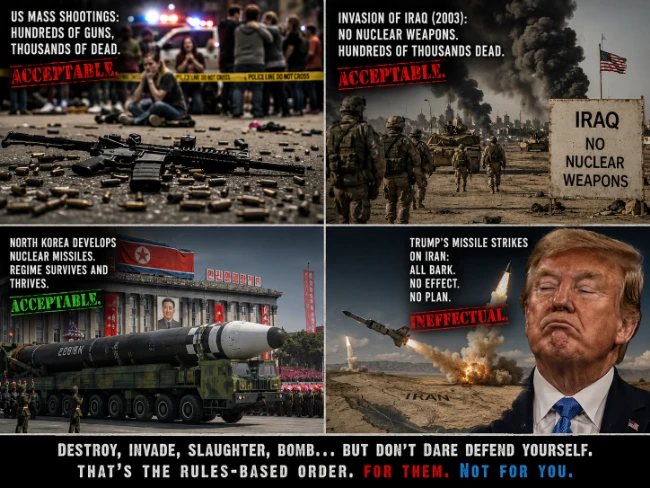
(Image by ChatGPT)
Here's a question that doesn't get asked nearly enough in the breathless cable news coverage of Iran's nuclear ambitions: What gives us the right?
The US has roughly 5,500 nuclear warheads. We're the only country that's ever actually used one — two, in fact — on a civilian population. And yet we've spent decades, burned through billions of dollars, destabilized an entire region, and pushed the world repeatedly to the brink of another shooting war over the possibility that Iran might someday build one. Just one.
The logic doesn't hold up. It never did. And our efforts to pursue that logic with military and economic force also never held up.
The best way to understand a broken foreign policy is to look at a broken domestic one.
The US has some of the most debated, most litigated, most politically explosive gun laws in the developed world. We argue endlessly about background checks, waiting periods, assault weapons bans, red flag laws. And yet there are more guns in this country than there are people. Somewhere north of 400 million firearms in civilian hands. Tens of thousands of Americans die from gun violence every year — in schools, in churches, in grocery stores, in their own homes.
All those laws, all that enforcement, all that political capital spent — and the guns are still everywhere and people are still dying.
Now scale that up to the international level. If we can't stop a determined American citizen from getting a gun despite decades of legislation and a massive law enforcement apparatus, what exactly makes anyone think we can stop a sovereign nation — one with its own scientists, its own resources, its own desperate incentives — from eventually building a nuclear weapon if it decides that's what it needs to survive? The answer, inconveniently, is: we can't. Not really. Not permanently.
This is the fundamental fallacy at the heart of US Iran policy. It's the same fallacy that's driven us into trillion-dollar wars and morally catastrophic foreign interventions for generations. It's the belief that if we just apply enough pressure — enough sanctions, enough covert operations, enough saber-rattling, enough proxy conflicts — we can prevent a determined actor from doing what determined actors with sufficient motivation almost always eventually do.
History is not kind to this belief. Pakistan built a bomb. North Korea built a bomb. Both did so under intense international pressure and crippling sanctions. Neither was stopped. What changed? Mostly just the level of danger and instability in their respective regions, which went up dramatically in the process.
Iran has been watching all of this. They've watched what happened to Saddam Hussein's Iraq after it gave up its weapons programs and let inspectors in. They watched what happened to Muammar Gaddafi's Libya after he made a deal to abandon his nuclear ambitions and cooperate with the West. Both men ended up dead and their countries in ruins. You'd have to be extraordinarily naive to look at that track record and think Iran's leadership wouldn't draw the obvious conclusion: the only real insurance policy against American-backed regime change is a nuclear deterrent.
We created this incentive. And then we act shocked that the incentive works.
The deeper disease here — and it is a disease, a kind of institutional pathology baked into American foreign policy — is what you might call the law-enforcement-industrial-complex mentality. It's the default assumption that the right response to any problem is unilateral force or the threat of it. Sanctions are just economic force. Military posturing is just kinetic force waiting to happen. Covert sabotage operations like Stuxnet are just force wearing a disguise. The toolkit barely changes. Only the packaging does.
What this mentality can't seem to accommodate is the possibility that the most effective long-term strategy isn't coercion at all. It's the patient, unglamorous work of building a world order in which Iran — or any other nation nursing nuclear ambitions — simply has less reason to want the bomb in the first place. That means actual diplomacy, not as a prelude to ultimatums but as a genuine end in itself. It means security guarantees that are credible because they're embedded in multilateral frameworks, not dependent on whoever happens to be in the White House. It means treating other countries as actors with legitimate interests rather than problems to be managed or threats to be neutralized.
The 2015 JCPOA — the nuclear deal that the Obama administration negotiated with Iran along with five other world powers — was an imperfect but genuine attempt at exactly this kind of approach. Iran agreed to massive reductions in its enriched uranium stockpile, intrusive inspections, dismantlement of centrifuges. In exchange it got relief from some of the sanctions that had been strangling its economy. It wasn't a perfect deal. But it was working. Iran was in compliance. The pathway to a bomb had been significantly lengthened.
Then we blew it up. The Trump administration walked away from the deal in 2018, reimposed sanctions, and assassinated Iran's top military commander for good measure. Iran responded by accelerating its nuclear program. Enrichment levels that were capped at 3.67 percent under the JCPOA are now pushing toward 60 percent — a short technical step from weapons-grade. We made the situation dramatically worse in exchange for nothing.
And what was the justification? That the deal wasn't tough enough. That we needed maximum pressure to get maximum concessions. That we could squeeze Iran into total capitulation if we just squeezed hard enough. It's the same logic that's failed in Cuba for sixty years, that failed to stop North Korea, that's failed everywhere it's been tried against a government willing to make its own people suffer in the name of survival and national pride. Turns out, when you back a regime into a corner, it doesn't usually surrender. It doubles down.
The uncomfortable truth that US policymakers have never been willing to say out loud is this: if a nation is genuinely willing to endure any consequence — economic collapse, international isolation, military strikes on its facilities — you cannot ultimately prevent it from acquiring weapons that other nations possess and that it believes it needs for its own security. The will to survive, at the national level, is not something you can sanction away.
That doesn't mean we should be indifferent to nuclear proliferation. It means we should be honest about what actually works and what doesn't. What doesn't work is the punish-and-pressure playbook we've been running for four decades. What might work — what has worked, in fits and starts, when we've actually tried it — is the slower, harder, less cinematic task of making the bomb less attractive by making the world less threatening.
We keep looking for a shortcut. There isn't one. And in the meantime, the billions keep getting spent, the lives keep getting lost, the region stays on fire, and Iran keeps enriching uranium. The hypocrisy and the fallacy march on together, arm in arm, wondering why nothing ever seems to get better.
Recent Articles
- China Feels Targeted by QUAD Cooperation
- South Korea Aims to Launch First Nuclear-Powered Submarine by the Mid-2030s
- Sam Altman Argues AI Unlikely to Lead to 'jobs Apocalypse'
- 'Zero-Gravity' Seats Under Scrutiny in China's Draft EV Safety Rules
- China Restricts Overseas Travel for Top AI Talent at Alibaba and DeepSeek
- Colonial-Era New Delhi Club Ordered to Move, Sparking Debate on India's Elites
- Australia-India-Japan-US Quad to Build a Port, Unveil Pact on Critical Minerals
- Foreign-Branded Phone Sales in China up 1.8% on Year in April
- Trump Claims 2020 Election 'rigged' at Least 107 Times in Six Months as Midterms Loom
- Pentagon Spars with SpaceX over Starlink Price Hike During Iran War