

The Minor Export that Gives China a Major Bargaining Chip
By Ben Lee | 20 Jul, 2026
Simply withholding this by-product mineral would let China disrupt production for US defense and communications industries.
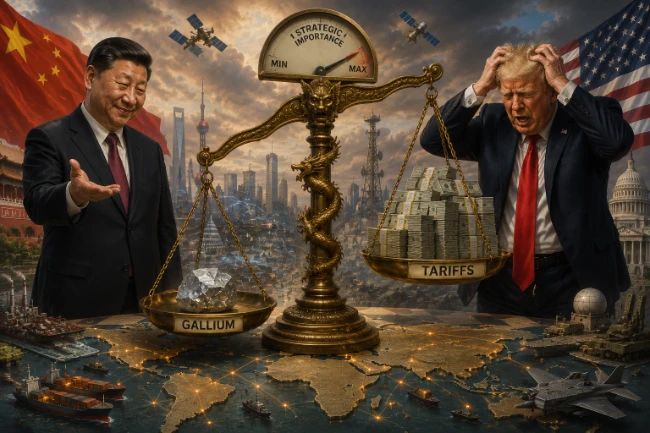
The strategic value of a commodity isn't measured by its dollar value. It is measured by how much damage its absence can cause.
That simple principle explains why gallium, a metal unfamiliar to most people and representing only a tiny fraction of China's export earnings, has become one of Beijing's most effective sources of geopolitical leverage.
The Tiny Metal With Outsized Influence
Gallium exports generate little revenue compared with China's vast shipments of smartphones, machinery, consumer electronics or electric vehicles. Yet the metal occupies an indispensable place inside the world's most advanced communications equipment, military radar, satellites, power electronics and semiconductor technologies. A complete interruption of gallium exports would barely register on China's trade balance while potentially imposing billions of dollars in costs on industries that the United States considers vital to both economic competitiveness and national security.
That extraordinary imbalance between economic value and strategic importance has transformed gallium from an obscure industrial byproduct into one of China's strongest bargaining chips in future trade and diplomatic negotiations.
An Element Hidden Inside Aluminum
Unlike copper or iron, gallium is almost never mined as a primary metal.
Instead, it exists in tiny concentrations inside bauxite, the ore used to manufacture aluminum, and to a lesser extent inside zinc ores. During aluminum refining, gallium gradually accumulates in the chemical solutions used to separate alumina from the ore. With additional processing it can be extracted and purified.
The irony is that gallium is not especially rare. It is actually several thousand times more abundant in Earth's crust than gold. The problem is that it is dispersed in concentrations measured in only a few dozen parts per million. Mining specifically for gallium would be absurdly uneconomic. Instead, producers recover it only after processing millions of tons of aluminum ore.
For decades China invested heavily in aluminum refining and, just as importantly, in the chemical expertise needed to isolate and purify gallium. Today it accounts for virtually all primary low-purity gallium production and dominates much of the world's refining capacity. That leadership did not arise because China possesses unique geological resources. It arose because it patiently built an industrial ecosystem that few competitors considered worth duplicating.
A Market Worth Millions That Supports Industries Worth Trillions
Gallium illustrates one of the great paradoxes of the modern economy.
The entire world consumes only several hundred metric tons each year. Even at today's elevated prices, the total market for primary gallium amounts to only a few hundred million dollars annually.
Yet those few hundred tons enable industries measured not in millions but in trillions of dollars.
Gallium arsenide chips amplify radio signals inside virtually every smartphone. Gallium nitride has become one of the most promising semiconductor materials for high-efficiency power conversion, allowing electrical systems to operate faster, cooler and with dramatically lower energy losses than conventional silicon devices. Blue LEDs, white LED lighting, laser diodes, satellite communications and many advanced optical systems all depend on gallium compounds.
The metal itself contributes only pennies or dollars to the cost of many finished products. Without it, however, many of those products could not be manufactured at all.
This is precisely the type of supply chain dependency that strategic planners lose sleep over.
The Foundation Of Modern Communications
Few consumers realize how much modern communications infrastructure relies on gallium.
Gallium arsenide has long been the semiconductor of choice for radio-frequency amplifiers because electrons move through it much faster than through silicon. That makes it particularly well suited for handling the high-frequency signals used in mobile phones, satellites, GPS receivers and wireless networking equipment.
As telecommunications migrate toward increasingly demanding frequencies for 5G, future 6G and satellite broadband systems, compound semiconductors built from gallium continue to occupy applications where silicon struggles to match their performance.
Equally important is gallium nitride.
GaN devices are revolutionizing power electronics by switching electricity at much higher frequencies while generating less heat. Smaller transformers, lighter power supplies and dramatically higher efficiencies become possible. AI data centers, which already consume staggering quantities of electricity, stand to benefit enormously from these improvements because even small gains in electrical efficiency translate into substantial reductions in operating costs.
Every percentage point of energy savings becomes increasingly valuable as AI infrastructure expands.
A Critical Defense Material
The military significance of gallium is even greater than its commercial importance.
Modern active electronically scanned array radars depend heavily upon gallium nitride power amplifiers. These radars can steer beams electronically without moving mechanical antennas, allowing aircraft, ships and missile-defense systems to track multiple targets simultaneously while resisting electronic jamming.
Gallium compounds also appear in infrared sensors, missile guidance systems, satellite communications equipment and electronic warfare systems.
Unlike consumer electronics, defense hardware cannot simply substitute another material if supplies become constrained. Every component must undergo years of testing, qualification and certification before entering military service. Even if alternative suppliers exist, changing them often requires extensive redesign and validation.
Consequently, a prolonged gallium shortage would affect military procurement far more severely than consumer electronics.
A Surprisingly Powerful Economic Weapon
China's leadership recognized years ago that strategic leverage does not require controlling enormous markets. It requires controlling indispensable bottlenecks.
The export value of raw gallium is tiny compared with China's overall trade. Restricting exports therefore imposes relatively little economic pain on Chinese producers while creating considerable uncertainty among foreign manufacturers.
This asymmetry gives Beijing a negotiating advantage.
A country that depends upon uninterrupted access to gallium must constantly consider whether future political disputes could threaten its supply chain. Even temporary licensing delays can disrupt manufacturing schedules, encourage stockpiling and increase costs throughout the semiconductor industry.
China demonstrated this leverage by placing gallium under export licensing requirements in 2023 and later imposing stricter restrictions on shipments to the United States before partially relaxing them. The message was unmistakable: strategic minerals can become diplomatic tools.
Why Replacing China Will Take Time
Some observers dismiss China's leverage by pointing out that gallium is abundant worldwide.
Geologically, they are correct.
Commercially, they are missing the point.
Recovering gallium requires sophisticated chemical processing facilities integrated into aluminum refineries. Building those facilities takes years, requires specialized expertise and only becomes profitable if purchasers are willing to sign long-term contracts.
For decades Western producers generally concluded that importing Chinese gallium was cheaper than building competing facilities.
Now governments are attempting to reverse that decision.
Projects are underway in Australia, Canada and elsewhere to establish alternative sources of gallium. Aluminum companies that previously ignored the metal are examining ways to recover it from existing refining operations. Recycling semiconductor manufacturing scrap also offers opportunities to expand supply.
These initiatives will gradually reduce China's dominance.
They will not eliminate it overnight.
The Lesson Extends Beyond Gallium
Gallium is only one example of a broader strategic pattern.
China also occupies commanding positions in processing heavy rare earth elements, graphite, antimony, tungsten, bismuth and several other critical materials. In many cases its advantage lies less in mining than in chemical refining, purification and downstream manufacturing.
This distinction matters enormously.
Opening a new mine is difficult. Building an entire industrial ecosystem of processors, refiners, crystal growers, materials scientists and semiconductor manufacturers is far harder.
China spent decades assembling these capabilities while many Western nations focused on lowering manufacturing costs through globalization. What appeared economically efficient during periods of stable international relations now appears strategically risky.
The same lesson applies to many technologies beyond mining. Supply chains optimized solely for cost often become fragile when geopolitical tensions rise.
Building A More Resilient Supply Chain
The United States and its allies are already responding.
Governments have designated gallium as a critical mineral, supported domestic refining projects, encouraged recycling and sought to diversify imports from friendly countries. Semiconductor manufacturers are redesigning some products to reduce gallium usage where technically feasible, while researchers continue developing alternative materials for selected applications.
None of these measures will eliminate dependence entirely.
Nor should they.
Global trade remains vastly more efficient than attempting to produce every critical material domestically. The objective is resilience rather than self-sufficiency.
A diversified supply chain can absorb disruptions that would cripple a concentrated one.
That diversification, however, requires years of investment before it produces meaningful results.
The Real Bargaining Chip
Gallium's greatest significance lies not in its intrinsic value but in what it reveals about twenty-first-century economic power.
In previous eras nations competed to control oil fields, iron mines and shipping lanes because industrial economies depended upon enormous quantities of raw materials.
Today's technological economy often depends instead upon tiny volumes of highly specialized materials embedded deep inside extraordinarily complex products.
A few hundred tons of gallium annually help enable global communications networks, advanced military systems, AI infrastructure and satellite technology. Interrupting that flow would not collapse the American economy, but it could create painful bottlenecks in industries that are disproportionately important to national security and technological leadership.
That is why gallium represents such an effective bargaining chip.
It costs China comparatively little to restrict. It would cost the United States far more to replace on short notice. And until alternative refining capacity is fully developed elsewhere, Beijing can remind trading partners that strategic influence sometimes comes not from exporting the most valuable products, but from controlling the least replaceable ones.
The future of geopolitical competition may therefore be shaped less by spectacular embargoes on major commodities than by quiet restrictions on obscure materials that few people have ever heard of—but upon which modern civilization quietly depends.
© 2026 by Asian Media Group Inc.
Recent Articles
- Trade Tiff with Canada Deepens with New 50% US Tariffs
- Cooling AI Rally Helps Lift Indonesia's Beaten-Down Stocks
- Samsung Electronics Creates Robotics Division with ex-Hyundai Executive Heading Up Strategy
- Yamamoto Dominates, Yoshida Prompts Win Streak, Suni Lee Is Back, BTS Headlines World Cup
- Chipmakers' Big Profit Gains May Not Be Enough
- Blockbuster Films Produce Record Revenues for AMC
- Archer, Anduril Unveil Autonomous Aircraft Platform for Defense
- Why Oil Prices Haven't Gone Crazy Despite 5 Months of US-Iran Conflict
- Suzuki's No-Frills Cars Once Ruled India. Then Buyers Demanded Frills.
- Japanese Mayor Makes History with Maternity Leave That Caused a Stir