

The New Ethics and Aesthetics of Male Makeup
By Kavya Anand | 19 Jul, 2026
This is a confusing time for men who want to look their best without arousing suspicions of gender identity.
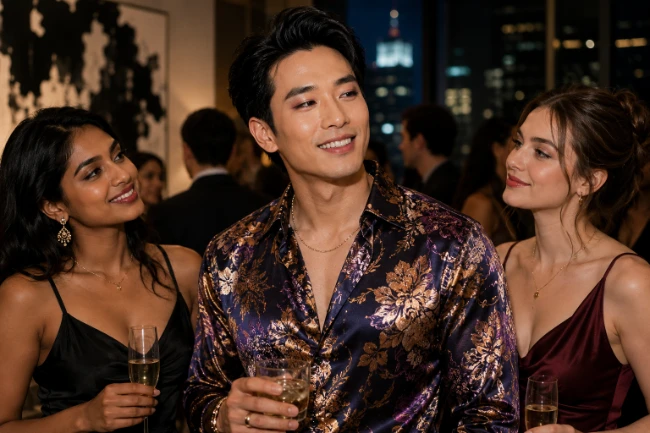
Ethically speaking the only hard rule is never to look prettier than your date. Aesthetically, however, the issue of male makeup has become convoluted, what with increasingly broadening images of male beauty and sexuality.
A generation ago, the question of whether a man should wear makeup answered itself: no, unless he was on television, on stage, or in a casket. Today the question has splintered into a dozen smaller questions, each with its own anxieties. Is concealer makeup, or is it grooming? Does tinted sunscreen count? If a man fills in a patchy spot in his beard with a pencil, has he crossed a line, and if so, which line, and who drew it, and are they still watching?
Of course nobody is watching as closely as the anxious man imagines. But the anxiety is real, and it deserves a serious accounting, because it sits at the intersection of two forces pulling in opposite directions: a culture that increasingly rewards men for looking polished, and a lingering suspicion that polish itself is a confession of something.
A Brief History of the Painted Man
It helps to remember that the barefaced man is a historical anomaly. Egyptian noblemen lined their eyes with kohl and considered it both sun protection and status. Roman men lightened their skin with chalk. The courtiers of Louis XIV powdered, rouged, and beauty-marked themselves into oblivion, and no one questioned their appetites for war, hunting, or mistresses. As late as the eighteenth century, a European gentleman of means wore more product than a modern news anchor.
The great renunciation came with the Victorians, who decided that a serious man demonstrated his seriousness by refusing ornament. Makeup was reassigned to women, actors, and the demimonde, and there it stayed for roughly a century and a half. What we think of as the natural order — men scrubbed, women painted — is really just a long Victorian hangover. This does not settle the modern question, but it should at least lower the temperature. A man reaching for concealer is not violating ten thousand years of masculine tradition. He is violating about a hundred and fifty, most of them bad for men anyway.
The Concealer Consensus
Somewhere in the last decade, quietly and without a press release, a consensus formed around the low end of the spectrum. Tinted moisturizer, sunscreen with a hint of color, under-eye concealer, a clear brow gel, lip balm that is technically balm but suspiciously flattering: these are now grooming, not makeup, in the same way that whitening toothpaste is dental care and not vanity. The distinction is philosophically indefensible and socially ironclad.
The logic of the consensus is corrective rather than decorative. A man may erase — dark circles, redness, a blemish that arrived the morning of the job interview — because erasure returns him to his own baseline. What he restores is presumed to be his real face, temporarily obscured by a bad night or bad luck. Nobody accuses a man of deception for concealing a pimple any more than for combing his hair over a cowlick. The corrective principle is why the beard-filling pencil passes inspection while eyeliner does not: the pencil claims to reveal the beard you were meant to have, while the eyeliner announces an ambition beyond your factory settings.
The Visibility Threshold
Which brings us to the central aesthetic law, the one that governs everything above the concealer line: male makeup must be invisible to succeed. This is a strange standard — imagine telling a tailor his suit must look like the man arrived naked — but it is nearly universal among men who wear makeup and the professionals who sell it to them. The men's lines launched by major cosmetics houses are marketed almost entirely in the vocabulary of stealth: "undetectable," "no-makeup makeup," "skin, but better." The product's highest achievement is to be deniable.
The visibility threshold explains most of the practical anxiety. A man standing in the drugstore aisle is not really asking whether makeup is permissible; he is asking whether he can pull it off, meaning whether he can apply it so competently that no one will ever raise the question. This is a skills problem masquerading as an ethics problem. The men who get caught are not caught for wearing makeup but for wearing it badly — the concealer two shades too light, the bronzer with a visible coastline at the jaw. The offense is not vanity but incompetence, which has always been the true masculine sin.
The Spectrum Complication
If the story ended there, it would be simple: correct invisibly, and go in peace. But the broadening images of male beauty mentioned above have complicated the picture from the other direction. K-pop idols wear frank, visible makeup — shimmering lids, gradient lips — to audiences of millions who consider them the most desirable men alive. Male beauty influencers do full glam to enormous followings. NBA players get manicures. The fashion runways send out men in blush and glitter, and while the runway has never been a reliable guide to the street, it is a reliable guide to where the street will drift in a decade.
For the anxious man, this expansion is paradoxically more stressful than the old prohibition. Under the old regime, the rules were clear and the answer was no. Now the answer is "it depends," and it depends on variables he cannot fully control: his city, his industry, his age cohort, the lighting. Visible makeup on a twenty-four-year-old creative director in Los Angeles reads as fluency; the same makeup on a forty-year-old regional sales manager in a steakhouse reads as a midlife event. This is unfair, but so is most of aesthetics. Style has always been jurisdictional, and the borders move faster than the maps. The best a man can do is know which jurisdiction he is standing in before he opens the tube.
It is worth saying plainly that the fear encoded in the phrase "suspicions of gender identity" deserves examination rather than accommodation. Makeup has no orientation. Plenty of straight men wear it; plenty of gay men would not be caught dead in it. The suspicion, where it exists, belongs to the suspicious, and its power is fading with each graduating class. Still, a man is entitled to want his appearance to communicate what he intends and nothing else, the same way he chooses a suit over a caftan for a deposition. The goal is not hiding; it is precision.
Rules for the Anxious Practitioner
So, some workable principles. First, master the corrective tier before attempting anything decorative. Concealer, matched exactly to your skin and blended past invisibility, is the driver's license of male cosmetics; nobody should attempt the highway without it. Second, adopt one thing at a time. The face can absorb a single upgrade without triggering an audit; three simultaneous upgrades constitute a makeover, and makeovers get noticed. Third, daylight is the only honest judge. If it survives a south-facing window, it survives anything.
Fourth — the ethical tier — never lie when asked directly. "Is that concealer?" is answered with "yes, I looked like a corpse this morning," delivered with the shrug of a man discussing snow tires. Confidence retroactively legitimizes almost anything; denial retroactively incriminates everything. The men who normalized hair dye, teeth whitening, and moisturizer did it not by hiding but by declining to be embarrassed, and embarrassment is the only thing an observer can actually detect.
Fifth, calibrate to context, not to courage. Wearing visible makeup to a wedding in Bushwick is not brave, and skipping it at a funeral in Omaha is not cowardly; both are simply fluent. The man who understands his audience is not surrendering to it. He is doing what dressing well has always meant.
The Long View
Here is the likely future: the corrective tier will finish its merger with ordinary grooming within the decade, and the word makeup will quietly stop applying to it, the way "cosmetic" no longer attaches to deodorant. The decorative tier will remain a genuine choice — a statement, available to any man who wants to make one, legible as style rather than symptom. The middle ground, where most of the current anxiety lives, will shrink until it disappears.
Until then, the anxious man can console himself with the oldest truth in aesthetics: people are not thinking about you nearly as much as you fear. They are thinking about themselves, and about whether their own concealer is blended. Look rested, look like yourself on a good day, answer questions cheerfully, and remember the one hard rule with which we began. Your date spent forty-five minutes on her face, or his. Arriving more luminous than the person you came to admire is not a triumph of self-care. It is a failure of manners, and manners, unlike beauty standards, never go out of style.
© 2026 by Asian Media Group Inc.
Recent Articles
- Trade Tiff with Canada Deepens with New 50% US Tariffs
- Cooling AI Rally Helps Lift Indonesia's Beaten-Down Stocks
- Samsung Electronics Creates Robotics Division with ex-Hyundai Executive Heading Up Strategy
- Yamamoto Dominates, Yoshida Prompts Win Streak, Suni Lee Is Back, BTS Headlines World Cup
- Chipmakers' Big Profit Gains May Not Be Enough
- Blockbuster Films Produce Record Revenues for AMC
- Archer, Anduril Unveil Autonomous Aircraft Platform for Defense
- Why Oil Prices Haven't Gone Crazy Despite 5 Months of US-Iran Conflict
- Suzuki's No-Frills Cars Once Ruled India. Then Buyers Demanded Frills.
- Japanese Mayor Makes History with Maternity Leave That Caused a Stir