

Tulsi Gabbard Isn't Who You Think She Is
By J. J. Ghosh | 26 May, 2026
Former Trump DNI has been all over the place. A look at how she got there — and where she's probably headed next.
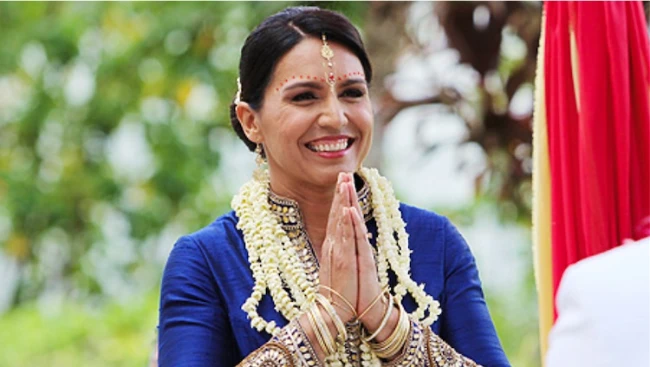
As an Indian American, I need to say something from the outset: Tulsi Gabbard is not one of us.
I don’t mean that in a “we don’t accept her because she doesn’t share our values” kind of way. I mean it as literally as possible: she is not Indian American.
It’s a common misconception that Gabbard, who just last week vacated her position as Director of National Intelligence in the Trump Administration, is South Asian — due in part to the fact she is Hindu and vaguely non-white. But her Hinduism comes from the fact that her Midwestern mother and Samoan father had converted.
The good news for any AAPIers who had hoped to claim her is that she is in fact still a Pacific Islander.
No, Tulsi Gabbard’s ethnic identity is not the most important thing about her. But in some ways, the confusion surrounding it perfectly encapsulates what we do not in fact know about one of the most fascinating figures in US politics.
And now that her time in the Trump administration has come to a close, her future remains just as big of a mystery.
The Origin Story
Gabbard, age 45, was born in Leloaloa, American Samoa. She grew up in Hawaii, the daughter of Mike Gabbard, a prominent Hawaiian politician who began his career as a Republican before switching to the Democratic Party in 2007, and Carol Porter Gabbard, originally from Indiana.
The family owned a vegetarian restaurant in Honolulu and practiced a form of Vaishnavism — a devotional Hindu tradition — which is where Gabbard’s religion comes from, and which contributed to the long-running misconception about her heritage.
In 2002, at age 21, she was elected to the Hawaii State House of Representatives, becoming the youngest person ever elected to a state legislature in Hawaii’s history. A year later, she enlisted in the Hawaii Army National Guard. In 2004 she was deployed to Iraq for a 12-month tour, serving in a medical unit, and was later awarded a Combat Medical Badge for her service. She would later deploy to Kuwait, training counterterrorism units.
The military background is important because it was never incidental to her politics. It was the foundation. Everything Gabbard did in public life — the anti-war positions, the foreign policy skepticism, the eventual disillusionment with Democratic orthodoxy — was filtered through the lens of someone who had actually been sent to fight the wars she was later criticizing.
The Democratic Years
Gabbard entered Congress in 2013 as a Democrat representing Hawaii’s 2nd congressional district. The first Samoan American and the first Hindu member of Congress, she was sworn in on the Bhagavad Gita. She was considered a rising star.
In January 2013 she was elected vice chair of the Democratic National Committee. It looked, for a moment, like the beginning of a conventional ascent — young, diverse, military-credentialed, progressively inclined. The kind of biography the Democratic Party says it wants to elevate.
It lasted three years.
In February 2016, Gabbard resigned her post as DNC vice chair to endorse Bernie Sanders — citing her military experience as the reason. “As a veteran and as a soldier I’ve seen firsthand the true cost of war,” she said. “I think it’s most important for us to recognize the necessity to have a commander in chief who has foresight, who exercises good judgment.”
The Sanders endorsement was a shot across the bow of the Democratic establishment — a signal that Gabbard’s loyalty was to principles, not to party machinery. It made her a hero to the left and a problem for the DNC. She’d already drawn attention in November 2015 for breaking with Democratic orthodoxy by calling for the US to let Syrian President Bashar al-Assad remain in power, and turned heads in November 2016 when she met with President-elect Donald Trump during his transition. That last fact, at the time, was treated as a curiosity. In retrospect, it was a harbinger.
In 2020 she ran for president as a Democrat whose biggest contribution to the race seemed to be relentlessly attacking Kamala Harris every chance she got.
But the campaign did at least solidify her brand: anti-interventionist, skeptical of military entanglement, distrustful of the foreign policy consensus that both parties had maintained since the Cold War.
She dropped out in March 2020 and endorsed Joe Biden — which is, in hindsight, a surprise given that he very much epitomized the establishment. A year later, she left Congress.
The Drift
What happened between 2021 and 2024 is the most interesting and least explained chapter of Gabbard’s political biography.
After her departure from Congress in 2021, Gabbard began taking more conservative positions on transgender rights, border security, and foreign policy. In 2022 she spoke at CPAC and left the Democratic Party, becoming an independent. She became a fixture on Fox News and Tucker Carlson’s show. She railed against what she called the “woke” takeover of the Democratic Party.
The transformation was swift enough to generate genuine confusion about what, exactly, she had believed all along.
In 2024 she endorsed Donald Trump for president and joined the Republican Party. Trump rewarded her with one of the most powerful roles in the intelligence community.
The charitable interpretation is that Gabbard’s anti-establishment instincts led her from the left-populism of Bernie Sanders to the right-populism of Donald Trump — that her ideological core was always skepticism of institutional power, and the institutions shifted around her.
The less charitable interpretation is that she found a more receptive audience on the right and followed the cameras.
The Iran Trap
Tulsi Gabbard, like many Trump supporters, had proclaimed that Donald Trump was opposed to the “forever wars” that were constantly started by presidents from both parties from Bush to Obama.
And then Iran happened.
Trump’s decision to strike Iran put Gabbard’s anti-interventionist past on a direct collision course with the administration’s eagerness to resort to military power. Gabbard said in written remarks to the Senate Intelligence Committee that there had been no effort by Iran to rebuild its nuclear capability after US attacks had “obliterated” its nuclear program — a statement that directly contradicted Trump, who had repeatedly asserted the war was necessary to head off an imminent threat.
When told that it was Gabbard who had made that assessment, Trump responded simply: “She’s wrong.”
Gabbard responded by saying it wasn’t the intelligence community’s responsibility to determine what is and is not an imminent threat — that it was the president’s decision, not hers. It was a remarkable statement from the nation’s top intelligence official: a public abdication of her own professional judgment in deference to a president who had just publicly contradicted her findings.
Her closest aide, Joe Kent, who served as director of the National Counterterrorism Center, resigned in March, saying he “cannot in good conscience” back the Iran war and that Iran had posed no imminent threat to the US. Reports emerged that Trump had polled cabinet officials on whether he should fire Gabbard, who had failed to publicly condemn Kent after his resignation.
In the end, she resigned before he could fire her — citing her husband’s diagnosis with a rare form of bone cancer. Trump confirmed the departure on Truth Social, saying she had “done a great job.” The cordiality was conspicuous.
What Comes Next
The question of where Tulsi Gabbard goes from here is genuinely open — and genuinely interesting.
She’s alienated the Democratic Party thoroughly enough that a return seems implausible. She called out party leadership for years, endorsed Trump, ran the intelligence apparatus of an administration that targeted progressive causes, and defended a war against Iran that a significant portion of the left and right both opposed. There’s no obvious lane back.
But she’s also, by the end, been functionally sidelined by the Republican administration she joined — contradicted publicly by the president, polled on for removal, and forced to publicly disavow her own professional assessments. The MAGA base that celebrated her endorsement of Trump is unlikely to forgive her for the Iran intelligence assessment, however carefully she tried to walk it back.
So where does that leave her?
My cynical prediction: the same place it leaves all of them.
We’ve seen this movie before. Alyssa Farah Griffin goes from White House Communications Director to co-host of The View. Chris Christie goes from Trump ally to Trump critic to CNN contributor to presidential candidate selling books about the man he once served. Anthony Scaramucci lasted eleven days in the White House and has been dining out on it ever since. John Bolton wrote a memoir. Stephanie Grisham wrote a memoir. Cassidy Hutchinson wrote a memoir.
The post-Trump redemption arc is practically a genre at this point, with a well-worn path from resignation letter to book deal to cable news contributor agreement to paid speaking circuit — all of it monetizing the proximity to power that the speaker is now publicly distancing themselves from.
Gabbard is uniquely well-positioned for this particular hustle. She has a built-in audience that spans ideological lines — the anti-war left that loved her before 2022, the MAGA right that embraced her after, and the independent voters who’ve always found her brand of principled outsider compelling regardless of where she was standing.
A book about her time as DNI, her private disagreements with Trump over Iran, and the moment she realized the administration she joined didn’t actually share her values would sell. A podcast where she talks to people across the political spectrum about foreign policy and institutional overreach would find listeners. A speaking fee for appearing at events where she represents whatever the audience needs her to represent that evening — that’s already a viable business model.
Whether any of this constitutes a genuine political future is a different question. A return to the Democratic Party is essentially impossible. A return to MAGA is foreclosed by the Iran assessment and the optics of her departure. And the possibility of a credible independent presidential run is practically non-existent.
But a lucrative second act as the former intelligence chief who was too principled for Trump but too skeptical of interventionism for the Democrats? That’s not a political future. That’s a brand. And Tulsi Gabbard has always been very good at having a brand.
The confusion about who she actually is has never stopped her from being commercially compelling. It probably won’t start now.
Whether any of this constitutes a genuine political future is a different question. A return to the Democratic Party is essentially impossible. A return to MAGA is foreclosed by the Iran assessment and the optics of her departure. And the possibility of a credible independent presidential run is practically non-existent.
Recent Articles
- Ferrari Takes Lon g View with Stereotype-Busting Luce EV Debut
- Chinese EV Brands Gain as Europe Car Sales Rise
- US Plans to Halt Immigration, Customs Processing at Airports of Biggest Cities
- American Airlines Plans to Double India Tech Hub Staff
- Canada to Buy Swedish Early Warning Planes in Snub to US
- Yao Ming to Become Face of NIO's Overseas Marketing Drive
- American Airlines Sees Strong Travel Demand from K-Shaped Economy Cushioning Fuel-Price Hit
- 4th-Gen Solid-State Battery Maker ProLogium to List on Nasdaq in $3.8 Billion SPAC Deal
- Global Firms Use AI at Indian Hubs to Bring Ad Creatives In-House
- Hong Kong Overtakes Switzerland as World's Top Cross-Border Wealth Hub