

Why TenCent Is China’s Answer to Alphabet/Google
By Goldsea Staff | 18 Feb, 2026
Since their founding in 1998 these tech giants took different paths to achieve digital dominance in their home countries.
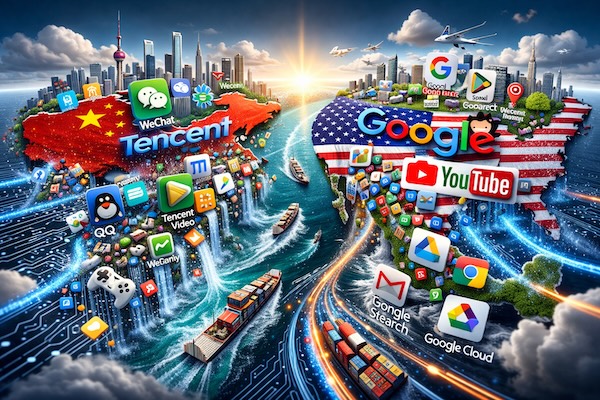
(Image by ChatGPT)
It’s rare for two companies founded in the same year, on opposite sides of the world, to end up shaping their nations’ digital lives so completely. Yet that’s exactly what happened with Alphabet/Google in the US and Tencent in China. They were born in 1998, grew up during the same internet boom, and matured into sprawling tech empires that now define how billions of people communicate, search, shop, pay, and entertain themselves. They didn’t follow identical paths—far from it—but the parallels are striking enough that Tencent is often described as China’s closest analogue to Alphabet.
The comparison isn’t perfect. Alphabet built its empire on search, ads, and a global web. Tencent built its on messaging, social networks, and a domestic ecosystem that became so essential it’s practically infrastructure. But when you zoom out, both companies ended up playing the same role: they became the operating layer of their country’s digital economy. They’re the companies you can’t avoid, the ones that quietly power everything else, the ones that turned the internet from a novelty into a necessity.
Understanding why Tencent is China’s answer to Alphabet means understanding how each company grew, what they prioritized, and how they embedded themselves so deeply into everyday life that opting out feels almost impossible.
Different Starting Points
Alphabet’s origin story is familiar: two Stanford graduate students built a better search engine, realized they’d stumbled onto something transformative, and turned it into the world’s most powerful advertising machine. Google Search became the front door to the internet, and everything else—Gmail, Maps, YouTube, Android—grew from that foundation. Alphabet’s genius was recognizing that if you control the gateway to information, you can build an entire ecosystem around it.
Tencent’s story is different but equally foundational. It started with QQ, a desktop instant‑messaging service that became wildly popular in China’s early internet era. But Tencent’s real breakthrough came in 2011 with WeChat, a mobile messaging app that quickly evolved into something far bigger. WeChat wasn’t just a chat app; it became a social network, a payment platform, a news feed, a gaming hub, a customer‑service portal, and eventually a full‑blown operating system for daily life. If Google organized the world’s information, Tencent organized China’s digital existence.
Both companies built their empires by becoming indispensable. They just chose different entry points.
The Social Graph vs. the Information Graph
Alphabet’s power comes from the information graph—the map of what people search for, what they click, what they watch, and what they need. Google Search and YouTube sit at the center of that universe. They’re the tools people use to navigate the world, answer questions, and discover content. Alphabet monetizes intent: when you search for something, you’re telling Google exactly what you want, and advertisers pay handsomely to appear in front of you at that moment.
Tencent’s power comes from the social graph—the map of who talks to whom, who pays whom, who shares what, and who belongs to which group. WeChat is the connective tissue of Chinese society. It’s where people message friends, follow brands, pay bills, book doctor appointments, hail rides, and read news. Tencent monetizes relationships and engagement: ads in WeChat Moments, payments through WeChat Pay, games played with friends, and mini‑programs that keep users inside the ecosystem.
Alphabet knows what you want. Tencent knows who you are.
Both models are incredibly powerful, but Tencent’s is arguably more deeply embedded in daily life. In China, you can’t really function without WeChat. In the US, you can live without Google if you really want to—it’s inconvenient, but possible. In China, not using WeChat is like not having a phone number.
Business Lines That Mirror Each Other
Even though they started from different places, Alphabet and Tencent eventually built similarly broad portfolios.
Alphabet has:
- Search
- YouTube
- Android
- Chrome
- Gmail and Workspace
- Google Cloud
- Maps
- Hardware
- “Other Bets” like Waymo and Verily
Tencent has:
- WeChat and QQ
- A global gaming empire (Riot, Epic, Supercell, and dozens of stakes)
- WeChat Pay and fintech services
- Tencent Cloud
- Tencent Video and Tencent Music
- Mini‑programs and digital services
- A massive investment portfolio across tech, entertainment, and e‑commerce
Both companies ended up as multi‑sector giants that touch nearly every part of the digital economy. Alphabet leans more on search, cloud, and global distribution. Tencent leans more on social, payments, and gaming. But the breadth is similar, and the strategic logic is almost identical: build a core platform, then expand horizontally until you’re unavoidable.
Scale, Revenue, and Workforce
Alphabet is larger in global revenue, thanks to its worldwide reach and dominance in search and video. It brings in around $350 billion annually and employs more than 180,000 people across dozens of countries. Its profits are enormous, and its cloud business is growing fast.
Tencent is smaller in absolute terms but still massive. It generates roughly $90 billion in annual revenue and employs around 100,000 people, most of them in China. Its profitability is strong, driven by gaming, ads, and fintech. And while it doesn’t have Alphabet’s global footprint, it has something Alphabet doesn’t: near‑total dominance of its home market’s social and payments infrastructure.
Alphabet is bigger. Tencent is more deeply embedded.
AI: Two Different Trajectories
Alphabet is one of the world’s leaders in AI research and deployment. Its Gemini models power search, YouTube recommendations, Workspace tools, and cloud services. It builds its own chips, runs some of the world’s largest data centers, and invests heavily in frontier‑model development. Alphabet’s AI strategy is global, ambitious, and infrastructure‑heavy.
Tencent’s AI strategy is more domestically focused. It builds large models optimized for Chinese language and regulatory environments. It uses AI to improve ads, content recommendations, gaming, and WeChat services. Tencent Cloud offers AI tools to Chinese enterprises. And while Tencent is strong in applied AI, it’s constrained by chip export controls and a more limited global data footprint.
Alphabet wants to lead the world in AI. Tencent wants to make AI indispensable inside China.
Expansion Outside Their Home Countries
Alphabet is a global company by design. Search, YouTube, Android, and Maps are used everywhere except where they’re blocked. Google Cloud competes globally. Pixel hardware is expanding. Alphabet’s challenge isn’t expansion—it’s regulation, competition, and maintaining dominance.
Tencent’s international strategy is more selective. It’s hugely influential in global gaming through ownership stakes and publishing deals. It invests in tech companies worldwide. It’s active in Southeast Asia, the Middle East, and emerging markets. But geopolitical tensions limit its ability to expand consumer‑facing products in the US and Europe. WeChat is popular among overseas Chinese communities but hasn’t broken into mainstream Western markets.
Alphabet exports products. Tencent exports capital and entertainment.
Why Tencent Is the Closest Analogue to Alphabet
When people say Tencent is China’s answer to Alphabet, they’re not saying the companies are identical. They’re saying the companies play the same role in their respective ecosystems.
Both are:
- foundational digital infrastructure
- advertising and data powerhouses
- ecosystem builders
- cloud providers
- entertainment platforms
- long‑term investors in emerging tech
Both shape how people communicate, consume information, and navigate the digital world. Both influence national policy debates about privacy, competition, and innovation. Both are so deeply embedded that removing them would break the internet as their citizens know it.
Alphabet built the rails of the global web. Tencent built the rails of China’s digital society.
That’s why the analogy works.
The Bottom Line
Alphabet and Tencent didn’t grow the same way, and they don’t dominate the same categories. But they ended up in remarkably similar positions: as the central nervous systems of their countries’ digital lives. Alphabet organizes information. Tencent organizes relationships. Alphabet is global. Tencent is domestic but omnipresent. Alphabet leads in AI research. Tencent leads in social integration.
If you want to understand China’s digital ecosystem, you can’t just look at Alibaba or ByteDance. You have to look at Tencent—the company that, like Alphabet, quietly built the infrastructure that everyone else depends on.
That’s why Tencent is China’s answer to Alphabet. They’re the twin giants of the 1998 internet generation, each shaping a different half of the digital world.
Recent Articles
- Cannabis Shares Retreat from Rally on Narrow Scope of Rescheduling
- White House Accuses China of Industrial-Scale Distilling of AI Models
- AI Turns Engineers and Project Managers into 'Builders'
- US Farmers Bet on Peas and Lentils on GLP-1-Related Protein Maxxing Trend
- Lee's Visit Produces 73 S. Korea-Vietnam Business Deals
- Biggest IPO Wave Ever Creates $3 Trillion Value on Zero Profits
- Marijuana Products Reclassified As Less-Dangerous Drug
- China's Global EV Push Backed by Ambition and Hard Domestic Landscape
- Keurig Dr Pepper Beats As Strong Beverage Demand Offsets Coffee Weakness
- Huawei to Invest $2.6 Billion for Leadership in Smart Driving Tech