

CC Wei Sees Huge Growth Opportunity for TSMC in Self-Driving, Robotics
By Reuters | 04 Jun, 2026
The TSMC chairman sees rising component costs but won't seek large price increases like those seen recently from Sk Hynix, Samsung and Micron.
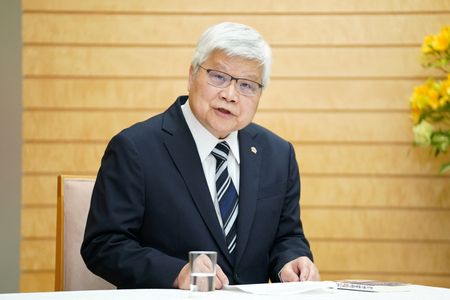
TSMC Chairman CC Wei speaks during a meeting at the Prime Minister's Office in Tokyo on February 5, 2026. KAZUHIRO NOGI/Pool via REUTERS
Taiwan's TSMC, the world's largest contract chipmaker, is confident in its growth over the next few years, thanks to robust demand for computing power and advanced semiconductors as it rides an AI boom, its chief executive said on Thursday.
C.C. Wei, speaking at TSMC's annual shareholders' meeting in the northern Taiwanese city of Hsinchu, said customers are still positive on the outlook for artificial intelligence, although the company continues to monitor the impact of rising component costs.
"We continue to see increasing adoption of AI models across consumer, enterprise and sovereign AI applications," Wei said.
"This trend is driving demand for greater computing power, which in turn supports strong demand for advanced semiconductor chips."
Asked whether TSMC could raise prices for customers, Wei said: "I'd like to do that ... we still need to make money."
"We don't want to suddenly raise prices like memory companies do. That's not sustainable. TSMC is focused on long-term, sustainable operations. We're not that kind of company."
TSMC is working hard to meet all customer demands, although it will take a "very long time" to fully satisfy American customers' needs with production in the U.S., he said, without elaborating on a time frame. TSMC is investing $165 billion to build new factories in the U.S. state of Arizona.
Wei said TSMC's performance over the past year had been remarkable, with its share price climbing to T$2,425 by Wednesday, up from T$950 on June 3 last year.
Its shares were down around 1% on Thursday, in line with the benchmark index.
Amid recent worker tensions over pay in South Korea, where Samsung Electronics last month clinched a deal with its union to avert a strike, TSMC said it was fully committed to taking care of its employees.
"(Our) employee profit sharing increased by about 30% from 2023 to 2024 and again by about 30% from 2024 to 2025," he said. "We are confident it will rise by another 30% in 2026."
"We believe this represents strong compensation for our employees," he said, adding that there is no ceiling for 30% annual growth in terms of employee profit sharing as it will continue to grow.
His comments underscored how the big global tech beneficiaries of a historic AI boom are coming under growing pressure to share more of their rapidly growing income.
Looking ahead, Wei said he views autonomous vehicles as long-term growth drivers and the company will be working hard to ensure robots can succeed. Taiwan remains TSMC's most efficient manufacturing area which is home to its best talent, core R&D and largest production base, he added.
Taiwan has been in focus this week as it hosts the annual Computex conference, where leaders of some of the world's most powerful tech companies are gathering. Executives from the likes of Nvidia and Intel have heaped praise on the island's central role in the global supply chain.
In April, TSMC, a major Nvidia supplier, raised its annual revenue forecast and said it was stepping up capital spending this year to meet relentless demand for its products.
TSMC faces political risk as China steps up military pressure on democratically and separately governed Taiwan, which Beijing views as "sacred" Chinese territory.
Nvidia CEO Jensen Huang has held court in Taiwan over the past few days, dining with South Korean technology leaders and signing autographs for some of his fans, just weeks after accompanying U.S. President Donald Trump on a visit to Beijing as part of a high-profile corporate delegation.
As the AI boom shows no signs of letting up, Huang said at Computex that his company has enough supply to accommodate robust growth in central processing units and graphics processing units, although constraints remain a concern.
(Reporting by Wen-Yee Lee; Editing by Anne Marie Roantree, Muralikumar Anantharaman and Thomas Derpinghaus)
Recent Articles
- CC Wei Sees Huge Growth Opportunity for TSMC in Self-Driving, Robotics
- SpaceX Upends Wall Street with $135 Price for Blockbuster IPO
- Hock Tan's Broadcom Shares Fall Despite Solid Sales and Robust AI Chip Forecast
- US House Votes to Check Trump War Powers in Iran
- GoldSea Votes: Tran to Face a Viet Candidate for All-Asian Congressional Race
- US Manufacturing Surge in April Based Entirely on Soaring Aircraft Orders
- AI 'Chipflation' Spreading from Data Centers to Wider Economy
- Targeted Drugs Let More Live with Cancer
- GLP-1 Drugs May Have a Beneficial Effect Across Many Types of Cancer
- Trump Confirms He Called Netanyahu Crazy in Phone Call