

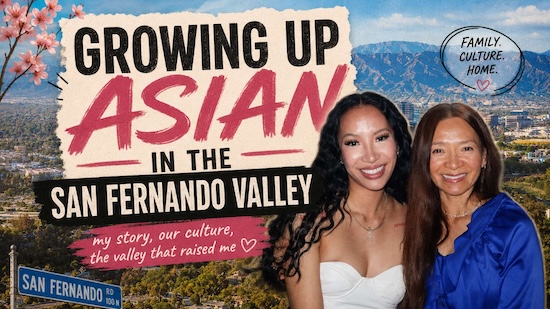
Growing Up Asian in the San Fernando Valley
By Kelli Luu | 12 Jul, 2026
Growing up Asian American in Los Angeles isn't a one-size-fits-all experience, so in this episode I opened up about what it was like growing up Vietnamese and Chinese in the San Fernando Valley, where Asians made up only a small part of my community.
Kelli (00:00)
Hi everyone, my name is Kelli and welcome to the Goldsea Podcast. Today I'm going to be talking about my experience growing up as an Asian American in Los Angeles, California. Usually, when people think about Asian Americans here in LA, they usually picture the San Gabriel Valley, Koreatown, Little Tokyo. If you think about just SoCal in general, a lot of people just think about Anaheim or Irvine, but I didn't grow up in any of those places.
I grew up in the San Fernando Valley, where Asians make up only 11% of the population. Looking back, I didn't realize how much that this shaped my identity until I became an adult. So I'm going to be discussing a little bit about my culture and the difference that I have noticed in growing up in the San Fernando Valley versus Asians that I have met that have grown up somewhere else.
My parents immigrated here after the Vietnam War at a very young age. My mom was six years old, and my father was 13 or 14 when he came here.
My mom is full Vietnamese and my dad is Chinese but was born in Vietnam.
Both of my parents went through their own struggles getting to America.
My mom was separated on a boat with her three younger siblings from their parents, and it so happened that they ended up all meeting on the same island together. And my dad his family in Vietnam had built their own private boat to escape in, and was eventually attacked by pirates on their journey here to America. I've always known these stories, but it wasn't until
After I was around 21 years old, where I was genuinely realizing how different my life was compared to my parents. And it I had once I got older, I had more of an understanding of how much pressure and how much hardship it really took for my parents to get here. So when they arrived, they settled in the San Fernando Valley and they
And they had to transition into American culture because of how young they were. My mom and her brothers attended a Christian school called Faith Baptist in West Hills. And they lived in a very cute family-style home.
Right in the middle of the San Fernando Valley.
So I would say my mom is definitely a valley girl and that transitioned over to me because I am definitely a valley girl. I love the San Fernando Valley. I don't like going out of the San Fernando Valley. I'm very comfortable here. I don't like driving far.
One thing about the valley though is that there's not that many Asians here. There are Asians in the San Fernando Valley. A lot of them do reside in the Granada Hills and Northridge area.
My mom was a teacher and she taught at a very good elementary school in Woodland Hills. So I started off going there and then my middle school was in Encino, Tarzana area, and my high school was in Calabasas, Woodland Hills.
The demographic of Asian students at all of the schools that I went to was very, very small. Most of the time I was the only Asian, only Asian student in the class. I remember it being very difficult for me in elementary school to fit in.
I spoke Vietnamese up until I was about four years old, five years old. And once I went into kindergarten, that's when it stopped because I started to learn English, I started to have American friends, and my parents never forced me to continue to speak it. My parents were very
supportive of me trying to assimilate to American culture. And at the same time, because they came over to America at such a young age, they also had to assimilate to American culture.
My parents never forced us to speak to them. My parents never forced us to follow certain Vietnamese traditions. And this was completely okay with me because when I would go to school and I would bring up anything Vietnamese, I'd get
Picked on for it. If I brought Vietnamese food to school, I would get laughed at because it smells funny. If I were to wear a Vietnamese dress, I would get laughed at for it. Starting in elementary school, a lot of the students already were coming up to me and slanting their eyes and saying funny things like Chinese, Vietnamese, look at these. And this happened quite often.
This was something that happened to me all the time. And this definitely traveled into my middle school years. I again went to an I went to a middle school where there was not that many Asians there as well. The demographic was a lot of Persians and a lot of Israelis, lots of Middle Easterns there. So it was really hard for me to, again, feel like
I was comfortable enough to truly be myself. I loved speaking Vietnamese as a child. And once I got into once I got into like the real world,
I felt like that it was weird to do that. I felt it was weird to speak Vietnamese. I felt it was weird to talk about my culture and to talk about so many different things that people don't know about because they're obviously not part of my culture and I completely wanted to shut that out in order to make my life outside of my house easier.
So since there were not that many Asians, I didn't have many Asian friends growing I noticed that most of my friendships developed with the black and Hispanic classmates.
I didn't feel that welcomed with the Middle Eastern classmates because they were always talking about my race and they would always talk about stereotypical things, ask me if I was good at math, or ask me if I ate rice this morning. So I didn't I never felt comfortable whenever I would hang out with the Persian crowd.
Middle school definitely taught me how to be strong and hard-headed and not take these kinds of things to heart. But now when I look back at it, it truly, I truly did take these things to heart. These things did hurt me, and these things made me not want to be Asian. These things made me not want to express that side of me. And because my parents weren't forcing the culture on me or telling me that, you know.
you shouldn't feel like that. You should be proud of your Asian culture. You should be proud of being Vietnamese. You should be proud of being Chinese. Instead of them telling me that, they tell me to just, you know, like try to be nice to them. Try to be nice to everybody. Try to just fit in. That's kind of what my parents would tell me.
So on one end, when I go to school, I feel like I'm not American enough. But the thought of not feeling Asian enough never crossed my mind until I got older.
Once society kind of deemed that being racist was not okay, that's when the Asian comments kind of trickled down. People weren't just saying things to me out of nowhere. People weren't coming up to me and slanting their eyes anymore. It still happens, of course. definitely people joke about I hear jokes about it.
But what's so funny is I didn't really feel I didn't really realize that I wasn't Asian enough or I didn't feel sad that I wasn't Asian enough until when I got older when Asian culture became more prominent in America. So during COVID, I feel like we all definitely experienced a time where
People were looking at us funny because we were Asian, because everyone thought that the Asians brought over the coronavirus. And after COVID, there seemed to be an increase in the popularity of K-pop and K dramas and K-beauty. And so much of American pop culture started to become derived from.
From Asian culture. And once that happened, it was suddenly cool to be Asian.
Now I feel like that I'm missing out on something.
I kind of started to feel like now I don't think I'm going to be accepted by my own people. So I wasn't already, I already wasn't accepted by the other kids that went to my schools, and now I feel like I'm not gonna be accepted by my own people because I'm not speaking Vietnamese fluently, because I completely stopped speaking Vietnamese because the kids in my school would make fun of me if I said something in Vietnamese. My parents were not overly traditional, so they didn't celebrate.
Chinese New Year. They didn't eat traditional food every single day. We didn't have we didn't have a little temple shrine in our home like my other family members did. But when I met other Vietnamese Americans in recent years, I've noticed how different their parents are. I realized that a lot of a lot of people from Orange County or the San Gabriel Valley, their parents are much more traditional.
And they have completely different upbringings. And I realize that's because they've grown up in that Asian community. With all of the Asians there, you're not getting made fun of. You guys are they're keeping their culture relevant. They are immersed in their culture still because they are growing up with those people. And unfortunately, I wasn't able to do that. So
I genuinely feel like I became much more curious about my culture later, which I regret. I wish I could speak Vietnamese fluently and converse. I can only understand it now,
Growing up and getting older definitely allowed me to take that step and really make the effort to try and understand my culture more. I've done a lot more research, I've read a lot more, I've watched a lot of different things that taught me about Vietnamese culture and Chinese culture. I've taken the initiative to talk to my family members in Vietnamese now and try to really learn the language.
Overall, I feel like all of this is a part of my complete identity journey over the years. I've met so many people and I have made a lot of friends that are not Asian, and I've made friends that are Asian. and being able to talk to all of these other Asian people, I've noticed that a lot of people can resonate with the same story that I have. A lot of Asian Americans specifically
we all can relate to a story like this. We all can relate to being laughed at because of our smelly food. we can all relate to losing our language and wanting to relearn it.
I think growing up in the San Fernando Valley definitely was a big part of what made me who I am today. I was able to see different perspectives and learn about different cultures and build these diverse friendships that I probably wouldn't have been able to develop if I lived elsewhere. I think that the San Fernando Valley as a whole is kind of like a community itself. And I don't want to say that I missed out. I would just say that I had a very different experience.
Being older now, I'm very grateful that I have that urge to want to learn more about my culture and
And really the truth is that growing up in the valley gave me a version gave me a version of the Asian American experience that other kids wouldn't have been able to get. It's still authentic. today I am still trying to relearn Vietnamese, trying to relearn all the stories that I may have missed out on before, but now I just feel like I'm more reconnecting with a part of myself that was always there. But
I'm older and smarter now, and I can understand it just a little bit better.
© 2026 by Asian Media Group Inc.
Recent Articles
- Open or Closed? Depends on Who You Ask
- China Temporarily Bans Helium Exports as Mideast Tensions Flare
- China Evacuates Nearly 2 Million as Typhoon Bavi Nears
- Ro Khanna Detained by Israeli Settlers During West Bank Visit
- Bedtime Story: The Moon Princess in the Bamboo Grove
- Growing Up Asian in the San Fernando Valley
- SK Hynix Sees Memory Shortage Worsening in 2027, Persisting for Years
- Three College Standouts to Watch in the MLB Draft
- Why India Has Never Played in a World Cup
- How Trump Turbo-Charged China's Quest for Global Primacy
Asian American Success Stories
- Asian American Polls
- Asian American Parenting
- Personalities
- Identity
- The 130 Most Inspiring Asian Americans of All Time
- 12 Most Brilliant Asian Americans
- Greatest Asian American War Heroes
- Asian American Digital Pioneers
- New Asian American Imagemakers
- Asian American Innovators
- The 20 Most Inspiring Asian Sports Stars
- 5 Most Daring Asian Americans
- Surprising Superstars
- TV’s Hottest Asians
- 100 Greatest Asian American Entrepreneurs