

I Regret Having Taken AAPI Heritage Month for Granted
By J. J. Ghosh | 23 Apr, 2026
President Trump is trying to erase heritage months and any activity that recognizes American diversity. The corporations falling in line are paying the price.
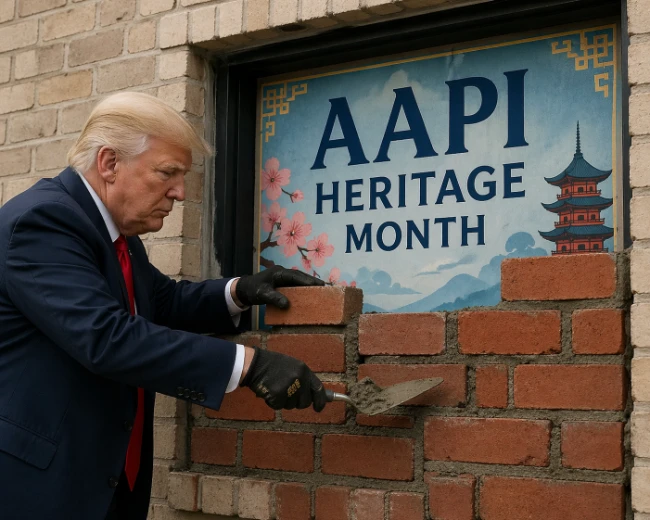
Every May my inbox fills up with emails from corporations wishing me a happy Asian American and Pacific Islander Heritage Month.
The emails usually feature a stock photo of a generic Asian person in a font that makes me wonder if fonts can be racist. But sometimes if I’m lucky there’s a discount code for a buy one get one free special.

Some companies like JP Morgan have stood up to Trump's attempts to dismantle DEI
If these emails were fortunate enough to make it out of my promotions folder, I would typically roll my eyes at them. It always felt like window dressing, plain and simple.
The cherry blossom accented profile pictures and AAPI Spotify playlists will be gone by June 1, after all.
But cynicism be damned, it’s better than nothing. Regardless of how strong the effort may be, I appreciate that it’s being made. At least, until now.
Window dressing or not, the Trump administration is trying to brick up the window.
What Actually Happened
On January 20, 2025, President Trump’s literal first day in office, the administration eliminated federal recognition of AAPI Heritage Month and dissolved the White House Initiative on Asian Americans, Native Hawaiians, and Pacific Islanders.
The initiative had coordinated federal efforts on AAPI community needs — healthcare access, language services, civil rights enforcement.
Meanwhile, the Defense Intelligence Agency banned employee activities related to eleven special observances, including AAPI Heritage Month, Black History Month, Women’s History Month, Juneteenth, and Holocaust Remembrance Day — all in compliance with Trump’s executive order banning DEI programs in the federal workplace.
The list also included Holocaust Remembrance Day — a detail that speaks for itself.
The Corporate Pile-On
The executive orders technically apply to the federal government. But corporations read the room fast.
Amazon, Google, McDonald’s, Meta, Target, and Walmart all scaled back or rebranded their diversity work, often citing the new legal and political climate.
Walmart had been quietly rolling back diversity policies for months, shifting language away from “DEI” and shutting down its Center for Racial Equity. Target wound down its Racial Equity Action and Change initiative. Google removed diversity-related language from its annual report and ended hiring targets for underrepresented groups. IBM’s annual report, which had included a dedicated diversity section every year since 2016, made no mention of the word “diversity” in 2025.
The advertising industry has not been spared either — ad agencies have been laying off chief diversity officers at a notable rate, with industry observers warning the cuts will only accelerate. Multicultural marketing agencies — the firms that specialize in reaching Black, Hispanic, and AAPI consumers — have watched potential clients put conversations on hold or quietly reduce the budgets they were once required to allocate to diverse-owned agencies. Which means the communities most likely to respond to culturally specific outreach are now less likely to see it — not because companies stopped wanting their money, but because the political climate is now actively discouraging corporate activity that appears aimed at celebrating ethnic diversity among their consumers.
The emails I used to roll my eyes at? They were the visible surface of something bigger — supplier programs, employee resource groups, hiring commitments. When companies started dismantling DEI, the emails didn’t disappear first. The substance did. The emails just followed.
It means the lunch-and-learns get canceled. The employee resource group budgets get cut. The supplier partnerships with minority-owned businesses get quietly reclassified. And the communities that were at least being nominally acknowledged are now not even getting that.
The lip service was never going to dismantle systemic inequality. But it was also a signal — however faint — that a company considered AAPI employees and customers worth acknowledging. Withdrawing that signal is also a signal.
Bigger Than Us
The AAPI community is not the only one being asked to celebrate its heritage in an environment actively hostile to that heritage.
Black History Month — recognized by every president since Gerald Ford in 1976 — was effectively banned as a federal employee activity. Hispanic Heritage Month faces the same erasure. The communities being told that recognition of their existence is now a legal liability span pretty much every non-white demographic in the country.
The particular irony for the AAPI community is that we were supposedly one of the groups whose support the administration was courting. As Republican strategist Raynard Jackson put it: “If they leave it the way it stands right now, Trump is going to destroy the very coalition he so marvelously brought to the table in November.”
Asian American voters who swung toward Trump in 2024 may want to check what their vote purchased.
Companies With Courage
To be fair, not everyone ran for the exits.
Costco’s board defended its DEI programs in unusually direct language, arguing that diverse employees and suppliers drive creativity and improve member satisfaction. When a conservative think tank pushed an anti-DEI shareholder resolution, more than 98% of shareholders voted it down.
Patagonia said flatly it would not scale back its diversity policies and Apple’s board rejected a proposal to eliminate its DEI programs, arguing it would restrict the company’s ability to manage its own business. Delta Air Lines held firm as well. In the words of their chief external affairs officer: “DEI is about talent, and that’s been our focus. We are steadfast in our commitment because we think they are actually critical to our business.”
These companies are also, not coincidentally, doing well. A 2025 reputation study found that companies that maintained their DEI commitments saw higher scores across trust, culture, and ethics — with Patagonia and Costco ranking in the top three for character and citizenship.
Bad Business
And as for the companies that did kowtow to Trump?
Target’s stock dropped 12% following its DEI rollback, erasing $12.4 billion in market value. Foot traffic declined for eleven consecutive weeks. The company eventually cut its annual sales outlook and announced its first major layoffs in a decade. Walmart suffered similar declines in foot traffic during boycotts, with the NAACP urging consumers to spend elsewhere.
The consumers doing the boycotting are not a niche demographic. Black and Hispanic shoppers — among the most loyal retail customers in the country — made their feelings known with their wallets.
The AAPI community, which collectively represents over $1.3 trillion in buying power, is paying attention too. Even the big institutional investors — BlackRock, Vanguard, the firms that actually own most of these companies — have continued to side against anti-DEI proposals, because they understand that a diverse workforce and customer base is good for business.
The companies that caved to political pressure generally claim to have done so at least partially out of legal fear. But legal experts have noted that the attacks on corporate DEI policies are much weaker than they appear, and that companies like Costco understood this. A lot of corporate America absorbed real reputational and financial damage to avoid a legal threat that was largely a bluff.
The heritage month emails and profile pictures were always a little much. But they were also proof of something: that someone, somewhere in a corporate structure, thought it was worth acknowledging that we exist.
So happy AAPI Heritage Month.
To the companies still sending the emails — I’m sorry I ever took you for granted. To the ones who stopped: we noticed. And apparently so did your shareholders.
© 2026 by Asian Media Group Inc.
The heritage month emails and profile pictures were always a little much. But they were also proof of something: that someone, somewhere in a corporate structure, thought it was worth acknowledging that we exist.
Recent Articles
- The Making of a Striking Tiger
- Japan's World Cup Prospects Brighter Than Their Single Group Point Might Suggest
- International Stars in the Red Devils' Lineup Suggests a Deep World Cup Run for S. Korea
- Italy's Meloni Says Trump 'Totally Invented' Story That She Begged Him for Photo
- Lebanon Ceasefire Agreed After US-Iran Talks in Switzerland Scrapped
- Qantas Bets on Sleep and Light Science to Sell 20-Hour Flights
- High-Wire Diplomacy Delivered US-Iran Deal but the Tricky Part's to Come
- Pentagon Asks for $80 Billion for Iran War Bills
- Ukrainian Drone Makers Zero in on Demand Created by Taiwan Tensions
- Bedtime Story: Tenali Raman and the Thieves