

Iran Scorns US Peace Proposal As 'Unrealistic', Sends Fresh Missile Barrage to Israel
By Reuters | 30 Mar, 2026
US proposals are "unrealistic, illogical and excessive" Iran declared Monday, unleashing more missiles on Israel and sending oil prices higher.
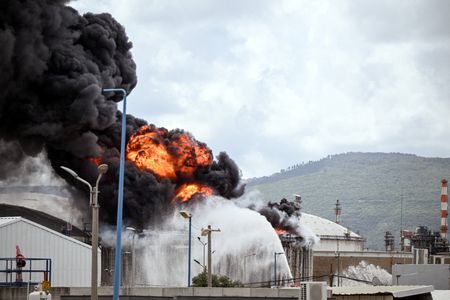
A blaze after Israel's Fire and Rescue Service said that an industrial building and a fuel tanker at Israel's Oil Refineries were hit by debris from an intercepted Iranian missile, amid the U.S.-Israel conflict with Iran, in Haifa, Israel March 30, 2026. REUTERS/Rami Shlush
Iran described U.S. proposals to end a month of war in the Middle East as "unrealistic, illogical and excessive" on Monday and unleashed more missiles on Israel, as oil prices rose further after Yemen's Houthis entered the conflict.
Israel's military said two drones from Yemen had also been intercepted on Monday, two days after the Iran-aligned Houthisfired missiles at Israel for the first time since the start of the U.S.-Israeli war on Iran that has spread across the region. Lebanon's Hezbollah also fired rockets at Israel on Monday.
The Israeli military said it had carried out missile strikes targeting what it called military infrastructure in Tehran as well as infrastructure used by Iran-backed Hezbollah in Beirut, leaving black smoke hanging over the Lebanese capital.
U.S. President Donald Trump issued another warning to Iran on Monday to open the Strait of Hormuz, a waterway used for shipping a fifth of global oil and liquefied natural gas supplies, or risk U.S. attacks on its energy infrastructure.
IRAN DEFIANT
Iranian Foreign Ministry spokesperson Esmaeil Baghaei said Tehran had received messages via intermediaries indicating Washington's willingness to negotiate. This followed a meeting of the foreign ministers of Pakistan, Egypt, Saudi Arabia and Turkey in Islamabad on Sunday to discuss mediation efforts.
But Baghaei, criticising the U.S. proposals, told a press conference on Monday: "Our position is clear. We are under military aggression. Therefore, all our efforts and strength are focused on defending ourselves."
Meanwhile, a Pakistani security official said that at this stage it appeared unlikely there would be direct U.S.-Iran talks this week. "We are trying our best to make it happen as early as possible," the official added.
Baghaei also said Iran's parliament was reviewing a possible exit from the Nuclear Non-Proliferation Treaty, which recognises the right to develop, research, produce and use nuclear energy as long as nuclear weapons are not pursued.
Trump has cited preventing Iran obtaining nuclear weapons as one of the reasons for attacking Iran on February 28. Tehran denies it is seeking a nuclear arsenal.
On Sunday, Trump said the U.S. and Iran had been meeting "directly and indirectly". But he has also been sending more U.S. troops to the region and Iran has remained defiant, maintaining its blockade of the Strait of Hormuz.
In a social media post on Monday, Trump wrote: "Great progress has been made but, if for any reason a deal is not shortly reached, which it probably will be, and if the Hormuz Strait is not immediately 'Open for Business,' we will conclude our lovely 'stay' in Iran by blowing up and completely obliterating all of their Electric Generating Plants, Oil Wells and Kharg Island."
FEARS OF MILITARY ESCALATION
The month-long war has spread across the region, killing thousands, causing the biggest disruption ever to energy supplies and hitting the global economy.
Iran has fired on Arab Gulf states during the conflict and war has been reignited between Israel and Hezbollah in Lebanon, where a U.N. peacekeeper from Indonesia was killed when a projectile exploded at one of its positions in southern Lebanon on Sunday. Another peacekeeper was critically injured.
Brent crude futures jumped by $2.42, or 2.2%, to almost $115 a barrel by 1116 GMT on Monday, and were on course for a record monthly rise.
The Houthis' attacks on Israel raised the prospect that they could target and block a second important shipping route, the Bab el-Mandeb Strait.
The oil market has all but discounted the prospect of a negotiated end to the war and "is bracing for a sharp escalation in military hostilities," said Vandana Hari of oil-market provider Vanda Insights.
She made her comments despite Trump saying on Sunday he thought a deal was possible with Iran and that the men who have replaced Iranian leaders killed in the war seemed "reasonable".
The Financial Times quoted Trump as saying in an interview that the U.S. could seize Kharg Island, from where Iran exports much of its oil, but also that a ceasefire could come quickly. Taking control of Kharg would require ground troops.
The U.S. Department of Defense is dispatching thousands of troops to the Middle East, giving Trump the option of launching a ground offensive, but he has not approved any of those plans, according to multiple news outlets.
ISRAELI STRIKES
Iran confirmed on Monday the death of Revolutionary Guards Navy Commander Alireza Tangsiri, the latest of its leaders killed including Supreme Leader Ayatollah Ali Khamenei, who has been replaced by his son Mojtaba Khamenei.
But the killings and four weeks of U.S.-Israeli bombardment have failed to silence Iran's missile and drone batteries.
Kuwait said on Monday an Indian national was killed in an Iranian attack on a power and desalination plant in the country. Iran's Revolutionary Guards later denied involvement.
An industrial building and a fuel storage tank near the main base of Israel's navy in the northern city of Haifa were hit by debris from an intercepted missile, Israel's fire service said.
Hezbollah later said it had targeted the naval base.
Since going to war again with Hezbollah, Israel has said it will seize a chunk of southern Lebanon to create a "buffer zone", stoking Lebanese fears of Israeli military occupation that could deepen instability and cause further displacement.
U.S.-based rights group HRANA says nearly 3,500 people have been killed in Iran, including 1,550 civilians, while authorities in Lebanon say nearly 1,240 people have been killed there. Over 400 Hezbollah fighters have been killed since March 2, sources told Reuters, but it is unclear if the official death toll includes those fighters.
At least 100 people have been killed in Iraq and 13 U.S. service members have been killed.
(Reporting by Reuters bureaux; Writing by Michael Perry, Stephen Coates and Timothy Heritage; Editing by Stephen Coates, Michael Perry and Gareth Jones)
Articles
- Mexican Immigrant Is 14th Death in ICE Custody in 2026 Alone
- NASA Set for Wednesday's Lunar Orbiter Launch
- Iran Scorns US Peace Proposal As 'Unrealistic', Sends Fresh Missile Barrage to Israel
- Microsoft Unveils AI upgrades, Rolls out Copilot Cowork to Early-Access Users
- South Korea AI Chip Startup Rebellions Raises $400 Million in Latest Funding Round
- China Southern Returned to Profit in 2025, Ending 5 Years of Losses
- US Airlines Face Fuel-Driven Shakeout
- Major US Airports Begin Returning to Normal As TSA Agents Set to Get Paid
- Women's Sports Draw Smart Money Seeking Growth Bargains
- BYD Expects to Hit 1.5 million Overseas Car Sales in 2026