

The Dirty Financial Motive Behind Japanese American Internment
By Goldsea Staff | 10 Feb, 2026
California business interests persuaded Governor Earl Warren to send Japanese Americans to internment camps, forcing them to sell their thriving farms and businesses to rivals at pennies on the dollar.
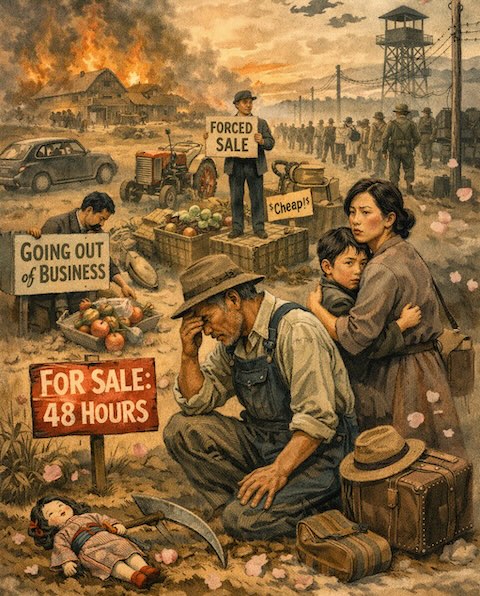
(Image by ChatGPT)
The forced internment of Japanese Americans during World War II is often framed as a tragic wartime necessity due to national security concerns and racial prejudice. The truth is much darker.
The systematic dispossession of Japanese Americans was driven in large part by the economic interests of white California farmers, business owners, and politicians who saw an opportunity to eliminate their most successful competitors and seize valuable assets at fire-sale prices.

Japanese American Success Against All Odds
By 1941 Japanese Americans had carved out remarkable success in California's agricultural sector while facing decades of discriminatory laws designed to limit their economic activities. They controlled approximately 40 percent of California's commercial truck farming, growing nearly all the state's strawberries, celery, and peppers, along with substantial portions of its tomatoes, snap beans, and other high-value crops.
This success had been achieved through extraordinary hard work, agricultural innovation, and tight-knit community cooperation, often on marginal lands that white farmers had dismissed as unproductive.
Anti-Japanese Laws Born of White Jealousy and Resentment
That hard-earned success bred resentment among white farmers and agricultural interests, organized into groups like the California Farm Bureau Federation and the Grower-Shipper Vegetable Association which for years lobbied for restrictions on Japanese land ownership and immigration.
The 1913 and 1920 Alien Land Laws in California prohibited "aliens ineligible for citizenship"—a category that included Japanese immigrants—from owning land or leasing it for more than three years. Yet Japanese Americans had found ways to persist, often placing land in the names of their American-born children or forming partnerships with sympathetic white landowners.
Pearl Harbor Presented Opportunity
The Japanese surprise attack on Pearl Harbor on December 7, 1941 provided these agricultural interests with the perfect political moment. Within weeks, organizations that had long opposed Japanese American economic success began publicly calling for removal, framing their demands in the language of patriotism and security.
The Grower-Shipper Vegetable Association, which had been demanding Japanese removal since the 1920s, now found a receptive audience. Austin Anson, managing secretary of the organization, was remarkably candid about the true motivations, stating in May 1942: "We're charged with wanting to get rid of the Japs for selfish reasons. We do. It's a question of whether the white man lives on the Pacific Coast or the brown men."
Earl Warren's Pivotal Role
Governor Earl Warren, who would later become Chief Justice of the Supreme Court and author the landmark Brown v. Board of Education decision, played a pivotal role in this dispossession. As California's attorney general in 1942, Warren was one of the most vocal advocates for mass removal of Japanese Americans from the West Coast. He testified before Congress, presented dubious maps purporting to show suspicious Japanese settlement patterns near strategic facilities, and argued—absurdly—that the very absence of sabotage by Japanese Americans proved they were planning a coordinated attack.
Warren's position was tied to his political ambitions and relationships with California's agricultural establishment. He had close ties to the California Farm Bureau Federation and other agricultural interests that had long sought to eliminate Japanese American competition. His aggressive stance on internment boosted his popularity among California voters and helped propel him to the governorship in 1942. Documents from the period show that Warren received substantial political support from agricultural organizations that stood to benefit from Japanese American removal.
48 Hours to Sell at Pennies on the Dollar
The economic devastation wrought by internment was swift and brutal. Japanese Americans were given as little as 48 hours to dispose of their property, businesses, crops, homes, and possessions before reporting to assembly centers. They were forced to sell everything at a fraction of its value to buyers who knew they had no negotiating power.
Farm equipment purchased for thousands of dollars sold for tens of dollars. Businesses built over decades were liquidated in days. One Japanese American farmer in California's Central Valley, who had spent years building a successful strawberry operation, was forced to sell his entire harvest, equipment, and leasehold for $200—a fraction of the season's potential earnings alone.
Massive Economic Losses and Devastated Lives
The Federal Reserve Bank of San Francisco later estimated that Japanese Americans lost between $108 million and $164 million in property and income due to internment, equivalent to between $2 billion and $3 billion in today's dollars.
These figures likely underestimate the true economic damage, as they don't fully account for lost business opportunities, destroyed community networks, and the long-term economic impact on families whose wealth accumulation was interrupted for years.
The White Beneficiaries
White farmers quickly moved to occupy lands previously farmed by Japanese Americans. The California Farm Production Council, formed in 1942 to deal with wartime agricultural needs, helped coordinate the transfer of Japanese American farms to white operators. Agricultural associations that had lobbied for removal now helped their members acquire the very properties they had coveted. The white farmers and businessmen who had been the loudest voices demanding removal were the same individuals who snapped up Japanese American properties and businesses.
The dispossession extended beyond agriculture. Japanese American-owned hotels, restaurants, grocery stores, nurseries, and fishing boats were seized or sold under duress. In Los Angeles's Little Tokyo, white business owners quickly occupied storefronts that had been vibrant centers of Japanese American commercial life. The economic infrastructure of entire communities was dismantled and transferred to white ownership.
The Government's Hand in Dispossession
The role of government went beyond simply ordering the removal. Federal agencies actively facilitated the economic dispossession. The Farm Security Administration, ostensibly created to help distressed farmers, worked to transfer Japanese American farms to white operators.
The Federal Reserve Banks served as custodians for some Japanese American property but provided little real protection against loss. Various government agencies that could have protected Japanese American property interests instead prioritized facilitating their removal and the transfer of their assets.
After the war, Japanese Americans who attempted to reclaim their property faced enormous obstacles. Many found their homes occupied, their farms operating under new ownership, and their businesses transferred to others. Legal battles to recover property were expensive, time-consuming, and often unsuccessful.
The 1948 Japanese American Evacuation Claims Act provided some compensation, but it was grossly inadequate, covering only a fraction of actual losses and requiring extensive documentation that many internees no longer possessed.
Earl Warren Recants
Earl Warren later expressed regret for his role in internment, calling it one of the mistakes of his career. But this retrospective contrition cannot erase the reality that internment served powerful economic interests that Warren actively supported. His evolution on civil rights issues as Chief Justice, while significant, came too late for the Japanese American families whose economic futures were destroyed with his assistance.
Dirty Motivation Behind Gravest Injustice in American History
The internment of Japanese Americans stands as one of the gravest violations of civil liberties in American history. But understanding it solely as a civil rights violation or a product of wartime hysteria obscures the calculated economic motivations that drove it. It was, in significant measure, a government-sanctioned theft orchestrated by business interests who used war fever as cover to eliminate competition and seize valuable assets.
Handy National Secruty Cloak for Economic Self-Interest
This history offers uncomfortable lessons about how easily economic self-interest can cloak itself in the language of patriotism and security, and how democratic institutions can be weaponized to serve the material interests of powerful constituencies at the expense of vulnerable minorities.
The dirty financial secret behind Japanese American internment is that it was not merely a tragic mistake born of wartime panic, but a deliberate act of economic warfare waged by American business interests against their most successful competitors, with the full cooperation of political leaders like Earl Warren who understood exactly what they were enabling.
Applying the Lesson to Today
The lesson of this episode of history is invaluable, as the use of national security to justify selfish financial interests has again become ascendant in today's United States. National security has once again become the easy justification to impose tariffs and export restrictions that command financial tribute to officeholders by those hoping to minimize their economic impact on their nations or businesses.
Sadly, political opportunism and cowardice of the kind seen during the Japanese Internment episode may prevent today's current abuses from being called out to shame the culprits until great damage has been done to the credibility of the United States as a model democracy for the world to emulate.
© 2026 by Asian Media Group Inc.
Recent Articles
- Qantas Bets on Sleep and Light Science to Sell 20-Hour Flights
- High-Wire Diplomacy Delivered US-Iran Deal but the Tricky Part's to Come
- Pentagon Asks for $80 Billion for Iran War Bills
- Ukrainian Drone Makers Zero in on Demand Created by Taiwan Tensions
- Bedtime Story: Tenali Raman and the Thieves
- Fujimori Edges Toward Peruvian Presidency as Sanchez Calls for Protests
- Republicans Blast Trump's Iran Agreement as Details Emerge
- SK Hynix Veteran Seok-Hee Lee Tapped to Lead Intel Foundry Packaging Push
- Mamdani Plans to Air World Cup for Free Throughout New York
- Myra Molloy Parlays Historic Broadway Success into a Leading Film Role