

The Reincarnation of Sui Dynasty Emperor Yang
By H Y Nahm | 27 Jan, 2026
Bold initiatives undertaken for ego-gratification and self-aggrandizement are the hallmarks of both leaders.
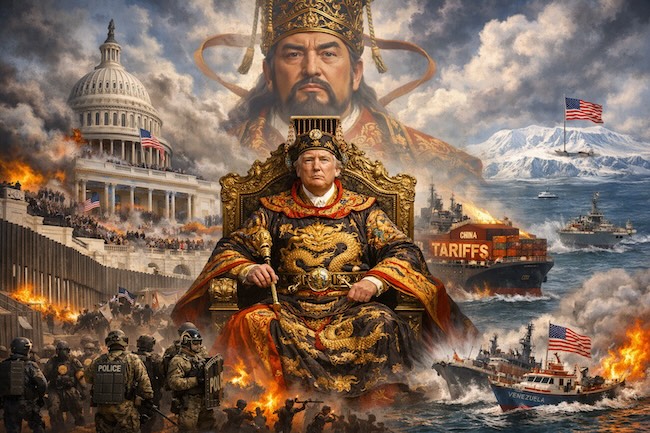
(Image by ChatGPT)
The parallels are so uncanny that you can’t help but squint across centuries and think, wait a second, haven’t we seen this movie before?
Emperor Yang, who reigned in the early seventh century, inherited a reunified China from his father. The hard work had been done. The country was stitched back together after centuries of chaos. What Yang inherited was stability, wealth, and a chance to govern wisely.
Trump inherited a large, powerful, and relatively prosperous nation. The United States was not perfect, but it was humming along with deep institutions, global alliances, and a massive economy. In both cases, the stage was set not for rebuilding from rubble, but for careful stewardship.
That isn't what happened.
Emperor Yang was obsessed with grandeur. He launched massive construction projects that looked impressive on paper and dazzled visitors, but crushed the people who had to build them. The most famous was the Grand Canal, an engineering marvel, yes, but one dug by forced laborers who died in the hundreds of thousands. Yang loved palaces, parades, and imperial tours that consumed enormous resources. He wanted the empire to look magnificent, to reflect his own sense of destiny and brilliance.
Trump’s signature obsessions were alike in spirit. The wall. The rallies. The gold-plated aesthetic. The constant demand that his name be affixed to everything, whether it was a skyscraper, a trade deal, or a vaccine rollout. Policy often felt secondary to branding. Decisions were evaluated less by whether they improved people’s lives and more by whether they generated applause, ratings, or personal validation.
Governance took a back seat to ego.
One of Emperor Yang’s most disastrous choices was his repeated military campaigns against the Korean kingdom of Goguryeo. These wars were staggeringly expensive and catastrophically mismanaged. Hundreds of thousands of soldiers were conscripted, marched long distances, poorly supplied, and thrown into unwinnable battles. The campaigns failed again and again, draining the treasury and breaking the population’s spirit. Yang refused to admit defeat because defeat would bruise his self-image as a glorious conqueror.
Trump’s foreign policy disasters were motivated by similar psychology. Trade wars launched on impulse and sold as proof of toughness ended up hurting American farmers, manufacturers, and consumers. Longstanding alliances were treated with contempt, not because doing so made Americans safer, but because Trump seemed to enjoy asserting dominance and nursing grudges. International relationships became stages for personal feuds and ego displays rather than tools for national interest.
Both men shared a dangerous allergy to expertise. Emperor Yang distrusted seasoned advisors who urged restraint. He preferred yes-men who told him what he wanted to hear. When reality contradicted his ambitions, he doubled down, convinced that failure was the result of disloyal subordinates or insufficient displays of will.
Trump, famously, treated experts with open hostility. Scientists, generals, diplomats, economists—all were suspect if they contradicted his instincts. Loyalty mattered more than competence. Public disagreement was treated as betrayal.
Another striking parallel is how both leaders weaponized resentment while living in extreme privilege. Emperor Yang positioned himself as the embodiment of imperial destiny, but he was profoundly disconnected from the suffering of ordinary people. The peasants dying in canal trenches or freezing on distant battlefields were abstractions to him.
Trump cultivated an image as a champion of the forgotten man, even as he staffed his administration with billionaires, funneled public money into private ventures, and governed in ways that overwhelmingly benefited the wealthy. The gap between rhetoric and reality was vast in both cases.
The consequences were predictable and devastating.
Under Emperor Yang, the Sui Dynasty collapsed with shocking speed. Exhausted by forced labor, crippling taxes, and endless wars, the population rebelled. Regional leaders rose up. The army mutinied. Yang fled, only to be assassinated by his own officers. A dynasty that had reunited China disintegrated in less than four decades, largely because one man couldn’t separate his personal glory from the public good.
Trump hasn't yet brought about the collapse of the American state, but he did something arguably more dangerous in a modern democracy: he undermined trust. Trust in elections. Trust in institutions. Trust in expertise. Trust in one another. His refusal to accept electoral defeat, and his encouragement of the lie that the system was rigged against him personally, culminated in a direct assault on the peaceful transfer of power. For a republic, that’s the equivalent of a dynastic heart attack.
What makes the comparison unsettling is not that Trump and Emperor Yang were identical, but that they shared the same governing pathology. Both treated leadership as a mirror, not a responsibility. The state existed to reflect their greatness, not to serve the people. When reality resisted, they attacked reality.
Another shared trait was the obsession with legacy. Emperor Yang wanted to be remembered as a builder, a conqueror, a peer of legendary rulers.
Trump constantly talked about how history would judge him, how he was treated unfairly, how his accomplishments were unmatched.
This preoccupation with personal legacy often led both men to choose dramatic gestures over boring competence. They preferred moves that would be noticed, tweeted about, or carved into stone, even if those moves weakened the foundations beneath them.
History doesn't care about the actors' preferences.
Emperor Yang isn't remembered as a great builder or visionary. He’s remembered as a cautionary tale, a ruler whose vanity destroyed a dynasty. Trump’s long-term historical judgment is still being written, but the early chapters aren't flattering. Lost elections. Legal troubles. A divided country. A party reshaped in his image, but hollowed out in the process.
No, Donald Trump probably isn't an actual reincarnation of Emperor Yang. History doesn’t recycle souls. What it does recycle are patterns. The pattern of leaders who confuse applause with approval. The pattern of vanity projects sold as national salvation. The pattern of scorched-earth responses to criticism. The pattern of ignoring the quiet, unglamorous work that actually keeps societies functioning.
The story of Emperor Yang survived for nearly two thousand years because it contains a warning. Power without humility corrodes. Grandeur pursued for its own sake becomes grotesque. When leaders see the state as an extension of their ego, collapse is not a matter of if, but when.
Trump’s story is still unfolding, but the echo is loud enough to hear. Whether the United States fully absorbs the lesson depends not on Trump himself, but on whether the people and institutions he tries to bend choose true leadership over spectacle the next time history offers the temptation.
© 2026 by Asian Media Group Inc.
Recent Articles
- Qantas Bets on Sleep and Light Science to Sell 20-Hour Flights
- High-Wire Diplomacy Delivered US-Iran Deal but the Tricky Part's to Come
- Pentagon Asks for $80 Billion for Iran War Bills
- Ukrainian Drone Makers Zero in on Demand Created by Taiwan Tensions
- Bedtime Story: Tenali Raman and the Thieves
- Fujimori Edges Toward Peruvian Presidency as Sanchez Calls for Protests
- Republicans Blast Trump's Iran Agreement as Details Emerge
- SK Hynix Veteran Seok-Hee Lee Tapped to Lead Intel Foundry Packaging Push
- Mamdani Plans to Air World Cup for Free Throughout New York
- Myra Molloy Parlays Historic Broadway Success into a Leading Film Role