

Trump Delusions About Stand-off Strikes Damage Perception of US Power
By Tom Kagy | 21 May, 2026
Now the world know that the US won't commit ground forces and can only inflict limited damage on a small nation while inflicting major pain on itself and allies.
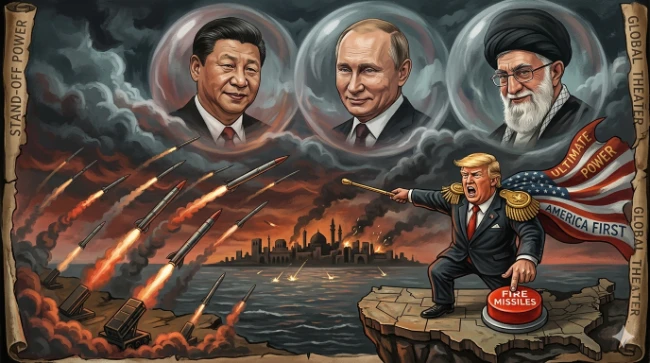
Only the most delusional can see the current fiasco in Iran as anything other than the complete humiliation of the US as a nation, and Americans as a people.
Unfortunately Donald Trump is one such deluded individual. He may actually believe that he hasn’t turned the US into such a petty, self-destructive and weak nation that it blindly blew half its stockpile of crazy-costly ordinance to succeed only in imposing staggering economic costs on the entire world with little to show but schoolgirl deaths and civilian rubble across the Middle East.
He’s earned himself the respect that the world accords a peevish and vengeful bully. But at what cost inflicted on the US and all our allies!
For decades the US cultivated an image of overwhelming military dominance. The mythology was simple: America could project force anywhere on earth, destroy adversaries at will, and dictate outcomes without paying serious costs itself. Donald Trump took that fantasy and inflated it into a cartoon version of warfare in which enemies could be intimidated, bombed from afar, sanctioned into submission, and humiliated without requiring the sacrifices historically associated with actual war.
The problem is that the rest of the world has now seen the limits of that approach in plain view.
The confrontation with Iran exposed something profoundly damaging to US credibility. It showed that the US political system no longer has the will to commit ground forces for a major conflict. It showed that even the world's most expensive military can expend staggering quantities of precision weapons and achieve only partial tactical results. And it showed that America's enemies have figured out how to impose enormous economic and geopolitical costs on the US and its allies without needing to defeat the US militarily.
That realization may prove far more consequential than the physical damage inflicted during the strikes themselves.
The Fantasy of Painless War
Trump has always spoken about military power as though it were a television spectacle. In his worldview, advanced aircraft, cruise missiles, stealth bombers and bunker-buster bombs are magical devices that can eliminate enemies instantly while generating applause at home.
That mentality reached its peak during the 2025 strikes against Iranian nuclear facilities and missile infrastructure under Operation Midnight Hammer. Trump publicly portrayed the operation as proof of total US dominance. He claimed Iranian nuclear facilities had been "obliterated" and suggested the strikes demonstrated overwhelming American superiority.
But even early intelligence assessments cast doubt on those claims. A Defense Intelligence Agency assessment reportedly concluded the strikes likely delayed Iran's nuclear program only by a matter of months rather than destroying it outright.
Subsequent Pentagon statements became noticeably more cautious, speaking of severe damage and setbacks rather than total destruction.
The contradiction between Trump's rhetoric and the actual military outcome damaged US credibility in several ways at once.
First, it made the US appear either dishonest or delusional.
Second, it highlighted how difficult it is even for the US military to destroy deeply buried facilities without nuclear weapons or a prolonged ground campaign.
Third, it advertised to adversaries around the world that hardened underground facilities remain surprisingly survivable even under intense American bombardment.
The sheer scale of munitions expenditure was astonishing.
Operation Midnight Hammer involved seven B-2 stealth bombers, roughly 125 aircraft overall, 14 massive 30,000-pound GBU-57 bunker-buster bombs, and more than 30 Tomahawk cruise missiles launched from submarines.
Those bunker-busters were among the most specialized conventional weapons in the US arsenal and had never previously been used in combat.
Yet after all that firepower, Iran's nuclear capability apparently survived in meaningful form.
The Limits of Stand-Off Warfare
Modern US military doctrine increasingly revolves around stand-off warfare. That means using long-range missiles, stealth aircraft, drones, cyberattacks and economic sanctions while avoiding large-scale occupation forces.
The attraction is obvious. American voters have little appetite for another Iraq or Afghanistan. Politicians don't want body bags returning home. Precision warfare offers the illusion that wars can be fought without national sacrifice.
But stand-off warfare has severe limitations.
You can damage infrastructure from the air. You can destroy air defenses. You can assassinate commanders. But unless you're willing to physically occupy territory and dismantle enemy systems directly, determined adversaries can often recover.
Iran understood this long ago.
That's why it dispersed facilities, hardened infrastructure deep underground, expanded missile production capabilities, developed proxy networks throughout the region, and built redundancy into its military-industrial base.
The result was a strategic nightmare for the US.
Washington could inflict punishment, but not decisive victory.
Iran, meanwhile, didn't need to defeat the US conventionally. It merely needed to survive while imposing costs.
And those costs were immense.
Economic Self-Destruction
One of the most revealing aspects of the Iran confrontation was how quickly global markets reacted.
Oil prices surged on fears of disruptions around the Strait of Hormuz. Insurance rates for shipping increased dramatically. Energy-importing allies in Europe and Asia faced rising economic stress. Global investors suddenly confronted the possibility that the US itself had triggered another destabilizing Middle Eastern conflict.
This is where Trump's worldview completely collapsed.
He seemed to believe military strikes existed in some isolated reality separate from economics.
But modern great-power competition isn't simply about bombing targets. It's about supply chains, energy flows, manufacturing capacity, debt burdens, industrial resilience and geopolitical alliances.
Iran exploited exactly those vulnerabilities.
Even limited Iranian retaliation or the threat of regional escalation created pain far beyond the direct military battlefield.
Meanwhile the US burned through astonishing quantities of expensive munitions.
Reports indicated the broader conflict heavily depleted American missile stockpiles. One assessment suggested the US expended roughly 1,100 long-range stealth cruise missiles, more than 1,000 Tomahawks, and over 1,300 Patriot interceptor missiles during operations associated with the Iran conflict.
That's an extraordinary rate of expenditure.
Tomahawks alone cost roughly $2 million each. Patriot interceptor missiles can cost several million dollars per shot depending on the variant. GBU-57 bunker-busters themselves are enormously expensive specialized weapons deployed by B-2 bombers costing over $2 billion apiece.
The US was essentially spending billions to partially degrade capabilities that Iran could often rebuild at far lower cost.
That's not a sustainable exchange ratio.
The China Lesson
Perhaps the most dangerous consequence of all this is what China learned.
Chinese military planners almost certainly studied the Iran conflict obsessively.
And the conclusions they likely reached are deeply troubling for Washington.
They saw that the US struggles to sustain large-scale precision strike campaigns without rapidly draining stockpiles.
They saw that even massive bombardment doesn't guarantee destruction of hardened infrastructure.
They saw that political constraints sharply limit America's willingness to escalate toward full-scale occupation warfare.
And they saw that economic disruption can create pressure on the US and its allies faster than military operations can achieve decisive outcomes.
This matters enormously in the context of Taiwan.
China is not Iran. Its industrial base, missile inventory, naval strength and manufacturing capacity dwarf those of Tehran.
If the US burns through munitions at extraordinary rates fighting a much smaller regional power, what happens during a prolonged Pacific war against China?
That question is increasingly haunting US defense planners.
Even recent reporting indicated concerns inside the Pentagon about depleted bunker-buster inventories and broader munitions shortages.
China undoubtedly noticed.
A Credibility Collapse
Military power ultimately depends heavily on credibility.
During the Cold War, US adversaries believed America might genuinely escalate if necessary. That belief itself created deterrence.
Today the picture looks very different.
Enemies increasingly suspect the US under Trump wants quick symbolic victories rather than prolonged hard warfare.
And they're absolutely right. Trump thinks primarily in terms of immediate headlines, not lasting impact.
After Iraq and Afghanistan, the American public has little tolerance for large occupation campaigns. Politicians know it. Military leaders know it. Adversaries know it.
Trump tried to square that circle by pretending advanced technology could replace political will.
But technology can't fully replace willingness to absorb pain.
That's the brutal historical truth.
Russia learned it in Afghanistan. The US learned it in Vietnam, Iraq and Afghanistan. Israel has repeatedly encountered it in Lebanon and Gaza.
War remains fundamentally about endurance, sacrifice and political will.
The side more willing to absorb suffering often prevails strategically even if it suffers greater physical destruction.
Iran understood this dynamic perfectly.
It didn't need to win a conventional war against the US. It merely needed to survive long enough to expose the limits of American coercion.
And in many ways, it succeeded.
Psychological Damage
Perhaps the most lasting consequence is psychological.
For generations, allies believed US intervention guaranteed security. Adversaries feared overwhelming retaliation.
Now both assumptions look shakier.
US allies increasingly worry that Washington may provoke crises it cannot decisively resolve.
Meanwhile adversaries increasingly believe America can be bled economically, politically and militarily without requiring direct battlefield victory.
That's an incredibly dangerous shift.
Because deterrence weakens when opponents stop fearing escalation.
Trump's rhetoric worsened this problem dramatically. By constantly boasting about total destruction and overwhelming success, he set expectations impossibly high. When reality inevitably proved messier, the gap between rhetoric and outcome made the US appear weak.
Had the administration framed the strikes more modestly as limited punitive operations designed to delay Iranian capabilities, the political damage might have been smaller.
Instead Trump treated military action like professional wrestling promotion.
That may work domestically with political supporters. But internationally it destroys credibility when outcomes don't match claims.
End of the Unipolar Illusion
The deeper issue is that the world has changed fundamentally since the 1990s.
After the Soviet Union collapsed, the US briefly enjoyed overwhelming military and economic dominance. Washington became accustomed to fighting weak states unable to retaliate meaningfully.
That era is ending.
Today even relatively modest powers can impose asymmetric costs through missiles, drones, cyberattacks, energy disruptions and attritional strategies.
Precision-guided weapons are no longer uniquely American advantages. Underground fortification techniques have spread widely. Cheap drones can threaten expensive platforms. Missile saturation can strain even advanced defenses.
The result is that warfare increasingly punishes the stronger power economically and politically even when it dominates tactically.
Trump never seemed to grasp this transformation.
He spoke as though America still occupied the uncontested strategic position it enjoyed after the Gulf War.
But the Iran confrontation showed something very different: a superpower capable of inflicting damage, yet increasingly unable to impose decisive outcomes without unacceptable costs.
That's a profound change in the global balance of perception.
And perceptions matter enormously in geopolitics.
Uncomfortable Reality
The uncomfortable truth is that modern America wants the prestige of empire without the sacrifices empire historically required.
It wants dominance without mobilization.
Victory without casualties.
War without economic pain.
Trump amplified those illusions instead of confronting reality.
The Iran confrontation exposed the consequences.
The US demonstrated extraordinary technical military capabilities. Nobody doubts that.
But it also demonstrated hesitation, vulnerability to economic blowback, dependence on finite high-end munitions, and limited willingness to escalate toward decisive ground warfare.
The world noticed all of it.
And once adversaries stop believing America is willing to go all the way, the psychological foundation of deterrence begins to erode.
That may ultimately prove far more damaging than anything destroyed by bunker-buster bombs in the mountains of Iran.
Recent Articles
- US-Sanctioned Industrial Giant Hengli Was Built from Scratch by Husband and Wife
- Greenlanders Demonstrate Against Trump as US Diplomats Open New Consulate
- North Carolina Sues Vietnam's VinFast over Delayed EV Project
- US and Iran Remain Opposed on Key Issues but Pay Lip Service to "Progress"
- Republicans Revolt Over Trump Demand for $2.8 Bil. Payday for Violent Rioters, Ballroom
- DHS Goes LOCO: Int'l Travel May Be Blocked in NYC, CHI, LA, SF, SEA
- Park Chan-wook’s Full Circle Moment at Cannes
- Kawasaki Heavy, Nvidia Plan Silicon Valley Robotics Center
- Trump Delusions About Stand-off Strikes Damage Perception of US Power
- JPMorgan to Hire More AI Staff, Fewer Bankers, Says Dimon