

Trump's Plan B Tariff Strategy Dinged Too by US Trade Court
By Reuters | 07 May, 2026
The US Court of International Trade ruled 2-1 against Trump's use of 10% temporary global duties under a 1970s trade law meant to address balance of payment emergencies, but limited broad application of its ruling pending review by the Supreme Court.
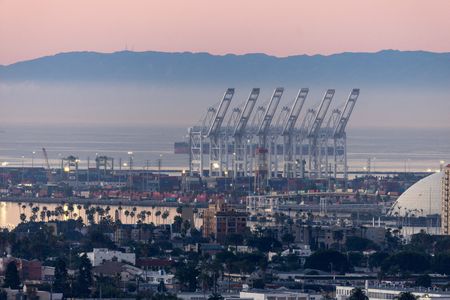
Pacific Container Terminal is shown in Long Beach, as seen from Signal Hill, California, U.S., January 14, 2026. REUTERS/Mike Blake
A U.S. trade court dealt another blow to President Donald Trump's tariff strategy, ruling that his latest 10% temporary global duties are unjustified under a 1970s trade law, but blocked the levies only for two private importers and the State of Washington.
The U.S. Court of International Trade's 2-1 decision leaves the temporary tariffs in place for all other importers while any appeal by the Trump administration plays out. They are expected to expire in July.
The court ruled that Trump's imposition of the tariffs under Section 122 of the Trade Act of 1974 was misguided. One of the judges said it was premature to grant victory to the plaintiffs.
While the ruling applies to a set of levies due to expire in about two months, it marks another major setback for Trump's global tariff ambitions and comes a week before he is due to discuss trade tensions with Chinese President Xi Jinping in Beijing.
It sets the stage for another protracted legal battle over billions of dollars worth of tariff refunds three months after the U.S. Supreme Court struck down Trump's sweeping global tariffs imposed under a national emergencies law.
NARROW INJUNCTION
The New York-based trade court declined to issue an injunction that blocks the tariffs for all importers, rejecting a request from a group of 24 states, mostly led by Democrats, saying those states did not have standing to ask for that relief.
"Private plaintiffs make no specific arguments for a universal injunction. Costs to one plaintiff is not an appropriate basis for the imposition of a universal injunction. Accordingly, the court declines to enter a universal injunction," the ruling said.
The White House and the U.S. Trade Representative's office did not immediately respond to requests for comment.
"The opinion undoubtedly will be appealed by the United States and thus sets the stage for further consideration by the U.S. Court of Appeals for the Federal Circuit and the Supreme Court," said Dave Townsend, a partner in Dorsey & Whitney's International Trade Group, adding that other importers likely will now ask the court for a broader remedy that applies to more companies.
The court ruled that most of the states that sued, with the exception of Washington, were not importers who had paid or could have paid the Section 122 tariffs. Washington submitted evidence that it paid tariffs through the University of Washington, a public research institution.
The two small businesses, toy company Basic Fun! and spice importer Burlap & Barrel, had argued the new tariffs were an attempt to sidestep a landmark U.S. Supreme Court decision that struck down the Republican president's 2025 tariffs imposed under the International Emergency Economic Powers Act.
Immediately after the Supreme Court ruling, Trump turned to the Section 122 statute, which allows for duties of up to 15% for up to 150 days to correct serious "balance of payments deficits" or head off an imminent depreciation of the dollar.
WRONG DEFICITS, COURT RULES
Thursday's court ruling found the law was not an appropriate step for the kinds of trade deficits that Trump cited in his February order.
“This decision is an important win for American companies that rely on global manufacturing to deliver safe and affordable products. Unlawful tariffs make it harder for businesses like ours to compete and grow,” said Jay Foreman, CEO of Basic Fun!
“We are encouraged by the court’s recognition that these tariffs exceeded the President’s authority. This ruling brings needed clarity and stability for companies navigating global supply chains," he said in a statement.
Jeffrey Schwab, who represented the importers, said applying the ruling only to the plaintiffs "of course brings up a lot of questions about how this will play out."
The Trump administration had argued that a serious balance-of-payments deficit existed in the form of a $1.2 trillion annual U.S. goods trade deficit and a current account deficit of 4% of GDP.
A number of economists have been dubious of the premise for the new Section 122 tariffs from the start, including former International Monetary Fund First Deputy Managing Director Gita Gopinath, who told Reuters at the time: "We can all agree that the U.S. is not facing a balance-of-payments crisis, which is when countries experience an exorbitant increase in international borrowing costs and lose access to financial markets."
One former trade official said the administration will likely challenge the ruling and later this year will be able to impose permanent tariffs under a different authority.
"The administration will appeal this decision but it will continue collecting most of the 10% tariffs under Section 122 until July 24, at which point we will likely have permanent Section 301 tariffs in place," said Ryan Majerus, a former senior U.S. Commerce official now with the King & Spalding law firm. He said Section 122 refunds will not be possible until the appeals courts have weighed in.
Schwab, who represented the two small businesses, said other companies could likely file lawsuits to seek refunds, although that depends in part on whether the government appeals or decides to let the tariffs expire on July 24 as scheduled.
(Reporting by Dietrich Knauth and Tom Hals, additional reporting by David Lawder and Andrea Shalal; Writing by Dietrich Knauth and David Lawder; Editing by Chris Reese and Sonali Paul)
Recent Articles
- Trump's Plan B Tariff Strategy Dinged Too by US Trade Court
- New Hostilities Throw US-Iran Ceasefire into Doubt
- CATL to Supply EV Chassis in First Overseas Project in Turkey
- 3 Asian Chip Giants Become New Investor Focus Amid AI Bull Run
- Tesla's China-Made EV Sales Jumped 36% in April
- Chinese Tanker Attacked Near Strait of Hormuz
- McDonald's Misses US Sales Growth Target as Consumer Spending Tightens
- China's May Day Tourism Rises but with Restrained Spending
- Energy Crunch to Persist Even If Iran Peace Deal Struck Says Maersk
- Jobless Claims Increased Less Than Expected Amid Low Layoffs