

Russia Tries to Jam Musk's Starlink Systems to Counter Ukrainian Drones
By Reuters | 08 Jul, 2026
Ukrainian success in disrupting the flow of Russian supplies is forcing the invader to camouflage its cargoes and install powerful jamming systems to disrupt the Starlink satellite internet system on which the drones rely for precise navigation to targets behind enemy lines.
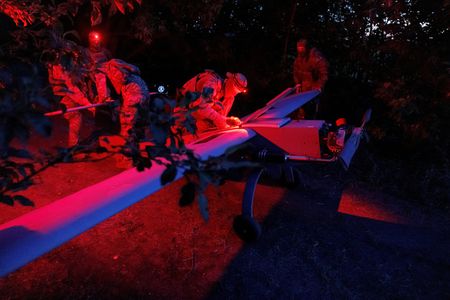
Service members of the Sparta company of the 422nd Unmanned Systems Regiment 'Luftwaffe' of the Ukrainian Armed Forces, prepare a Zozulia mid-strike drone for a flight while they work at a position near a front line, amid Russia's attack on Ukraine, in an undisclosed location in Southern Ukraine, on an undisclosed date, 2026. REUTERS/Valentyn Ogirenko
Russian forces are trying to counter Ukrainian "mid-strike" drone attacks by camouflaging cargoes and installing powerful jamming systems to disrupt Elon Musk's Starlink satellite internet system, Ukrainian drone commanders and pilots told Reuters.
Kyiv's development of "mid-strike" drones that can hit targets dozens of kilometres behind front lines accurately and cheaply, and are often flown via Starlink, has transformed the war in Ukraine.
In a concerted mid-strike campaign this year, Ukraine has attacked supply lines, fuel storage facilities, air-defence installations and command centres, disrupting Russian forces' logistics and causing fuel shortages in Russian-occupied Crimea.
But Russia is now developing many ways to try to counter the mid-range strikes, four drone commanders and pilots told a Reuters crew that visited Ukraine's 422nd Unmanned Systems Regiment at work in the southern Zaporizhzhia region.
JAMMING DEVICES
Russia's methods to protect fuel and other military supplies range from hiding shipments in civilian vehicles to using sophisticated electronic jamming devices to block connections used to pilot the drones, they said.
Jamming devices have been installed by Russia near towns and military facilities, including some that can disrupt the Starlink systems operated by Musk's SpaceX, they said.
Most of Ukraine's mid-strike missions are flown using Starlink, which allows a pilot to remotely communicate with a drone and had been considered largely immune to jamming.
Serhii Beskrestnov, an advisor to Ukraine's defence ministry, said Russia was deploying a jamming system called the Volna Kupol Garant that emits a signal strong enough to destabilise the Starlink connection in an area of about 20 square km (7.7 square miles). He added that about 10 had been detected so far.
However, the system is itself a prominent target for Ukrainian drone crews keen to knock out any impediment to their flights.
The 422nd regiment has taken part in operations to hit two of these systems, including one that was struck several hours after being detected in a joint mission with the SBU security service, Kolesnyk said.
A video of one attack showed a large explosion as a drone struck a site containing six large boxes resembling trailers.
"As soon as we struck that installation, our Starlink-equipped (drones) flew without problems," said a crew commander who uses the callsign 'Dyryhent'.
Musk has meanwhile cut Russian forces off from using Starlink to stop Moscow using it in its own drone strikes.
SpaceX did not respond to a request for comment for this story, nor did Russia's defence ministry. Reuters was not able to independently verify the tactics being used by Russia to avoid strikes.
MILITARY SUPPLIES IN CIVILIAN VEHICLES
During Reuters' visit to the 422nd regiment, Ukrainian soldiers operating in a field in the dim red glow of headtorches loaded a warhead packed with high explosive into a winged drone. Its propeller engine spluttered and then roared into life.
Launched by a catapult, the "Zozulya" ("Cuckoo") drone flew southeast towards Crimea under cover of darkness, targeting a base used by Russian drone pilots.
Kolesnyk and other drone commanders outlined some of the tactics Moscow is using to protect fuel and other supplies.
"We hit water tankers and the tankers were burning because there was gasoline inside," Kolesnyk said. "We've hit painted-up milk trucks that had diesel fuel in them."
Russian forces now run small convoys of fuel tankers protected by pickup trucks with mounted machine guns, take smaller roads to avoid surveillance and use civilian vehicles to carry supplies, the Ukrainian commanders said.
Ukraine's military intelligence told Reuters Russian forces were using small civilian cars, quadbikes and motorcycles to transport fuel, ammunition and provisions to the front.
They also use camouflaged dugouts, abandoned buildings and agricultural structures to conceal supplies and civilian petrol stations to store fuel for the military, it said.
Rob Lee, a senior fellow at the U.S.-based Foreign Policy Research Institute, said Ukraine's mid-strikes were perhaps the most important battlefield development this year, but Moscow was starting to have some success at counteracting them.
"If they scale production of the jammers, they could make it more difficult to conduct the middle-strike campaign," he said.
Despite its impact, the mid-strike campaign has not stopped deadly Russian strikes on Ukraine, Russia still holds about a fifth of Ukrainian territory four years after its full-scale invasion, and not all Ukrainian drone strikes succeed.
When the 422nd regiment fired a RAM-2X drone at a fuel tanker during Reuters' visit, it missed, and the surveillance drone used to follow the truck was hit by a Tor surface-to-air missile system.
"At least we know it's there now," said one of the crewmen, who logged the Tor into Ukraine's digital battlefield targeting system – leaving a target for another day.
(Editing by Daniel Flynn and Timothy Heritage)
© 2026 by Asian Media Group Inc.
Recent Articles
- Denmark Ready to Defend 'Every Inch of NATO', Including Greenland, PM Says
- Italy's Meloni Says No Regrets over Trying to Woo Trump
- Trump Rushes Back toward Abyss with Iran
- Mercedes-Benz Q2 Sales Fall, China Competition Intensifies
- Russia Tries to Jam Musk's Starlink Systems to Counter Ukrainian Drones
- China Domestic Car Sales Fall Again but Exports Stay Strong
- Crypto Firms Prepare Defenses to Fast-Approaching Quantum Threat to Encryption
- AI Chip Startup SambaNova Valued at $11 Billion in $1 Billion Funding Round
- Trump Goes Retro with Anti-Communist Message for Midterms
- MiniMax Plans to Leapfrog AI Rivals with Giant 2.7 Trillion Parameter Model