

A Despised Strongman Transformed Destitute Korea into a Global Industrial Powerhouse
By Ben Lee | 24 Jun, 2026
Park Chung-hee led a military coup and gave S. Korea's most aggressive businessmen the means to build world-class export machines.
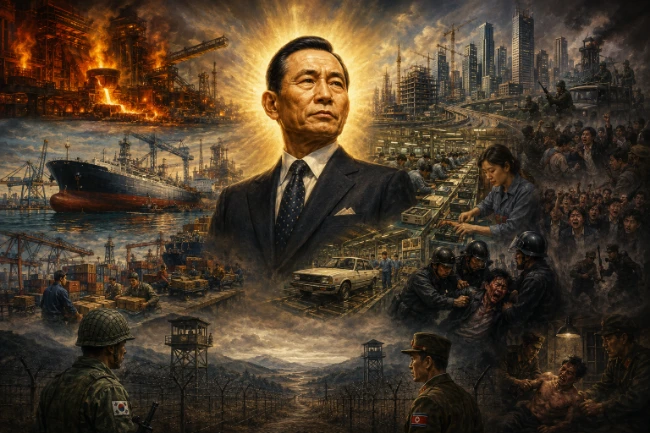
When Park Chung-hee and a group of military officers seized power on May 16, 1961, South Korea was poor, aid-dependent, politically exhausted and widely seen as the weaker half of a divided peninsula.
Seoul had little heavy industry, a tiny domestic market, few natural resources and a business class still tainted by cronyism from the Syngman Rhee years. North Korea, with Soviet-backed industry and a stronger military posture, looked like the more formidable Korean state.
By the time Park was assassinated in 1979, South Korea still wasn’t democratic, free or socially just. But it had become something almost no one had expected in 1961: an industrializing export power with the foundations of world-class companies in steel, shipbuilding, construction, electronics, petrochemicals, automobiles and global trading.
That’s why Park remains one of modern Asia’s most contested figures. To his admirers, he was the stern father of the “Miracle on the Han River,” the leader who forced a humiliated nation to stand up, build, export and compete. To his critics, he was a dictator who crushed unions, censored the press, jailed opponents, tortured dissidents and fused politics with big business in ways that still distort Korean society. Both views are true enough to make him impossible to dismiss.
The Great Bargain
His great historical significance lies in the bargain he struck with South Korea’s emerging family conglomerates, the chaebol. Park didn’t invent Samsung, Hyundai, Lucky-Goldstar, Sunkyung or Daewoo. Some had roots before his rule. But he turned them into instruments of national policy. He gave them credit, licenses, protection, tax privileges, foreign-loan guarantees and access to scarce capital. In return, he demanded exports, industrial upgrading and obedience.
The story began with coercion. Park came to power promising to sweep away corruption. In 1961 and 1962, his regime went after wealthy businessmen accused of profiting under Rhee. Lee Byung-chul of Samsung and other industrialists were placed under pressure to surrender wealth or prove their usefulness to the new state. The final bargain was blunt: keep your companies, but build the industries the nation needs.
That bargain became the operating system of Korean capitalism.
Park’s first major institutional move was the creation of the Economic Planning Board. It wasn’t just another ministry. It became the nerve center of development, staffed by technocrats and given authority over budgets, investment priorities and five-year plans. The First Five-Year Economic Development Plan, launched in 1962, was designed to drag Korea out of subsistence and into manufacturing. The state would choose priorities, steer capital and measure success not by speeches but by output, exports and growth.
The banks were crucial. By bringing finance under state control, Park could decide which firms lived on cheap credit and which were starved. In a country with little domestic savings, this was enormous power. A businessman who hit export targets could receive more loans, import licenses, tax breaks and political favor. A businessman who failed could be humiliated, investigated or cut off.
This wasn’t laissez-faire capitalism. It was capitalism under command. But it also wasn’t Soviet-style central planning. Park wanted private entrepreneurs to hustle, improvise and compete abroad. The state would point the cannon; the chaebol would fire it.
Humble Beginnings for South Korean Exporters
The first export push was humble. South Korea didn’t begin with semiconductors, supertankers or luxury cars. It began with textiles, wigs, plywood, shoes, clothing and light manufactures. These products were labor-intensive and suited to a country with cheap, disciplined labor and few resources. Samsung’s Cheil Wool Textile became one of the early stars. Daewoo, founded in 1967 by Kim Woo-choong, first rose as a trading company moving textiles and apparel into overseas markets. Sunkyung, later SK, grew from textiles and synthetic fibers. Lucky-Goldstar, later LG, had already begun making radios and electrical goods.
Park treated exports as a patriotic crusade. He created ceremonies to honor exporters, demanded constant reporting and pushed officials to remove obstacles faced by companies trying to sell abroad. Foreign exchange was precious. Every dollar earned overseas was fuel for machines, raw materials and more investment. In a tiny market like South Korea, exporting wasn’t optional. It was the only path to scale.
Unpopular Normalization with Japan
The next big event was the 1965 normalization of relations with Japan. It was politically explosive. Many Koreans saw the treaty as a humiliating settlement with the former colonizer. Park saw something else: capital, technology and access to a nearby industrial giant. Japanese grants, loans and commercial ties became part of the financial base for Korea’s next stage of development. The money and expertise helped support infrastructure, industry and eventually steel.
No project better symbolized Park’s ambition than POSCO. Building an integrated steel mill in a poor country with no iron ore advantage looked irrational to many foreign advisers. Park saw steel as the backbone of national strength. Without steel, there could be no modern shipbuilding, autos, machinery or heavy construction. POSCO’s rise gave Korea the industrial spine needed for the chaebol’s next leap.
That leap became official in 1973, when Park launched the Heavy and Chemical Industry drive. By then, he had tightened his rule through the Yushin Constitution, which gave him near-dictatorial power. The political darkness of the 1970s can’t be separated from the industrial drive. As Park became more repressive, he also became more determined to push Korea beyond shirts and shoes into steel, petrochemicals, shipbuilding, machinery, nonferrous metals, electronics and defense-related industries.
Hyundai and the Shift to Heavy Industry
Hyundai became the great symbol of this phase. Chung Ju-yung had built Hyundai from construction, and Park saw in him the kind of reckless, tireless, nationalistic entrepreneur he could use. Hyundai built roads, won overseas construction contracts and then was pushed into cars and shipbuilding. The Ulsan shipyard was an audacious gamble. Korea had never built ships on that scale. Hyundai needed foreign loans, foreign designs, foreign technical assistance and government backing. Yet by building supertankers while the shipyard itself was still being completed, Hyundai announced that Korea wouldn’t wait politely for permission to enter heavy industry.
Samsung’s path was different but just as consequential. Lee Byung-chul’s group had roots in trading, sugar, textiles and finance, but Park’s system nudged it toward industrial depth. Samsung Electronics was established in 1969 and began with modest consumer products like black-and-white televisions. Much of early Korean electronics was subcontracting for foreign brands, but the habit of learning by producing would later become decisive. The same applied to GoldStar, the electronics side of Lucky-Goldstar. GoldStar’s radios, televisions, appliances and components helped create the foundation for the LG that would one day become a global electronics and battery powerhouse.
Sunkyung’s trajectory showed how textiles could lead into petrochemicals and energy. The group’s early base in fibers made vertical integration attractive: from petroleum to synthetic yarns, from trading to chemicals, from chemicals to broader industrial holdings. That logic fit Park’s world perfectly. He wanted companies that could move up the chain, absorb technology and reduce dependence on foreign suppliers.
Daewoo was the purest creature of the export age. Kim Woo-choong built it with extraordinary speed, using trading skills, government support and relentless expansion. Daewoo embodied both the brilliance and danger of the Park model. It could move fast because the state opened doors. It could enter new sectors because policy pointed the way and credit followed. But the same system encouraged overextension, leverage and the belief that size itself was a national virtue.
Favoring Big Groups with Export Leverage
That was the deeper pattern. Park’s Korea rewarded scale. Small companies mattered, but the state preferred big groups that could take on huge projects, borrow abroad, absorb risk and carry out orders. The chaebol became private empires performing public missions. Their founding families retained control, but their growth depended on state favoritism. They were capitalist dynasties raised inside a developmental barracks.
The costs were severe. Workers paid for the miracle with long hours, low wages and limited rights. Labor unions were suppressed or domesticated. Students and journalists who challenged the regime faced surveillance, imprisonment or worse. The same state that could coordinate steel mills and shipyards could also coordinate fear. By the late 1970s, Park’s system was showing stress: inflation, debt, overinvestment, labor unrest and rising public anger.
Assassinated by Own Intelligence Chief
His assassination on October 26, 1979, by KCIA chief Kim Jae-gyu ended the man but not the model. South Korea would endure more dictatorship before democratizing in the late 1980s. The chaebol would keep expanding, stumble badly in the 1997 Asian financial crisis, restructure and rise again. Samsung, Hyundai, LG and SK became global names. Daewoo, once the boldest emblem of the export machine, collapsed under debt and overreach, becoming the cautionary tale embedded inside the miracle.
Park’s legacy, then, isn’t a clean parable about dictatorship producing growth. Plenty of dictatorships produce only poverty, corruption and monuments. What made South Korea different was the combination of state discipline, export accountability, technocratic planning, education, cheap but capable labor, foreign capital, geopolitical urgency and entrepreneurs forced to compete in world markets. Park’s genius, if that’s the word, was to bind privilege to performance. He let businessmen become rich, but only if they helped make Korea stronger.
That doesn’t absolve him. South Korea’s democracy was delayed, its workers were squeezed and its economy was concentrated in family-controlled conglomerates whose political influence remains controversial. The miracle had victims as well as beneficiaries.
But history rarely gives us tidy figures. Park Chung-hee was both nation-builder and jailer, modernizer and autocrat, visionary and brute. He took a destitute country and imposed on it a furious industrial will. He made the chaebol serve the state, then made the state serve their rise. From that hard, compromised bargain came the Korea the world knows today: wired, wealthy, export-driven, technologically ambitious and still arguing with the ghost of the strongman who helped create it.
© 2026 by Asian Media Group Inc.
Recent Articles
- A Despised Strongman Transformed Destitute Korea into a Global Industrial Powerhouse
- Trump, Republican Senator Get into Shouting Match over Iran
- KOSPI Jumps 5.5% As Micron Earnings Ease AI Jitters
- Micron Forecasts Strong Quarterly Results on Soaring Memory Chip Demand
- Micron and Qualcomm Forecasts Ignite $400 Billion AI Chip Stock Rally
- China Push for Lead in 'Future Industries' Triggers Flood of Venture Capital, Bubble Potential
- 360 Unveils China's Answer to Anthropic’s Mythos
- Venus, Not Mars, Is the Visionary 2nd Earth Play
- Keiko Fujimori's Victory Returns Divisive Dynasty to Peru
- SK Hynix Targets $29 Billion US Listing as AI Demand Surges