

Altman Mocks Musk's 'Stealing a Charity' Allegation
By Reuters | 12 May, 2026
CEO Sam Altman testified that Elon Musk was aware that OpenAI might become a for-profit company but that Altman was 'extremely uncomfortable' with Musk getting control.
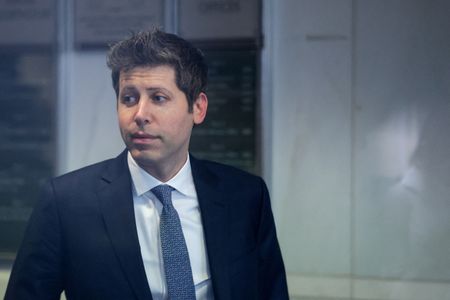
CEO of OpenAI Sam Altman arrives at the courthouse on the day of the trial in Elon Musk's lawsuit over OpenAI for-profit conversion at a federal courthouse in Oakland, California, U.S., May 12, 2026. REUTERS/Manuel Orbegozo
OpenAI Chief Executive Sam Altman on Tuesday rejected Elon Musk's claim that he betrayed the ChatGPT maker's founding mission to serve the public good, at a trial that may determine the future of OpenAI and its leadership.
In an August 2024 lawsuit, Musk accused Altman and OpenAI of persuading him into giving $38 million, only to see the nonprofit abandon its mission to benefit humanity and instead become a for-profit corporation.
Testifying in the Oakland, California, federal court, Altman denied Musk's claim that he and OpenAI President Greg Brockman, who is also a defendant, tried to "steal a charity."
"It feels difficult to even wrap my head around that framing," Altman said. "It does not fit with my concept of the words 'stealing a charity' to look at what is happening here."
Altman said he hoped that "as OpenAI continues to do well, the nonprofit will do even better."
He also rejected any suggestion that OpenAI was actually Musk's startup, and said OpenAI in its early days considered various corporate structures, both non-profit and for-profit.
"At the time we had no conception we would someday have profits or revenue," Altman said.
OPENAI CHAIR SURPRISED AT MUSK TAKEOVER BID
The trial also marks a clash among tech giants with Musk, the world's richest person, portraying himself as a defender of ordinary people from the perils of AI and Silicon Valley titans who care more about money.
It came after OpenAI raised hundreds of billions of dollars from large technology companies and investors to build its computing power, ahead of a potential $1 trillion initial public offering.
OpenAI has tried to show that Musk knew about the for-profit plan but wanted control of the company, and is suing now because he regrets missing out on potential riches.
"I was extremely uncomfortable" with Musk's demand for control, Altman said.
Musk is seeking about $150 billion in damages from OpenAI and Microsoft, a major investor, to be paid to an OpenAI nonprofit. He also wants the removal of Altman and Brockman from their roles.
Bret Taylor, chairman of OpenAI, testified on Tuesday that OpenAI received a formal takeover offer from a consortium led by Musk’s rival company xAI in February 2025, six months after Musk sued.
“I was surprised,” Taylor said. “This proposal was to acquire this non-profit by a group of for-profit investors, which felt contradictory to the spirit of the lawsuit."
Testimony in the trial before U.S. District Judge Yvonne Gonzalez Rogers may conclude this week. Jurors could begin deliberating whether the defendants are liable by May 18. Rogers would determine any remedies.
MOTIVES, ASSURANCES ARE DEBATED
The faceoff has transfixed many in Silicon Valley and beyond, with testimony at times focusing on the clashing personalities and leadership styles of Musk and Altman.
Former OpenAI chief scientist Ilya Sutskever testified on Monday that he spent about a year gathering evidence for OpenAI directors that Altman had displayed a "consistent pattern of lying."
Microsoft Chief Executive Satya Nadella, whose company is a major OpenAI investor, testified on Monday that the investment was a "calculated risk."
Others who have testified include Brockman, former OpenAI technology chief Mira Murati and Shivon Zilis, a former OpenAI board member who is also mother to four of Musk's children.
Musk testified early, saying: "If you have someone who is not trustworthy in charge of AI, I think that’s a very big danger for the whole world."
He also said OpenAI was his idea before executives looted it, and that while he knew there were discussions about making OpenAI a for-profit enterprise, Altman assured him it would remain a nonprofit.
(Reporting by Deborah Sophia in Bengaluru, Deepa Seetharaman and Kenrick Cai in Oakland, California, and Jonathan Stempel in New York; Editing by Shilpi Majumdar, Nick Zieminski and Daniel Wallis)
Recent Articles
- Altman Mocks Musk's 'Stealing a Charity' Allegation
- Google-Spinoff Isomorphic Raises $2.1 Billion to Scale AI-driven Drug Discovery
- The Quiet Power Behind Taiwan's Unmatched Industrial Efficiency
- Zendaya Helps Sportswear Maker On's Asia Growth Soar
- Mayor Eileen Wang Plead Guilty to Acting as Chinese Propaganda Agent
- EBay Rejects GameStop's $56 Billion Bid as 'Neither Credible nor Attractive'
- Pyongyang Streets Jammed with Chinese Cars Amid New Auto Boom
- CEOs Accompanying Trump Seek Key Business Goals in Beijing Summit
- JD.com Reports Beats with 5% Q1 Revenues
- Tesla to Invest $250 Million in Battery Plant Outside Berlin